The motion at today’s Cityscape conference in Riyadh was: The 15-Minute City model will improve quality of life for all communities and can be easily scaled globally.
Who would choose to argue against the principles of the 15-Minute City? Walkable. Sociable. Low carbon.
Who wouldn’t want any of that?
But, if not the principles of the 15-Minute City, what we should be deeply concerned about is the experience of translating those principles into practice.
My colleague Katya and I are going to argue against the motion from our experience of what many developers and designers are naively promoting in the name of the 15-Minute City.
Because what we are seeing in cities all over the world are individualistic, inward-looking, over-localised, gated developments calling themselves 15-Minute Cities.
Why do their proponents claim that these are 15-Minute Cities? Well, because they are relatively small, they have a mix of land uses and there’s a varying degree of infrastructure for walking and cycling.
But there’s typically very little, if any, public transport and the connections to other so-called 15-Minute Cities usually require the pedestrian or cyclist to cross the major roads and even highways that separate them. So these would-be walkers and cyclists usually end up jumping in a car and driving.
We know a lot about this in the UK because the 15-Minute City concept was at the heart of disastrous 20th Century New Town planning, even if we didn’t call them 15-Minute Cities back then.
Communities – especially women – found themselves unable to walk easily between neighbourhoods because they felt unsafe next to fast cars or having to move through the tunnels that had been built under the highways or up, over and down the bridges that are the visible symbols of civic failure.
As a result, these 15-minute ‘islands’ are car-dependent and, with that, lock in all sorts of problems:
- economic underperformance – because it takes so long to get from anywhere to anywhere
- environmental damage from enormous transport carbon footprints
- profound mental health problems from loneliness created by people not having enough regular contact with other people
- and physical health problems in the form of obesity because when you really want to experience life you have to get in your car and drive to try and find it. You end up in traffic jams – anxious and overweight.
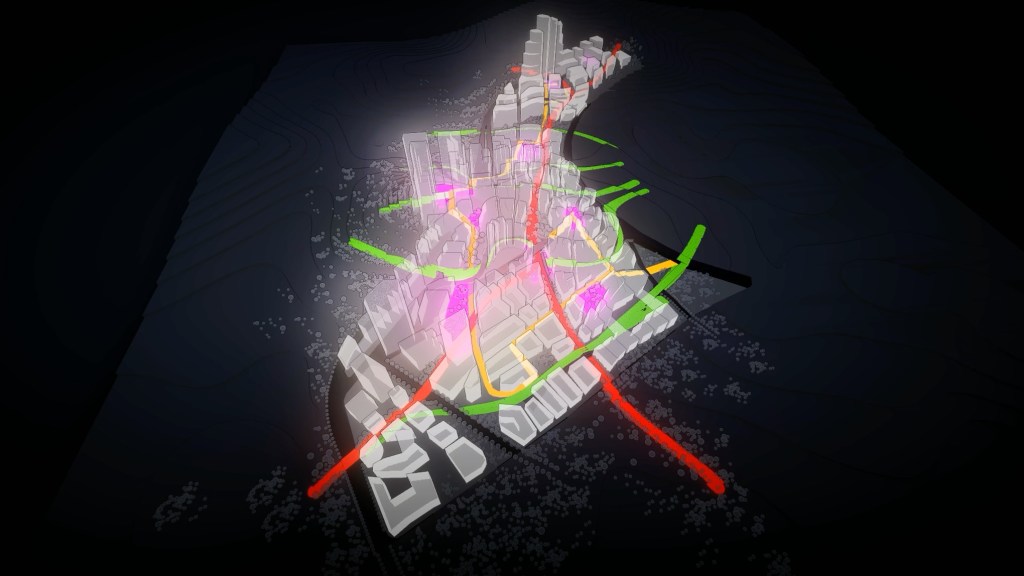
These cookie cutter, self-enclosed places are not real cities, even if they call themselves that. A real city is a continuously interconnected collection of 15-minute neighbourhoods that aren’t surrounded by walls and fast highways. Instead, they are seamlessly joined together – stitched together like the clothes on our backs, not hanging off us like gaping rags.
They’re woven together so that you can walk from one neighbourhood to another without quite knowing when you’ve left the first and entered the second. They have fuzzy, overlapping boundaries and not hard edges. This is the magic of walking across all the real cities that we truly value: the great historic cities of Rome, Paris, New York, İstanbul. I could go on.
And I will! Because you get operas, nationally significant museums and galleries, top league football clubs, great universities and, taken together, an abundance of social, cultural and economic vitality. You get scale. And power. And influence.
And you don’t need to drive to access any of it because, holding it all together you have the connective tissue of a slow-speed, walkable street network, a cycling network and, the obvious symbol of a real city: extensive public transport. Not just one or two lines but multiple routes: metro routes, tram routes and bus routes.
And this means you can easily access the everyday uses such as schools, hospitals, business and industrial centres that won’t be found in most 15-Minute neighbourhoods but which, in real cities, are only a short walk or bus journey away.
So our message in this debate is not against the principles of walking, or gentle density, or social life in public places. Katya and I have built our careers on promoting the benefits of great urban space so we would be the last people to do that.
No, our concern is about the naive, cookie-cutter misinterpretation of the 15-Minute City principles by architects and urban planners, who are locking in huge risks for the investors, owners and the users of real estate developments by designing car-dependent bubbles.
In summary, the 15-Minute City concept might easily be scaled globally but it will NOT improve the quality of life for all communities – unless 15-minute neighbourhoods are seamlessly interconnected by the connective tissue of walkable street networks and public transport.
If we continue to build these isolated, inward-looking, 15-minute compounds then the motion in this debate will never be achieved.
_____________
REBUTTAL POINTS
The 15-Minute City model will improve quality of life for all communities
The next time someone offers you a 15MC model, take a careful look at it. If it’s bounded by highways. If it turns it’s back on the land next to it. If it’s devoid of proper public transport. Then it’s not a 15MC. It’s a bubble, an enclave and a risk to social, economic and environmental sustainability.
If on the other hand it’s carefully woven into the fabric of the wider city and is linked up with multiple public transport options then go for it. IF YOU CAN WALK TO IT. We salute you!
So vote carefully. Are you voting for the myth that the 15MC model is the answer to everything no matter how they connect to the wider city, or will you vote for the practical reality that the 15MC is too often just a badge being worn by questionable, car-dependent and introspective developments?
We urge you to vote against the motion.


Leave a comment