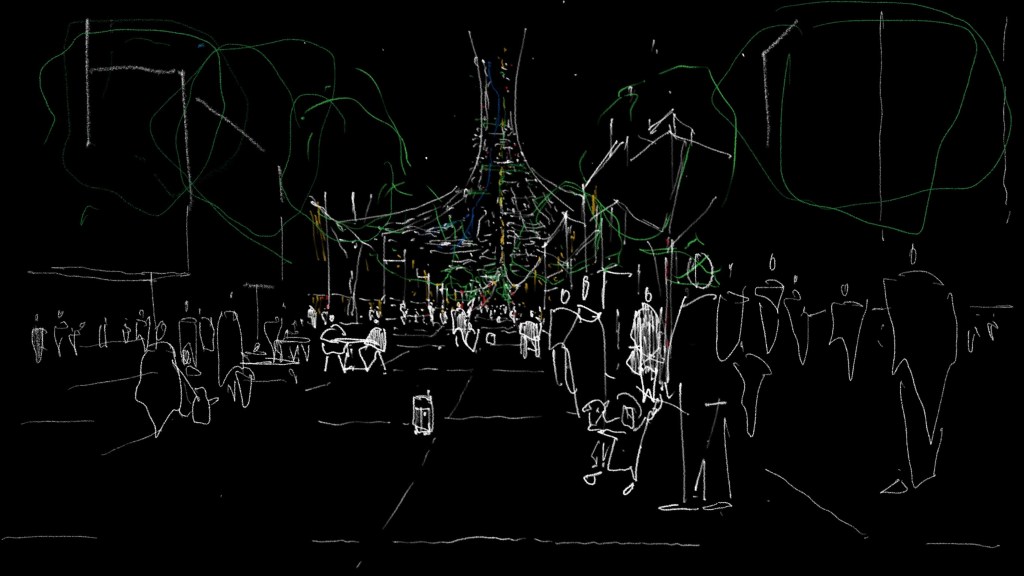
Notes from a talk given at the Lombardini22 Event on ‘Extreme Spaces’ in Milan, 7th May 2026.
In preparing for this talk I set myself the challenge of designing a spaceship that could carry humans away from Earth to other parts of space where they might settle. What would this spacecraft look like? What would be its key design features?
First, it would need to be mechanically and operationally competent. But that’s just the beginning.
Spaceflight is undoubtedly an extreme undertaking, with the structural integrity of the spacecraft being only one of many extreme hazards. Other profound risks include the reliability of propulsion, energy and communications systems.
It was a failure in structural integrity that led to the loss of the space shuttle Columbia. A failure in the energy system that led to the Apollo 13 crisis. And a failure in the propulsion system that led to the Challenger disaster.

Failures in communication also happen. The final descent to the moon of Apollo 11 was blighted by difficulties in finding a signal between mission control, the command module and the lunar module. Then, moments later, problems in the software system with an overloaded computer needing to shut off less-essential processes in order to preserve processing power for the systems that mattered more at the time. Difficulties that were ultimately resolved.
The challenge I’d like to consider in this talk is of a different order – it’s not a mechanical challenge but a social one. We can see its origins in the near mutiny that occurred during the Apollo 7 mission when an argument broke out between the crew and Mission Control about the intense schedule and its demands on the astronauts.
Spaceflight is highly programmed. Aside from rest periods, there’s hardly a second never mind a minute that isn’t programmed. Getting the balance wrong between rest and activity between focus and relaxation – can have an impact on physical and mental wellbeing. But a demanding schedule is understandable for one simple reason: missions are short. Even a flight to the moon and back is a matter of days.

The International Space Station is different. Crew are generally there much longer. But it’s still only a matter of months, a year at most. What we do know though is that, with these longer space flights, crew need to readjust physically and mentally to being back on Earth. Physically because they’ve existed without gravity and so their musculoskeletal systems need to be rebuilt.
And, mentally because they have also been confined in what amounts to nothing bigger than a small prison.
Not only this but the cognitive load of being surrounded by task-oriented equipment, without the relief of social spaces dedicated to relaxation
We can say that these are some of the most restrictive and cognitively demanding spatial layouts in the history of our species.
In spatial terminology they are ‘trees’: the trunk of the main section with branches leading off it.

Now we know from our experience here on Earth that trees have become the prevalent form of low-density suburban social housing.
Not only is this form of settlement car-dependent, it is also prone to burglary. To obesity. And, most profoundly, to loneliness.
This is what I’d like us to think about because when the human species eventually leaves Earth for colonies elsewhere, the physical and spatial challenges of travel need to be solved.

First we need gravity. The rotating ‘torus’ of 2001 is a solution, generating artificial gravity and creating the phenomenon of the endless corridor.
But gravity is only the beginning of the answer. The torus of popular science fiction is typically a narrow world. Kubrick’s cinematography emphasises the linearity of the torus in subtly curving, seemingly endless corridors. But look again and what’s missing is breadth.

In science fiction depiction after depiction, the torus world is a skinny one. Narrow. Confining. A circular form not unlike Jeremy Bentham’s Panopticon: a circular prison that allowed inmates to be kept under surveillance from a central position. Locally confining.
Not unlike The Line. A massive project but one that, by virtue of its geometry, maximally separates people from one another. And, in doing so, reducing the chances of serendipitous encounters with strangers.
These encounters are important because being comfortable in the presence of strangers is the essence of urbanism. We may not ever talk to those people walking beside us but somehow they create a virtual community that feels better when it’s there than when it’s absent.
And when, through processes of introduction – friends linking friends to each other – those strangers become familiar, all manner of good things can happen: conversations that lead to the creation of new ideas, new technologies, new methods, new businesses, new relationships.
All of this will be essential on spaceships, which will need to establish the same processes of technological and cultural evolution that have been part of human history on Earth.
In order to foster such evolution, we need a spatial geometry that is unlike the tree, unlike the line.
And we can find it in the simple magic of the ‘grid’.

From Milan to Florence to Paris and London, great cities are not ‘trees’ like the ISS or lines like the torus, but ‘grids’. Whether more regular like Manhattan or irregular like Istanbul, grids are innate to the human condition. For as long as we’ve had cities, humans have built grids.
And, not only in historic centres but in places made by people without the input of architects and urban planners: unplanned and informal settlements.

Grids are the secret sauce of urbanism and so we design them whenever we can in our practice at Space Syntax.
Perhaps the most important property of the grid is that it offers choice to users.
- first, this means that people can vary their daily journeys.
- second, it means that grids offer redundancy. If one link is blocked, there’s another way round.
- third, it means that it’s possible to wander with confidence that you will find your way back to where you need to be. Key to this is the network of Main Streets that form the backbones that connect grids of local neighbourhood streets together.
Grids generate the life of cities and that life is played out in Main Streets – and spaces close to them – that are lined with pavement bars, cafés, shops and galleries. Places where people meet up, meet new people and talk about ideas.
In this way, grids are machines of invention, engine rooms of social, economic and cultural evolution.
In buildings too: museums & galleries, hospitals, markets & other retail environments.
Grids define the human species and so we should expect to see them in space. Because the most important requirement in future spaceflight will be invention.

In 1959 Buckminster Fuller proposed a dome over Manhattan to create an air conditioned environment that he calculated would save 80% of the heating and cooling costs of the city below.
This was a bold idea but perhaps not bold enough. Why save only one part of the city?
The Truman Show revealed the trauma of confined living under a dome.
The solution to air conditioning on Earth is, I believe, to plant trees.
But, if we fail in this, we will one day need spaceships that can transport the human species to new homes. And, in order to think about what these spaceships might look like, let’s pull together some of the characteristics I’ve already described.

First, a torus that rotates to generate gravity. But not a skinny one. Instead, a huge one: 10km in diameter and just over 30km in circumference. Big enough to accommodate a city the size of central Milan, Paris or London. In fact a city the size of the three of them combined. And, in this supercity, a street grid that flows with human life, serendipitous encounters, trade and cultural activity. With Main Streets where the action is, and residential streets which are quieter.
With land to farm in. All connected by a river and branching water system to irrigate productive vegetation that ‘naturalises’ the urbanism.

The setting of this city will undoubtedly be fantastic, with curving perspectives that give all citizens the ‘overview effect’ of seeing their entire world in one view: to date, only a privilege for the small number of humans that have travelled into space.
Nevertheless, this potentially shocking experience will be normalised by the everyday experience of moving through the streets and lanes of the city. Being in the presence of friends and strangers. Never far from the buzz of the Main Street or the calm of the back street.
Being comfortably human in the most extreme of circumstances.


Leave a Reply