Category: Idea

  • Spaceship City

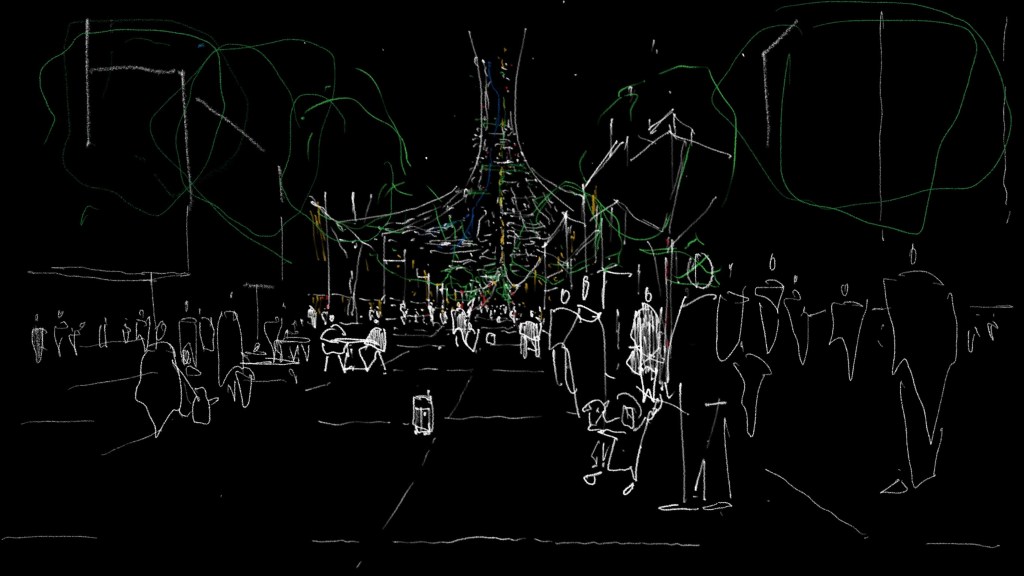
    Spaceship City

    Notes from a talk given at the Lombardini22 Event on ‘Extreme Spaces’ in Milan, 7th May 2026.

    In preparing for this talk I set myself the challenge of designing a spaceship that could carry humans away from Earth to other parts of space where they might settle. What would this spacecraft look like? What would be its key design features?

    First, it would need to be mechanically and operationally competent. But that’s just the beginning.

    Spaceflight is undoubtedly an extreme undertaking, with the structural integrity of the spacecraft being only one of many extreme hazards. Other profound risks include the reliability of propulsion, energy and communications systems.

    It was a failure in structural integrity that led to the loss of the space shuttle Columbia. A failure in the energy system that led to the Apollo 13 crisis. And a failure in the propulsion system that led to the Challenger disaster.

    Failures in communication also happen. The final descent to the moon of Apollo 11 was blighted by difficulties in finding a signal between mission control, the command module and the lunar module. Then, moments later, problems in the software system with an overloaded computer needing to shut off less-essential processes in order to preserve processing power for the systems that mattered more at the time. Difficulties that were ultimately resolved.

    The challenge I’d like to consider in this talk is of a different order – it’s not a mechanical challenge but a social one. We can see its origins in the near mutiny that occurred during the Apollo 7 mission when an argument broke out between the crew and Mission Control about the intense schedule and its demands on the astronauts.

    Spaceflight is highly programmed. Aside from rest periods, there’s hardly a second never mind a minute that isn’t programmed. Getting the balance wrong between rest and activity between focus and relaxation – can have an impact on physical and mental wellbeing. But a demanding schedule is understandable for one simple reason: missions are short. Even a flight to the moon and back is a matter of days.

    The International Space Station is different. Crew are generally there much longer. But it’s still only a matter of months, a year at most. What we do know though is that, with these longer space flights, crew need to readjust physically and mentally to being back on Earth. Physically because they’ve existed without gravity and so their musculoskeletal systems need to be rebuilt.

    And, mentally because they have also been confined in what amounts to nothing bigger than a small prison.

    Not only this but the cognitive load of being surrounded by task-oriented equipment, without the relief of social spaces dedicated to relaxation

    We can say that these are some of the most restrictive and cognitively demanding spatial layouts in the history of our species.

    In spatial terminology they are ‘trees’: the trunk of the main section with branches leading off it.

    Now we know from our experience here on Earth that trees have become the prevalent form of low-density suburban social housing.

    Not only is this form of settlement car-dependent, it is also prone to burglary. To obesity. And, most profoundly, to loneliness.

    This is what I’d like us to think about because when the human species eventually leaves Earth for colonies elsewhere, the physical and spatial challenges of travel need to be solved.

    (more…)
  • The urban cortex

    The urban cortex

    A talk given at Lombardini22 architects in Milan on 13th May 2025.

    The idea I’d like to explore this evening is that cities serve a higher purpose than we typically credit them with, and this idea is that cities are natural extensions of the human brain. Far from being artificial, alien objects, cities work with us, their users, to help us solve the problems of our times. Cities are extensions of our brains and, just like our brains, cities are sophisticated computers.

    At least they are, if we design them well. 

    Great cities are not just beautiful to look at and stimulating to be in. They are also highly efficient human transactions machines: bringing people together to form relationships and generate outcomes. Cities are the outermost layer of our common existence. Hence the title of this talk: the ‘urban cortex’.  

    One challenge when discussing cities is that urban commentators often begin by describing cities as chaotic, that their street networks are ‘labyrinthine’. This is a lazy approach to urbanism – and not one that we share at Space Syntax. Instead, we’ve spent the last 50 years studying the apparent chaos of cities and discovering regularities within them – of spatial layout, of land use distribution, of density, mobility and the distribution of inequalities. 

    These discoveries help us both to understand cities and to better design them. 

    Cities are not chaotic. We don’t build them by chance. Within their apparently labyrinthine randomness there are structures that organise the ways we move through cities – and interact with each other within them.

    There are regularities that allow us to understand cities – not just as urban scientists might pick them apart but as every day users make sense of the places they’re in:

    • how they feel comfortable in them
    • feel like they want to visit and explore them
    • meet people in them
    • go to work in them
    • invest their time and their money 
    • have fun
    • feel excitement. 

    This is the ‘urban buzz’ that draws people to cities.  

    (more…)
  • Digital urbanism – a sketch of a structure

    Digital Urbanism has two key components:

    1.  Computing
    That organisations and individuals are involved in the creation, collection, visualisation and analysis of data, leading to the creation, through computing, of modelling tools and predictive analytics. This kind of activity is now central to the operations of public and private organisations. It is no longer peripheral.

    2.  Human behaviour
    That people now think about places online as well as places on land; that cyberspace is as real as physical space; that networked computing means we have moved beyond the single chatroom and into the interconnected “place-web”.

    These, I believe, are the twin aspects of Digital Urbanism and, of the two, the second is the primus inter pares because human behaviour patterns should drive computing activities.

  • MSc Advanced Architectural Studies – graduate employability

    A talk given at the 40th Anniversary celebrations of the MSc in Advanced Architectural Studies – the “space syntax” MSc at University College London, 3rd September 2013.

    Good evening, everyone.

    Let me begin by paying tribute to the genius of Bill Hillier and Julienne Hanson. Not only for pioneering a theory – the theory – of architecture, but also for finding a way to teach it that has had such an effect on us all.

    I’ve been asked to speak this evening about the issue of employability: does taking the MSc in Advanced Architectural Studies either enhance or inhibit the job propsects of its graduates?

    Here’s what I want to say:

    First, I’d like to review the perceived problem of Space Syntax – why it’s sometimes viewed with skepticism and how that impacts at interview; second, the nonsense of this criticism: why do I even need to be up here to defend the course; third, the “Hang on, maybe there’s an element of truth here” moment; and finally a belief that we can’t rest on our laurels. (more…)