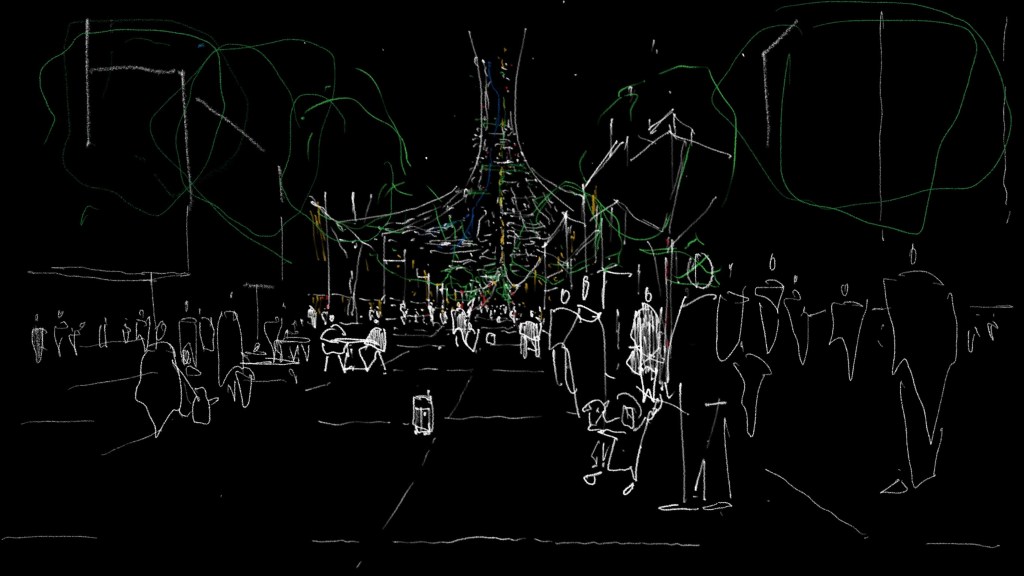
Notes from a talk given at the Lombardini22 Event on ‘Extreme Spaces’ in Milan, 7th May 2026.
In preparing for this talk I set myself the challenge of designing a spaceship that could carry humans away from Earth to other parts of space where they might settle. What would this spacecraft look like? What would be its key design features?
First, it would need to be mechanically and operationally competent. But that’s just the beginning.
Spaceflight is undoubtedly an extreme undertaking, with the structural integrity of the spacecraft being only one of many extreme hazards. Other profound risks include the reliability of propulsion, energy and communications systems.
It was a failure in structural integrity that led to the loss of the space shuttle Columbia. A failure in the energy system that led to the Apollo 13 crisis. And a failure in the propulsion system that led to the Challenger disaster.

Failures in communication also happen. The final descent to the moon of Apollo 11 was blighted by difficulties in finding a signal between mission control, the command module and the lunar module. Then, moments later, problems in the software system with an overloaded computer needing to shut off less-essential processes in order to preserve processing power for the systems that mattered more at the time. Difficulties that were ultimately resolved.
The challenge I’d like to consider in this talk is of a different order – it’s not a mechanical challenge but a social one. We can see its origins in the near mutiny that occurred during the Apollo 7 mission when an argument broke out between the crew and Mission Control about the intense schedule and its demands on the astronauts.
Spaceflight is highly programmed. Aside from rest periods, there’s hardly a second never mind a minute that isn’t programmed. Getting the balance wrong between rest and activity between focus and relaxation – can have an impact on physical and mental wellbeing. But a demanding schedule is understandable for one simple reason: missions are short. Even a flight to the moon and back is a matter of days.

The International Space Station is different. Crew are generally there much longer. But it’s still only a matter of months, a year at most. What we do know though is that, with these longer space flights, crew need to readjust physically and mentally to being back on Earth. Physically because they’ve existed without gravity and so their musculoskeletal systems need to be rebuilt.
And, mentally because they have also been confined in what amounts to nothing bigger than a small prison.
Not only this but the cognitive load of being surrounded by task-oriented equipment, without the relief of social spaces dedicated to relaxation
We can say that these are some of the most restrictive and cognitively demanding spatial layouts in the history of our species.
In spatial terminology they are ‘trees’: the trunk of the main section with branches leading off it.

Now we know from our experience here on Earth that trees have become the prevalent form of low-density suburban social housing.
Not only is this form of settlement car-dependent, it is also prone to burglary. To obesity. And, most profoundly, to loneliness.
This is what I’d like us to think about because when the human species eventually leaves Earth for colonies elsewhere, the physical and spatial challenges of travel need to be solved.
(more…)
