Category: Mobility

  • The urban cortex

    The urban cortex

    A talk given at Lombardini22 architects in Milan on 13th May 2025.

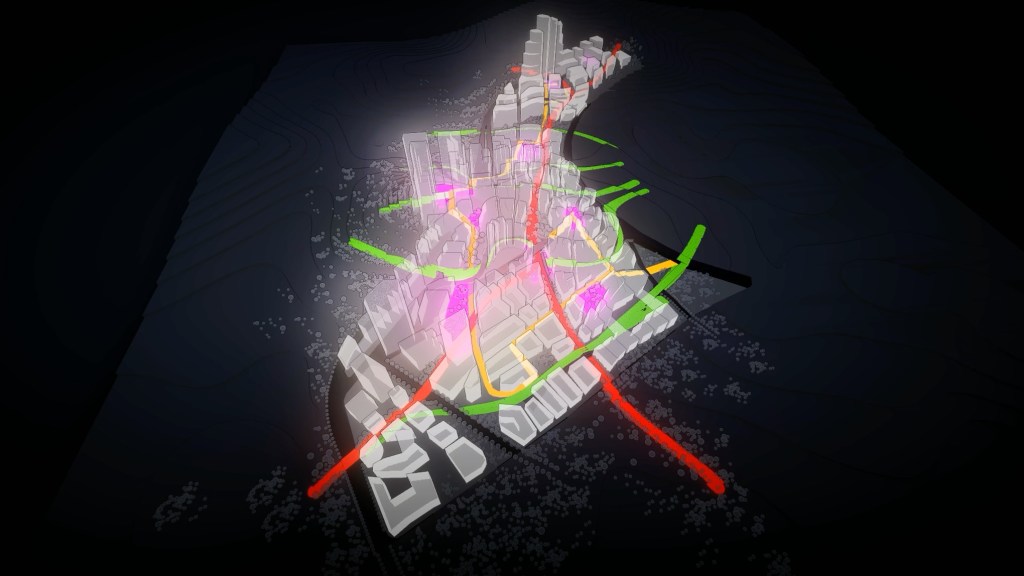
    The idea I’d like to explore this evening is that cities serve a higher purpose than we typically credit them with, and this idea is that cities are natural extensions of the human brain. Far from being artificial, alien objects, cities work with us, their users, to help us solve the problems of our times. Cities are extensions of our brains and, just like our brains, cities are sophisticated computers.

    At least they are, if we design them well. 

    Great cities are not just beautiful to look at and stimulating to be in. They are also highly efficient human transactions machines: bringing people together to form relationships and generate outcomes. Cities are the outermost layer of our common existence. Hence the title of this talk: the ‘urban cortex’.  

    One challenge when discussing cities is that urban commentators often begin by describing cities as chaotic, that their street networks are ‘labyrinthine’. This is a lazy approach to urbanism – and not one that we share at Space Syntax. Instead, we’ve spent the last 50 years studying the apparent chaos of cities and discovering regularities within them – of spatial layout, of land use distribution, of density, mobility and the distribution of inequalities. 

    These discoveries help us both to understand cities and to better design them. 

    Cities are not chaotic. We don’t build them by chance. Within their apparently labyrinthine randomness there are structures that organise the ways we move through cities – and interact with each other within them.

    There are regularities that allow us to understand cities – not just as urban scientists might pick them apart but as every day users make sense of the places they’re in:

    • how they feel comfortable in them
    • feel like they want to visit and explore them
    • meet people in them
    • go to work in them
    • invest their time and their money 
    • have fun
    • feel excitement. 

    This is the ‘urban buzz’ that draws people to cities.  

    (more…)
  • 15-minute cities or 15-minute ‘bubbles’?

    15-minute cities or 15-minute ‘bubbles’?

    The motion at today’s Cityscape conference in Riyadh was: The 15-Minute City model will improve quality of life for all communities and can be easily scaled globally. 

    Who would choose to argue against the principles of the 15-Minute City? Walkable. Sociable. Low carbon. 

    Who wouldn’t want any of that?

    But, if not the principles of the 15-Minute City, what we should be deeply concerned about is the experience of translating those principles into practice. 

    My colleague Katya and I are going to argue against the motion from our experience of what many developers and designers are naively promoting in the name of the 15-Minute City. 

    Because what we are seeing in cities all over the world are individualistic, inward-looking, over-localised, gated developments calling themselves 15-Minute Cities. 

    Why do their proponents claim that these are 15-Minute Cities? Well, because they are relatively small, they have a mix of land uses and there’s a varying degree of infrastructure for walking and cycling. 

    But there’s typically very little, if any, public transport and the connections to other so-called 15-Minute Cities usually require the pedestrian or cyclist to cross the major roads and even highways that separate them. So these would-be walkers and cyclists usually end up jumping in a car and driving. 

    We know a lot about this in the UK because the 15-Minute City concept was at the heart of disastrous 20th Century New Town planning, even if we didn’t call them 15-Minute Cities back then.

    Communities – especially women – found themselves unable to walk easily between neighbourhoods because they felt unsafe next to fast cars or having to move through the tunnels that had been built under the highways or up, over and down the bridges that are the visible symbols of civic failure. 

    (more…)
  • World Cities Summit: leveraging the science of cities

    World Cities Summit: leveraging the science of cities

    As an architect & urban planner my principal concern is to make cities work for people. This means understanding how their streets connect to either encourage low carbon transport such as walking and public transport. Or, if they’re disconnected, do they lock in car dependence and its carbon impacts?

    (more…)
  • How do we measure connectivity, walkability & car-dependence at Space Syntax?

    How do we measure connectivity, walkability & car-dependence at Space Syntax?

    SPATIAL LAYOUT ATTRACTION MODELLING
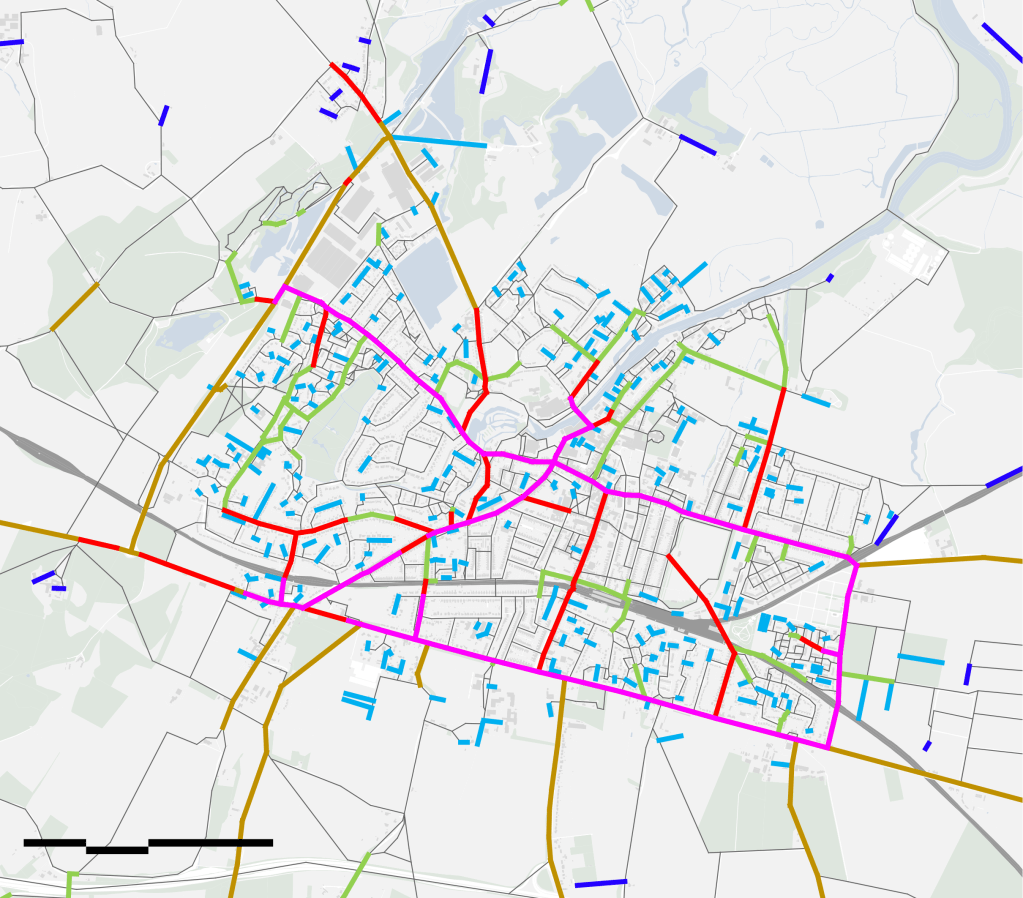
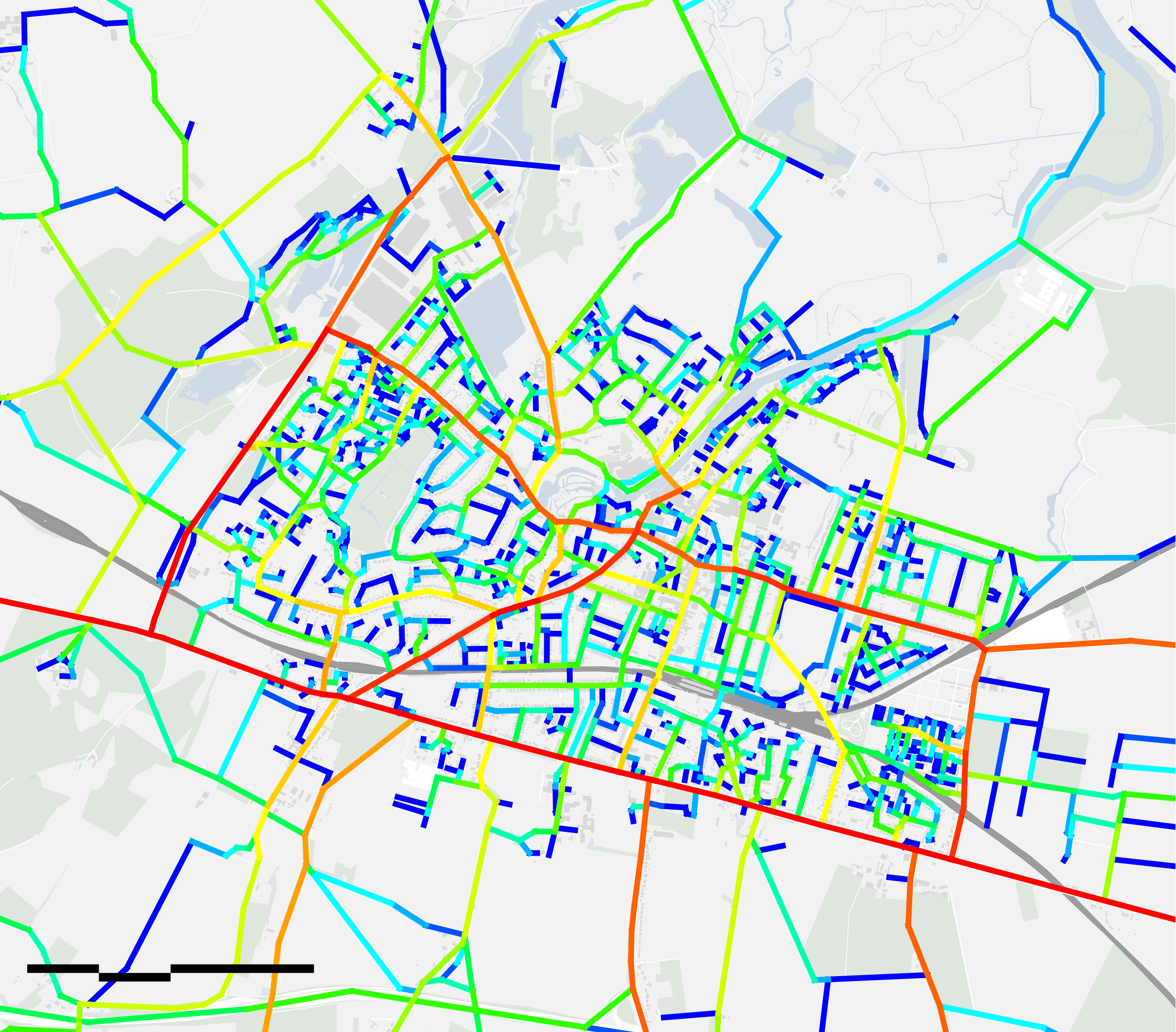
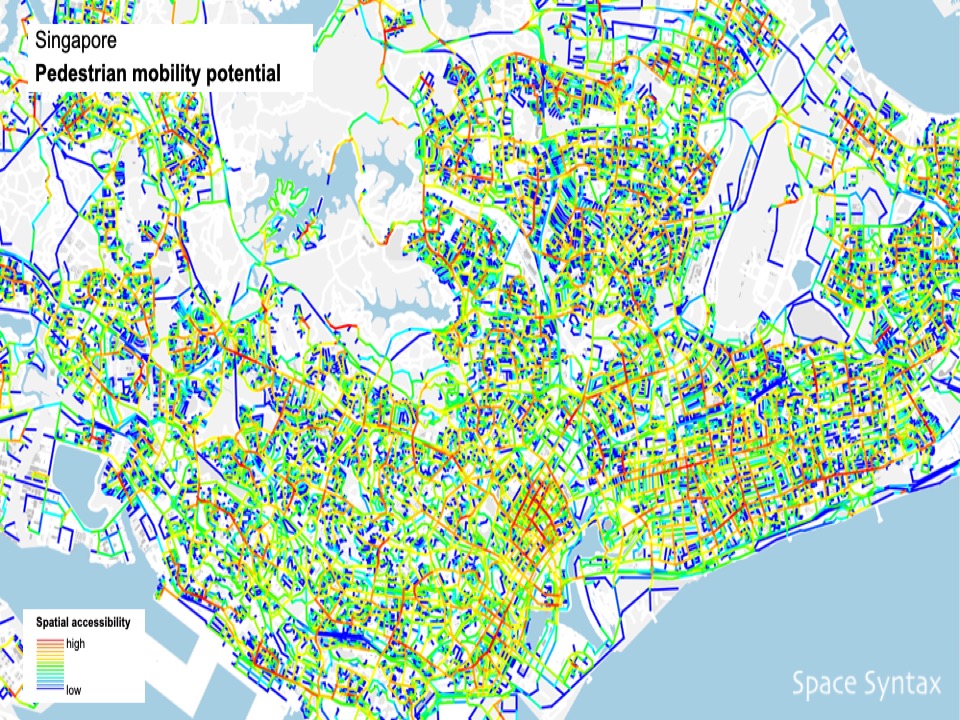
    Spatial Layout Attraction Modelling’ is a computer modelling technique that calculates the relative importance of each street segment – each piece of street between two intersections – for people moving within towns and cities. 

    We begin by analysing road the geometry of the street network, using road centreline data.

    By finding the simplest routes from all street segment origins to all destinations – the shortest routes that involve the fewest twists and turns – an algorithm calculates how likely it is that movement will pass along any individual route.

    Segments that are part of straighter, more connected and more central streets tend to be used more frequently as part of journeys across the urban network. 

    Journey catchments
    However, the overall importance of any street segment may vary depending on the scale of the journey. Some segments are more likely to be used as part of longer journeys, some as part of shorter journeys, some at both scales and some at neither. 

    For this reason, Spatial Layout Attraction modelling is undertaken at two different scales: first, for a catchment of 10km, which typically identifies the movement hierarchy of people making longer journeys in vehicles and on bikes:

    (more…)

  • Good things take time…

    Good things take time…

    Urbanism is a long game. The kids grow up for a start.

    This morning I met with local town council members & county council officers to discuss a new pedestrian crossing in #Faversham. Only later did I realise this is on exactly the same location as the photo taken 12 years ago for an article by Katie Puckett for Building Magazine!

    Here’s the article:
    https://lnkd.in/dRfm9Cb

    “This junction has been designed for the benefit of cars. At 8.30am it is teeming with kids trying to get to school but there’s nowhere to cross the road.”

    This small but significant intervention would build on the recently approved 20mph speed limit in Faversham, something that’s been a long time in coming. Let’s see what happens in the next few months.

    We can’t wait another decade.