The RIBA today launched a set of think-pieces on Digital planning: ideas to make it happen.
The RIBA today launched a set of think-pieces on Digital planning: ideas to make it happen.
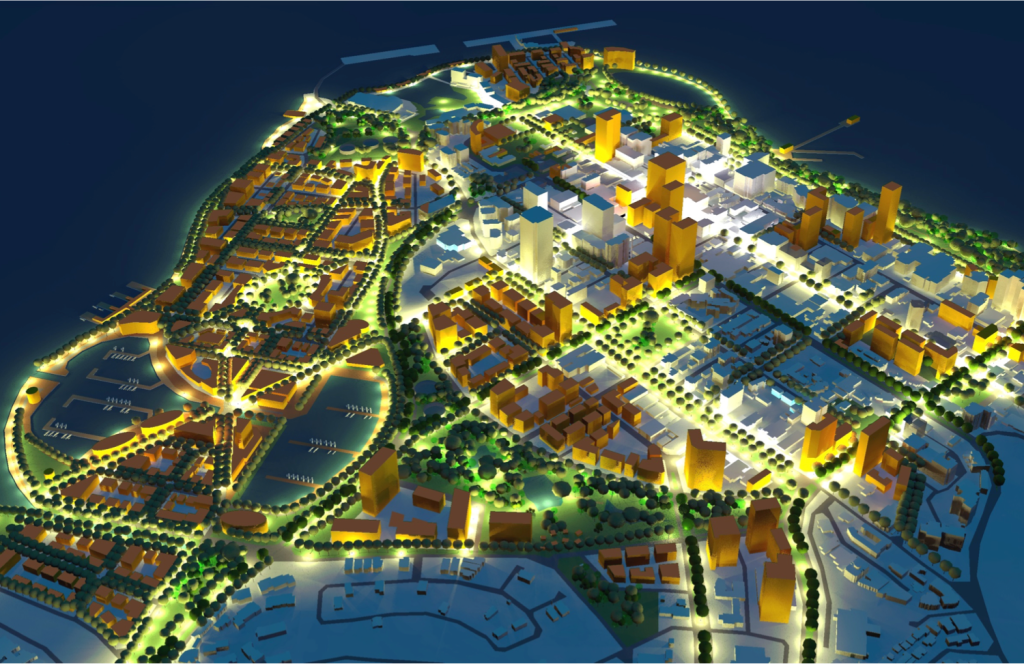 Darwin City Centre Masterplan, Space Syntax
For too long, architects and urban planners have pursued the myth that human scale means “local” scale. In doing so, they have downscaled space, thinking that by fragmenting and disconnecting towns and cities into small enclaves they would be creating “community”. They were wrong.
Isolated and disconnected, people on inner -city housing estates, new towns and sprawling housing developments have found it hard to form social networks. To engage with the outside world. To be human.
And this form of urban planning prevails, being exported to developing cities worldwide.
In contrast, human scale is a combination of the local and the global, acting simultaneously on the individual. We are, unsurprisingly, more sophisticated than we were given credit for.
What do I mean? Well, consider having a doorstep conversation with a neighbour while watching the world go by on your street, or a coffee with a friend on the High Street. These are simultaneous local:global experiences.
Space Syntax analysis identifies the places where shops are most likely to locate in historic towns and cities. Using network models to study patterns of street connectivity, we find that shops are usually in locations that are simultaneously embedded in both local and global movement networks. Where everyday movement criss-crosses, be that local, short-distance movement or larger distance, global movement.
We call this “multi-scale” analysis and the places it identifies are multi-scale places.
Human behaviour is no mystery when the right kind of science is directed towards its understanding.
And the key finding for the creation of future urban settlement is that we need to think more globally. To connect more. To embrace the outside world more. To create more multi-scale places.
To make places work more effectively at the local scale we need to connect them more effectively at the global.
We need to see the human scale as a multi-scale phenomenon.
I was asked an interesting question yesterday about the barriers to growth and acceptance of Space Syntax and Integrated Urban Models.
I believe there are three important components to the answer.
First, the growth of Space Syntax Limited‘s business was robust for 19 years, following its startup as a UCL spinoff company in 1989 – until 2008, when the bottom dropped out of the global real estate market. In that initial period, the company’s turnover grew at an annual rate of over 20%. This allowed continuous staff growth and market penetration. During this time the company devoted profits to the production of new software and new research findings as well as a modest return to shareholders and staff bonuses. It invested this way because it was determined that its growth should be about long term success and sustainability, not short-term reward.
2008 saw the global financial crisis hit the urban planning and design industry at home and abroad. This disrupted the growth curve at Space Syntax for two years. The company is today back on an accelerated growth track having seen consistent turnover growth at over 40% in each of the past two years, the steepest rate in its history. (more…)
How might cities be planned in the future?
This is not only a question of how they might look but also, and more importantly, about how they might be laid out as patterns of buildings and spatial connections.
Laying out a city means answering two key questions: “what goes where?” and the “how does it all connect together?” The answers to these questions have fundamental implications for the social, economic and environmental performance of urban places. And the jury is out as to which is the best way to do so: to use spatial planning to create place.
The global urban risk is that architects and planners have created, and continue to create, highly unsustainable city layouts – car dependent, socially divisive, congested and life-suppressing. And, it would seem, the more technologically advanced cities have become, the less efficiently they have worked.
By contrast, the street-based, continuously connected grid – the kind of layout that the slow, incremental evolution of cities produced before the intervention of modernism – has largely fallen out of fashion.
My argument in this piece is that the continuously connected grid is the only form of urban layout that can deliver sufficient social, economic and environmental value. The only kind of grid that is truly sustainable. (more…)
Notes from a meeting with the Beijing Institute of Agriculture and Forestry at Space Syntax London, 18th September 2013.
Common themes
Production
The rural landscape is a place of production. So is the city: production of goods and production of ideas.
Protection
Protection of natural assets in the rural landscape. Protection of historic buildings in the city. Avoidance of pollution in both. Protection of water courses – natural and artificial in both.
Waste
Avoidance of waste in both urban and rural settings. The rural landscape as the wastebasket of the urban landscape. Tension.
Movement
Conflicts in the rural landscape between local movement (agricultural productivity) and urban-rural movement (commuting). Tension. (more…)
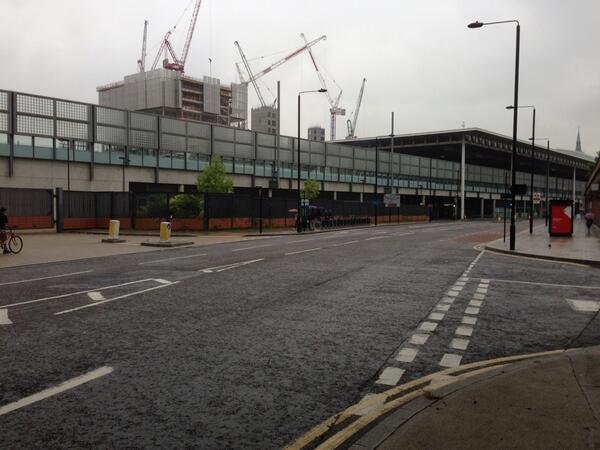
St Pancras Way will one day have active frontages, costing millions more than the initial HS1 investment. The blank frontages and negative street character that were originally built will eventually be transformed to create a place that London deserves. In the meantime, people walk through the loading bay, across the security barrier, past the blank walls.
This is the lesson of cities – they fix their problems. But only after money has been spent needlessly. It is a mistake that HS2 must avoid:
On Tuesday afternoon, 3rd September, I led a walking tour of built projects by Space Syntax.
Trafalgar Square
Royal Festval Hall
Tate Modern
One New Change
New Bloomberg Headquarters (under construction)
Willis Building
30 St Mary Axe
Heron Plaza (under construction)
Liverpool Street Station retail concourse
Broadgate, Exchange Square
Barbican Arts Centre (more…)
I’ve written before about the benefits of using science-based models in the planning and design process. I’ve raised concerns about the frequent lack of objective analysis in urban and building projects, and the risks this creates in decision-taking. Basing important decisions on gut instinct and experience, then willing on success with little more than hype, just isn’t good enough.

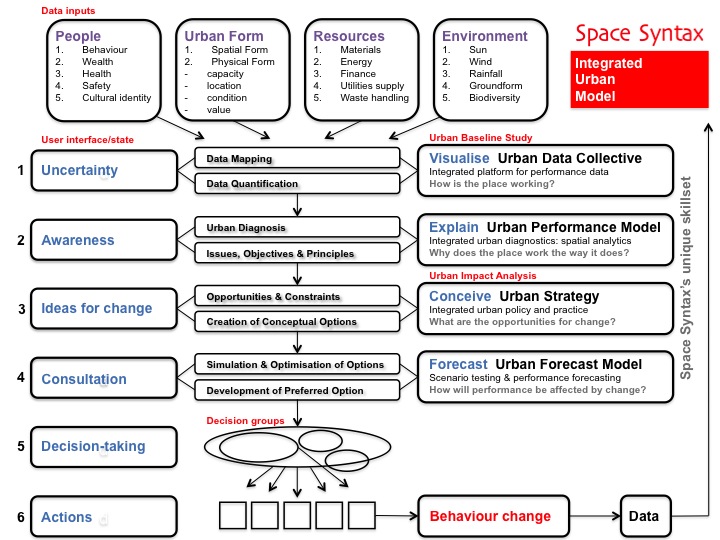
Here is a diagram that summarises Space Syntax’s approach to urban modelling. It’s a staged process: collecting datasets; analysing them to identify relationships between urban form and urban performance; drawing out key issues and developing creative ideas – all the time using the model to test proposals. The approach is transparent and communicative – helping stakeholders participate in the process and, most importantly, helping people take decisions that lead to actions and changed behaviours.
It’s more than a pipedream – we’ve been using the model on projects for over 25 years, evolving it through continuous application. And we’ll continue to do so, adapting to the ever richer data context that digital urbanism provides.
And always remembering that the ultimate objective is the creation of behaviour change to the benefit of human wealth, health and education.
Broadcast 26th August 2013 on BBC4, featuring Space Syntax analysis of Wren, Hook & Evelyn’s plans for rebuilding the City of London after the Great Fire of 1666.
Link to the programme on the BBC website
Link to the programme on YouTube
Download a presentation of Space Syntax’s analysis
“Using her skills to uncover long-forgotten and abandoned plans, architectural investigator Dr Olivia Horsfall Turner explores the fascinating and dramatic stories behind some of the grandest designs that were never built.
Destruction, whether intentional or circumstantial, often creates a clean slate and demands a fresh outlook in which we come to think the unthinkable. This programme looks at bold, and in some cases shocking, plans to make revolutionary changes to Britain’s biggest cities. (more…)
Given by audio link to Darwin CBD Masterplan Workshop 1 on 21st August 2013.
Download the presentation, including voiceover
“Good afternoon, everybody.
My name is Tim Stonor. I’m the Managing Director of Space Syntax and unfortunately I’m not able to join you for the workshop today. But my colleague Eime Tobari is with you and will be able to address any questions you may have at the end of this presentation. I did though have the pleasure of being in Darwin a couple of months ago and had the chance then to meet colleagues and discuss some of the issues facing the future of the city.
Today, I want to give you a presentation about the Spatial System of the city – it’s route network, its streets, its pedestrian pathways – and how these can work to improve the movement of people across the city; the bringing together of people in space to trade socially and economically. And I want to show you the work that Space Syntax has done to date in analysing the strength currently of spatial connections in the city and then analysing some opportunities for future growth.
But I want to start by looking at some issues that face all cities worldwide, and especially the issue of the private car and its place alongside other modes of transport, namely public transport and walking. Many cities worldwide have got the balance wrong and they have over-provided for private transport and under-provided for those other modes to their cost. (more…)
1. The nature of transaction
The principal purpose of cities is to facilitate human interaction and, as a result, socio-economic transaction. Cities are transaction machines. With the rise of online transaction, what will be the role/nature of physical transaction? How will the physical and online worlds interact to create a “digital urbanism”?
2. The nature of movement
In the 20th century, cities have grown at low densities, occupying ever larger spatial footprints. To overcome such distances, cities became movement machines. This led to the erosion of the street (in which movement and transaction both occurred) and its replacement by a twin system of highways and neighbourhoods: the separation of movement from “place”: the parcelisation of the city. And, with this came social isolation, sedentary lifestyles and obesity. There was a shift in the “fundamental urban paradigm” away from transaction and towards movement.
More recently, some cities have attempted to turn this tide with a greater focus on walking and cycling as principal movement modes – a more local focus geared towards the creation of “place”.
What are the future trends in urban movement?
3. The look and feel of cities
What will the physical-spatial signature of cities be? This is less a question of high-rise v low rise but more about high-density v low density. Especially about high-speed, divisive motorway (needed to connect low-density cities) or mixed-mode boulevard (possible if densities are great enough)?
What are the most effective street patterns? Land use arrangements? Transport mixes? What will future cities look like?
4. The modelling of urban performance
We have witnessed an institutional failure of international urban planning to create “place”: to create social vitality as well as economic success. Successes are exceptions to the rule. There is a lack of system-wide urban performance modelling: social, economic and environmental. Instead, there has been a historic focus on traffic modelling alone, principally private vehicle modelling. Cities have been planned with these models and have grown to be dominated by private vehicles.
What is the future of urban performance modelling? First, mixed-mode traffic modelling, including walking, cycling and public transport? Second, social, economic and environmental modelling?
How will developments in sensing permit more robust urban modelling systems?
How can changes in the fundamental urban paradigm (from movement to transaction) inspire new modelling approaches?
What are the key societal/transactional objectives around which urban performance models should be developed?
Sketch…
Space Syntax is keen to play a role in initiatives that embed the Space Syntax approach in everyday urban practice. The watchword is “dissemination”. Our aim is to create a professional landscape that uses Space Syntax as an everyday approach to the planning, designing and general governance of places.
Here are some of my thoughts about the potential structure of an urban design course, which are largely about using this as an opportunity to break down many of the barriers that conventionally get in the way of good urban design:
1. combine art and science: especially the importance of a science-informed approach to urban design, which is often missing
2. combine creative and analytic/disciplines: bring together designers and analysts in an intellectual cocktail
3. combine design, planning, infrastructure engineering, finance, governance, legals
4. put the human being at the heart of it all (more…)
Some advice for people promoting a Smart City approach. Prepare your answers to the following questions:
1. Why do we need “smart” and do we even need cities any more?
First, provide a clear and simple explanation of why cities are important ie what they do that is special: they arrange physical buildings within spatial networks to create intensifications of opportunities for people to interact and transact, socially and economically. Acknowledge the interdependencies between cities, towns and villages but emphasise the primacy of cities.
Second, explain how this process is facilitated by the propinquity and connectivity that cities offer – traditionally physical connectivity and, increasingly, digital.
Third, describe the threats to the efficiency of cities: gradual, sprawling growth; over-reliance on private cars.
Fourth, describe the consequences of inefficiency: economic inefficiency, social isolation, unhealthy living, short-term investment, environmental degradation.
Fifth, speculate on the further risks associated with a “same as usual” approach. (more…)
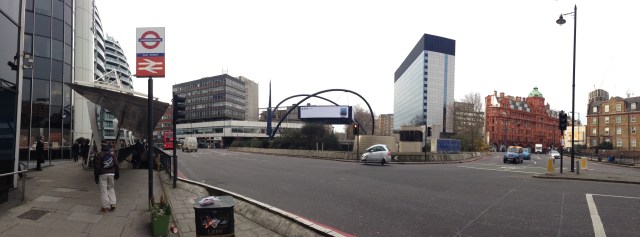
Old Street Roundabout is a heady intersection of urban movement flows: on foot, on cycles and in vehicles, including the Tube. But it is currently a mess, out of place within the surrounding network of generally convivial streets. In order to appreciate the severely negative condition of the place you only have to walk to Old Street Roundabout from a few hundred metres in any direction to witness the sudden, dramatic degradation of public space, the increase in traffic speeds and the disappearance of pedestrians into subways.
Yet, as a nexus of movement, the Old Street junction has the urban design foundations – the DNA of urbanism – to be a great public space, serving the local area as well as acting as a global emblem of Tech City. Not a valley, glen or vale but a truly urban object: a forum, a plaza, a piazza, a market place a square: Old Street Square. Or even, in keeping with the open source/open access aspirations of many in the technology community: Old Street Commons. For this to happen, the public realm of the Old Street junction needs to be overhauled. Radically. (more…)
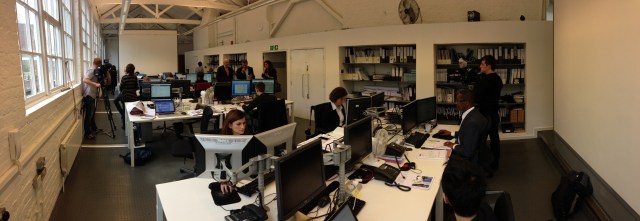
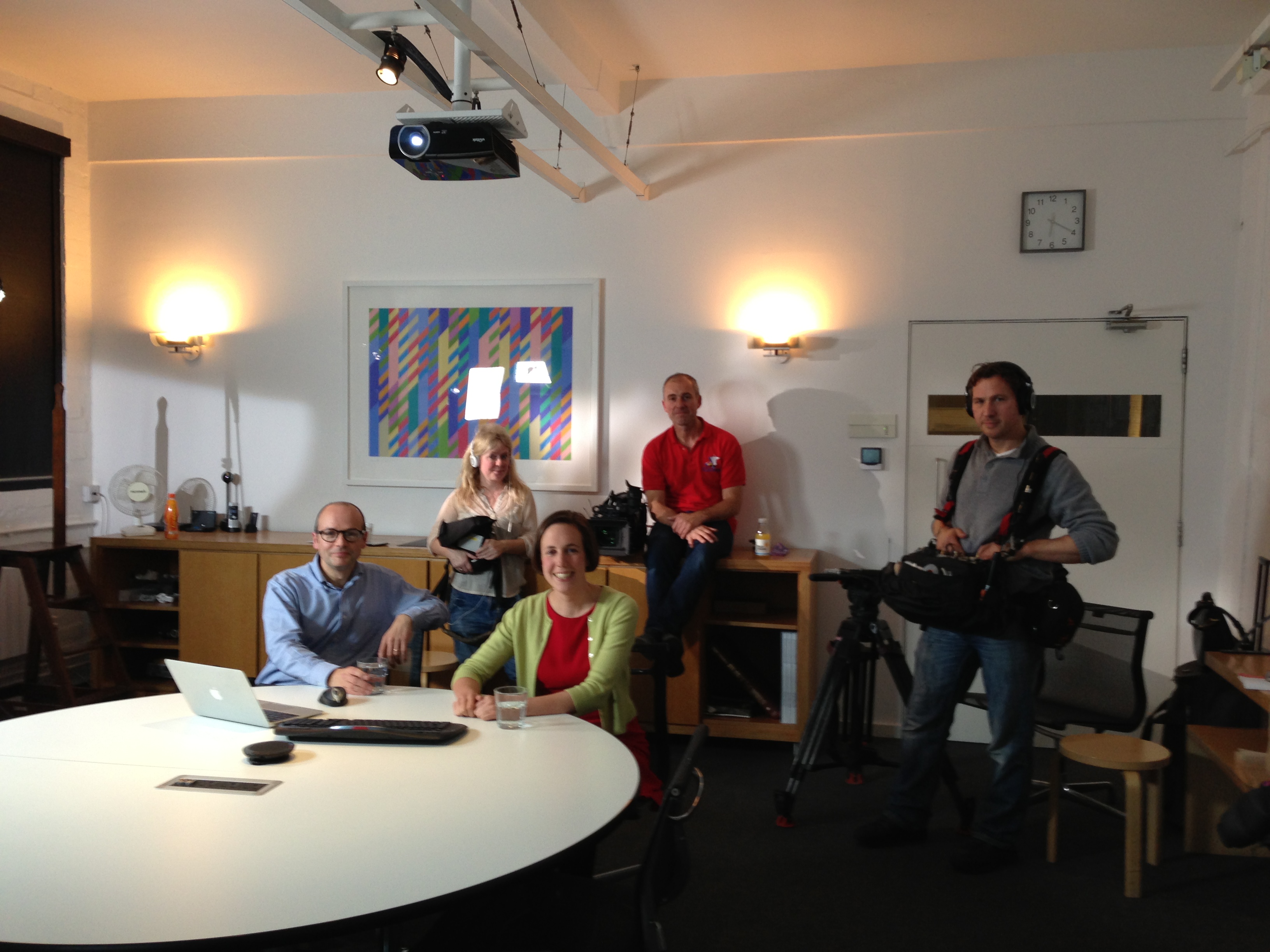
On 15th November 2012, UK Secretary of State for Business, Vince Cable, visited the Space Syntax London studio.