Category: Architecture
-
“The Architect: What Now?” Some suggestions…
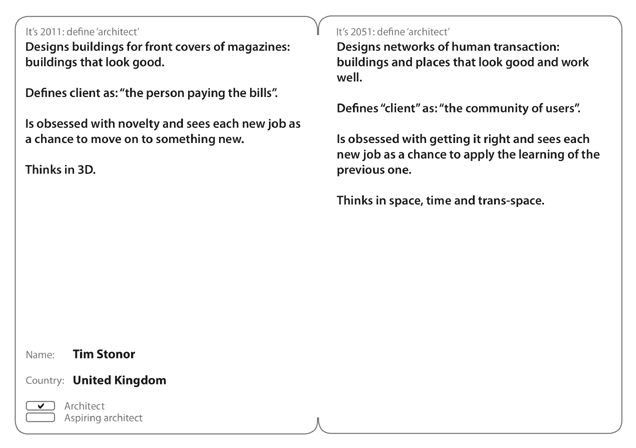 “The Architect: What now?” is an exhibition using debate, inks, film, sound and sculpture to explore the momentous identity change facing the architectural profession. Its aim is to encourage visitors to define / redefine the role of the architect and understand what this means for the construction industry.
I was delighted to be asked to participate.
-
UNICEF Notes from Tim Stonor’s presentation
Upgrading Urban Slums
The importance of child-centred planning and designUnited Nations
New York City, New York
UNICEF HeadquartersSpeaker
Tim Stonor (architect and town planner)
UCL Space Syntax (Research Organization and Consulting Group)UNICEF escort
Nikola Balvin17 June 2011
1 – 2 PMReport written by Sydney Keen
Presentation
I. UCL Space Syntax’s approach
a. Many architects don’t consider the way space is used
i. A city is a city : they do not consider people’s movement habits or
tendencies, economic effects, etc.b. It is important to focus on the movement and habits of people in urban planning
c. How does architectural planning affect the sense of community?
i. Social interaction and economic activity are directly related to spatial
planning
ii. Much of the social housing built after WWII has failed in these respects
iii. There’s room for the aesthetic but we must approach architecture as a thing to be used
iv. Consider the flow of traffic and the use of the city
v. Many slums have very specific layout with street plans which cut them off
from the city, limiting economic activity to the slum
vi. Cut-off areas are normally occupied by the very rich and the very poor
vii. 60-80% of movement flows are due to the structure of the network,
measured by spatial accessibility
1. More accessible places get more movement
viii. How will infrastructural developments affect the economic activity in the
city?
ix. “If I build a bridge over this river, will anybody use that bridge?”II. We are in cities for economic and social activity so we must have these corridors of movement – boulevards and avenues
a. Spatial layout determines land valueb. Carbon footprint is directly related to spatial layout
i. Layout can encourage or discourage pedestrian flow, therefore
determining motor vehicle trafficc. We need more boulevards and avenues, and fewer highways
d. Champs Elysees, Paris: perfect planning – high traffic, high pedestrian flow,
increasing cycling rate, high real estate value, high economic activity, beautiful
landscaping
i. These sorts of roads create the heart of the city: cities thrive on theme. Areas that have undergone many redesigns (generally very old cities) tend to
share spatial similarities
i. These are the cities that “work” – i.e. Paris
Upgrading Urban Slums : The importance of child-centred planning and designf. Office buildings tend to want to “protect” themselves from the city via a vacant
first floor
i. Instead, we need to activate buildings at ground level to increase
pedestrian flow through that street, and therefore economic activity
ii. 80% of London retail located on 20% most spatially accessible areasIII. Slums (unplanned and informal settlement)
a. Aside form the risks of violence inevitable in the destruction of slums, we must
mind the affect it would have on their economyb. Because they are unplanned, many are well laid-out and have a strong economic
identity
i. Those that are poorly developed (high rise, etc.) tend to lack that identityIV. Crime
a. Spatial layout influences crime and safetyb. You can design crime out by designing urban areas that create “natural
surveillance”
i. Encourage pedestrian flow
ii. Open the areas upc. One is more vulnerable if he is alone
i. Urban planners can avoid street crime (mugging, etc.) if they take this into
consideration by promoting pedestrian flow
ii. The chances of being harmed when surrounded by hundreds of people
such as on the boulevards of NYC are much lower than side streetsV. Jeddah
a. Mayor : “I want a humble city.”
i. Strong social and religious identity, strong economyb. 1/3 or Jeddah’s population lives in slum conditions
i. Over 50 slums in Jeddah
ii. Populations range from 3,000 to 120,000c. Centre of Jeddah is almost entirely unplanned, informal settlements
d. Jeddah slums are surrounded by highways, disconnecting them from the rest of
the city, and with it, potential markets
i. Most “walkable” routes in Jeddah are located in slums
ii. Most “drivable” routes are the highways
iii. “walkable” and “drivable” are disconnectedVI. Pedestrian Studies
a. Studies in Camden, UK, suggest that the pedestrian flows of adults v. children are
nearly oppositeb. The deeper you enter into a community the fewer adults you see
c. Housing
i. Successful : adults v. children – directly proportional
ii. Problem : adults v. children – inversely proportionald. Adults avoid “deep space where they’re on their own; kids, on the other hand,
love it because they can get away from the adults and socialize on their own”
i. Kids do not learn the basic rules of behaviour
ii. Adults aren’t there to encourage “socially acceptable” interaction
iii. Increases the stereotypical “juvenile behaviour”
Upgrading Urban Slums : The importance of child-centred planning and designDiscussion
I. How does urban planning affect children?
a. Urban planning must consider sociology and psychology, because it is ultimately
about human interaction and movementb. Families in the slums want the same benefits and privileges that people outside
the slums have (i.e. Schools, hospitals)c. Different cultures have different spatial styles
d. Whether or not streets are paved affects movement – particularly with children
e. Must consider children’s ages – children’s needs vary based on age
f. Children’s habits of movement through streets are perhaps more important that
simply their location
i. A better method for taking this data is necessary
1. Something like tracking mobile phonesg. Urban planning affects the prevalence of “juvenile behaviour” (socially
unacceptable behaviour)h. the more mutually child-friendly and adult-friendly urban areas are, the lower the
crime rates will beII. How can we ensure that children’s rights are included in urban planning?
a. In NYC, children are given the opportunity to design a space, and the results are
compiled in order to integrate the children’s ideasb. Children tend to know streets better than adults do
c. Visual design and maps area appealing to children
d. Reach out to the schools for design ideas
e. Study the movement tendencies of children in order to gain a better idea of their
needsIII. What scale of social integration do you propose? Privacy is desirable as well as economic activity
a. The key is a balance between pedestrian traffic and strangers, which help
economic flow, and maintaining the option to live in more private, residential
areas
b. To create a plan for a whole city takes five years before implementationIV. Viability of a plan
a. Consultation of inhabitants of the area being redesigned is necessary
i. Take people through the logic of the argumentb. Citizens are much more receptive to a scientific approach than architects are
c. Planning based on natural movement
d. Comment: usually, drastic dissection of an area is negative
i. Vehicle speed, physical design (dimensions), etc. are necessary to consider
in designing such a cut through a neighbourhoode. Key considerations
i. Shopping centres are less economically beneficial because they are
segregated from the rest of the community
Upgrading Urban Slums : The importance of child-centred planning and design
ii. Connectivity must be readily available between residential areas and
health facilities, food providers, and schools
iii. Climate, region, and social norms make differences in the planning of
cities
1. You cannot plan a city in China in the same way you would a city
in Morocco – different customs, religions, ideals
2. Jeddah: public spaces are busiest at night, as well as beaches
3. In Saudi culture, wealth = driving. The wealthy do not walk.
iv. Gender roles
1. Studies of movement in terms of gender is different in different
societies, according to gender roles in a given area
2. Women tend to use fewer, busier streets, whereas men use a wider
range because of their lower risk of danger
v. The presence of people on their own is much more prevalent in the slums than in other urban areas in JeddahThe ultimate goal: integrate slums with cities and children with adults to create more harmonious communities
-
The aesthetics of performance
“…Thanks for thinking of me re the architecture event. I’m actually in London next week but am flying out on the 4th.
Discussions of architectural aesthetics are often dull in my opinion, because they only deal with how things look rather than how they work; the aesthetics of performance are more my thing – and the automotive industry knows a thing or two here of course. So, if you go and they mince on about the merits of symmetry or some such nonsense, perhaps you can ask them if it’s enough to talk about buildings and shouldn’t they also be talking about the aesthetics of people movement, social interaction and economic transaction. There’s beauty in performance. Ask a dancer or an engineer!…”
-
Spatial layout, urban movement & human transaction
“Designing mobility for democracy: the role of cities”
#demobility
Thursday, 14th April 2011 from 1pm to 5pm
NYU, Kimmel Center, Eisner & Lubin Auditorium
60 Washington Square South, New York Summary
Given the title of this event: “Designing mobility”, I want to turn to the subject of design and the role of architects. The key message of this presentation is that cities need architects, not only to design the buildings that fit into them but also for the networks of space that connect them together. Why? Because architects have a special skill: to resolve complex problems into elegant solutions. And the spatial network of the city is a complex design problem.However, before they can really help, architects need to “get” cities. The problem for cities is that architects are not sufficiently familiar with the way cities work and therefore the design principles they need to work with to make cities more effective as places of human transaction.
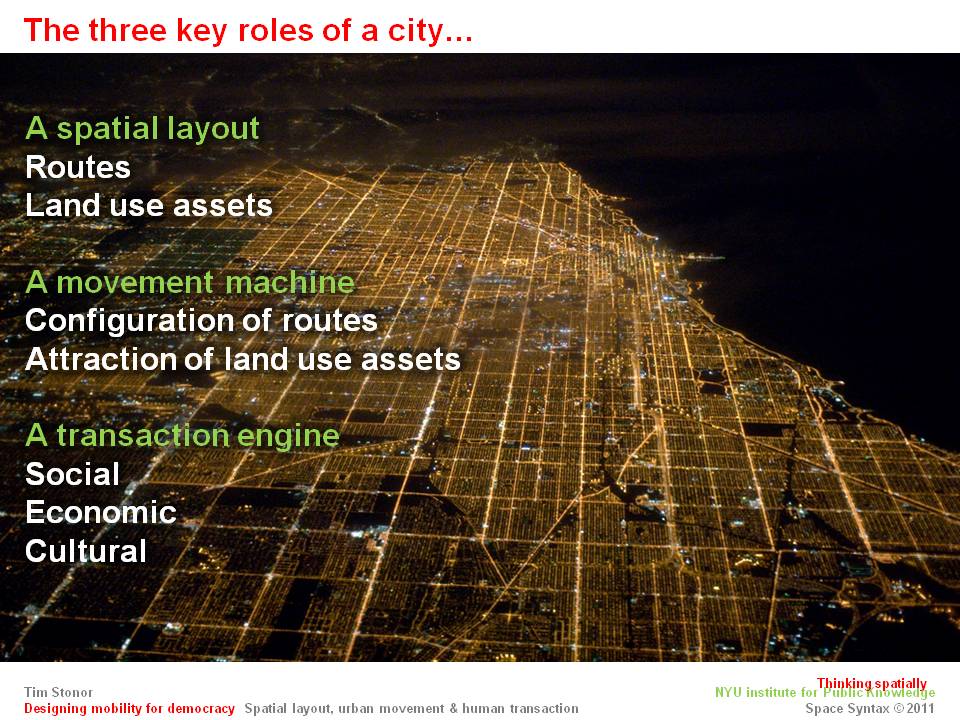
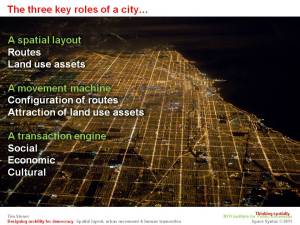 So what is the role of a city?
A city should act in three key ways:
1. as a spatial layout – of routes (streets and paths) and of land use assets
2. as a movement machine, organised by the configuration of the route network and the attraction of the land uses assets
3. as a transaction engine, generating and accommodating social, economic and cultural exchange.
A city is therefore a place of production and reproduction.
When cities don’t work a whole series of assumptions are typically loosed into the policy framework. Perhaps the greatest and most damaging of these is that that they lack transport infrastructure. Witness Sydney’s aerial people mover or the radical and crude plumbing of highway arteries into the capillary network of historic cities, especially here in the US.
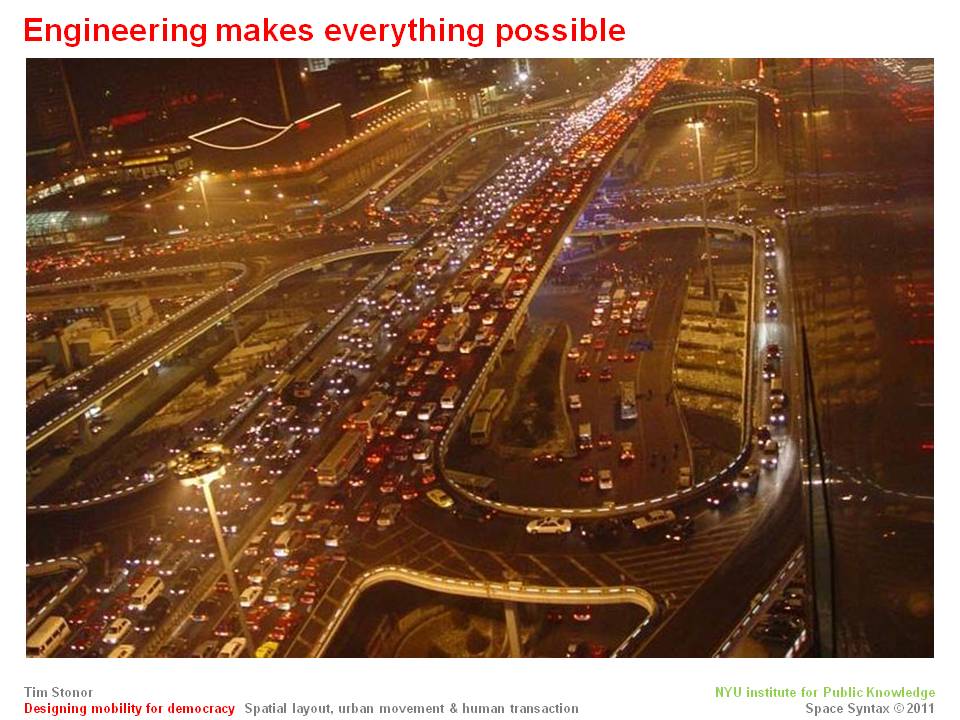
 Often the last thing that troubled places need is more transport infrastructure, especially when it is about moving people large distances. Engineering shows us that we can move human beings in pretty much any way we please, whether it’s to the moon or into the hearts of historic places, like here in Beijing.
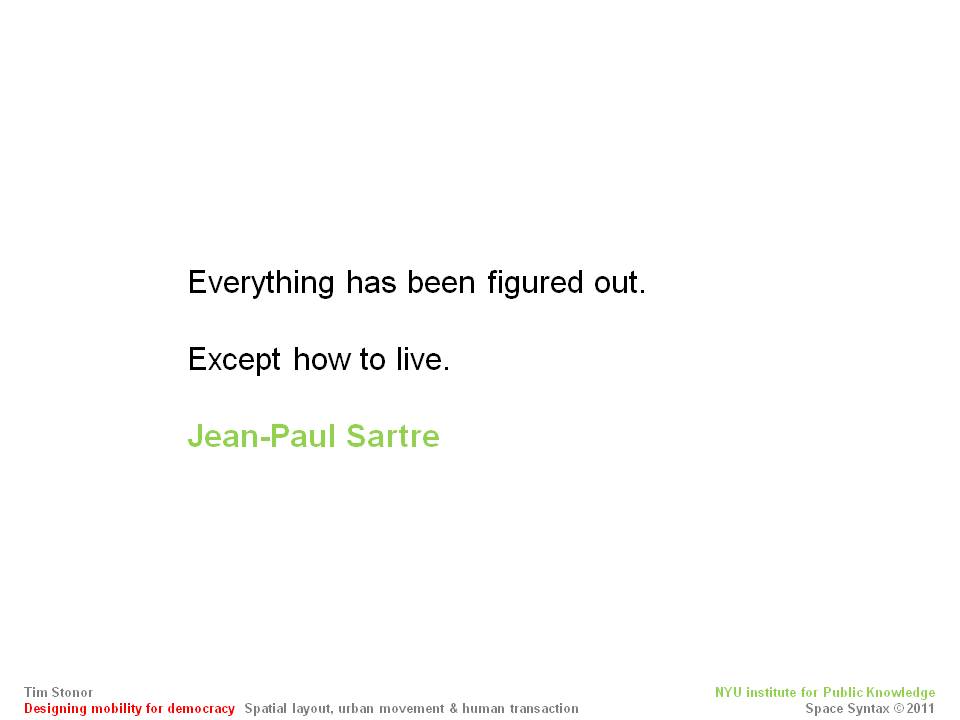
 As Sartre remarked, “Everything has been figured out, except how to live.”
Heroically engineered mobility in the form of great road intersections such as that in Beijing is – with notable exceptions – the default response of the global transportation community and therefore of the political system. Witness the federal response to the current economic recession and the bent towards building and fixing highways.
In this talk I want to argue that, if cities are to fulfill those three roles I set out they need to provide a new kind of mobility. And this is not, as Enrique Peñalosa said, only a problem of government. it is also a problem of design. And a problem of design theory at that.
-
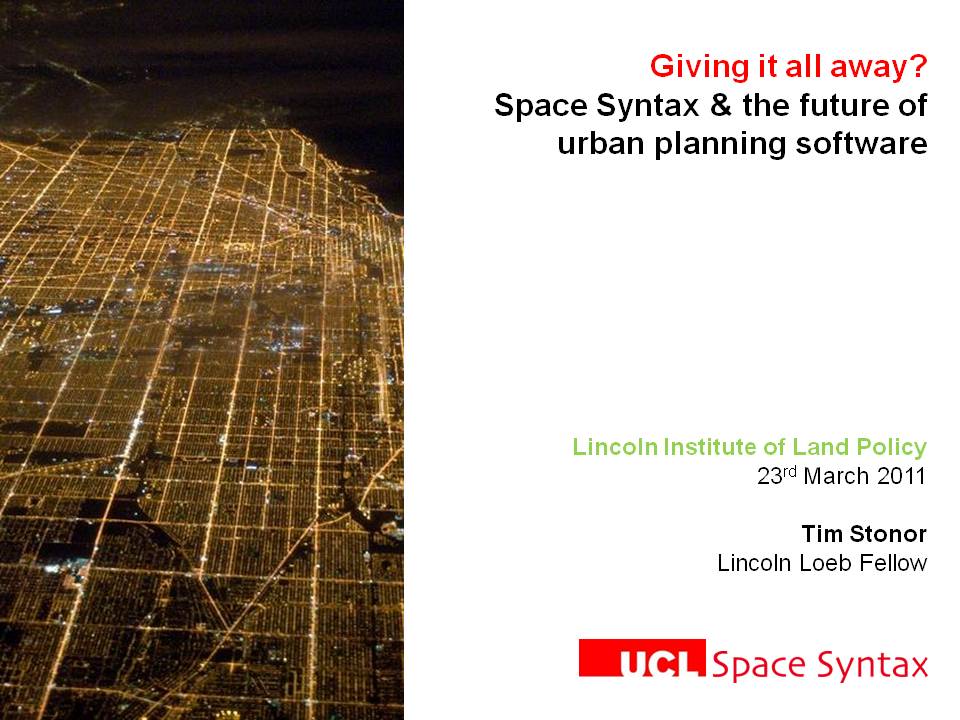
Space Syntax & the future of urban planning software
Notes from a lecture given at the Lincoln Institute of Land Policy
23rd March 2011View a summary of the presentation on YouTube

Opening comments
Good afternoon. I am delighted to have this opportunity to report on my progress as this year’s Lincoln Loeb Fellow. My brief today is in two parts: first, to describe my work as an architect and urban planner at the strategic consulting company, Space Syntax Limited; second, to say something about where I think my practice, and the field generally, is heading.
In doing so, I want to make special reference to new technologies and new methods of communication that have emerged in recent years.
A plan to transform an established business
“Space Syntax” is an evidence-based approach to planning and design, with a focus on the role of spatial networks in shaping patterns of social and economic transaction. First developed at University College London, it explains, scientifically, why the continuously connected city is a good thing and it exposes the risks that come from sprawl and disconnection. It has much to say about the benefits of density and the hazards of urban fragmentation. It gets us away from simplistic banners like “New Urbanism” or “Landscape Urbanism” by providing a detailed, forensic description of the city.Space Syntax is best known in the UK but, over the last fifteen years, we have established a network of Space Syntax consulting companies to take the approach into a growing number of countries. Although not immune to the ebbs and flows of the market, we have a commercially successful operation.
Yet, in collaboration with UCL, we now plan to make it available at low or no cost, to as many people as are willing to take it up. More than that, we are about to open up the “source code” of the software to anyone who wants to get their hands on it. We are, in other words, about to publish the recipe for our secret sauce.
In my talk today I will argue that this can only be a good thing. (more…)
-
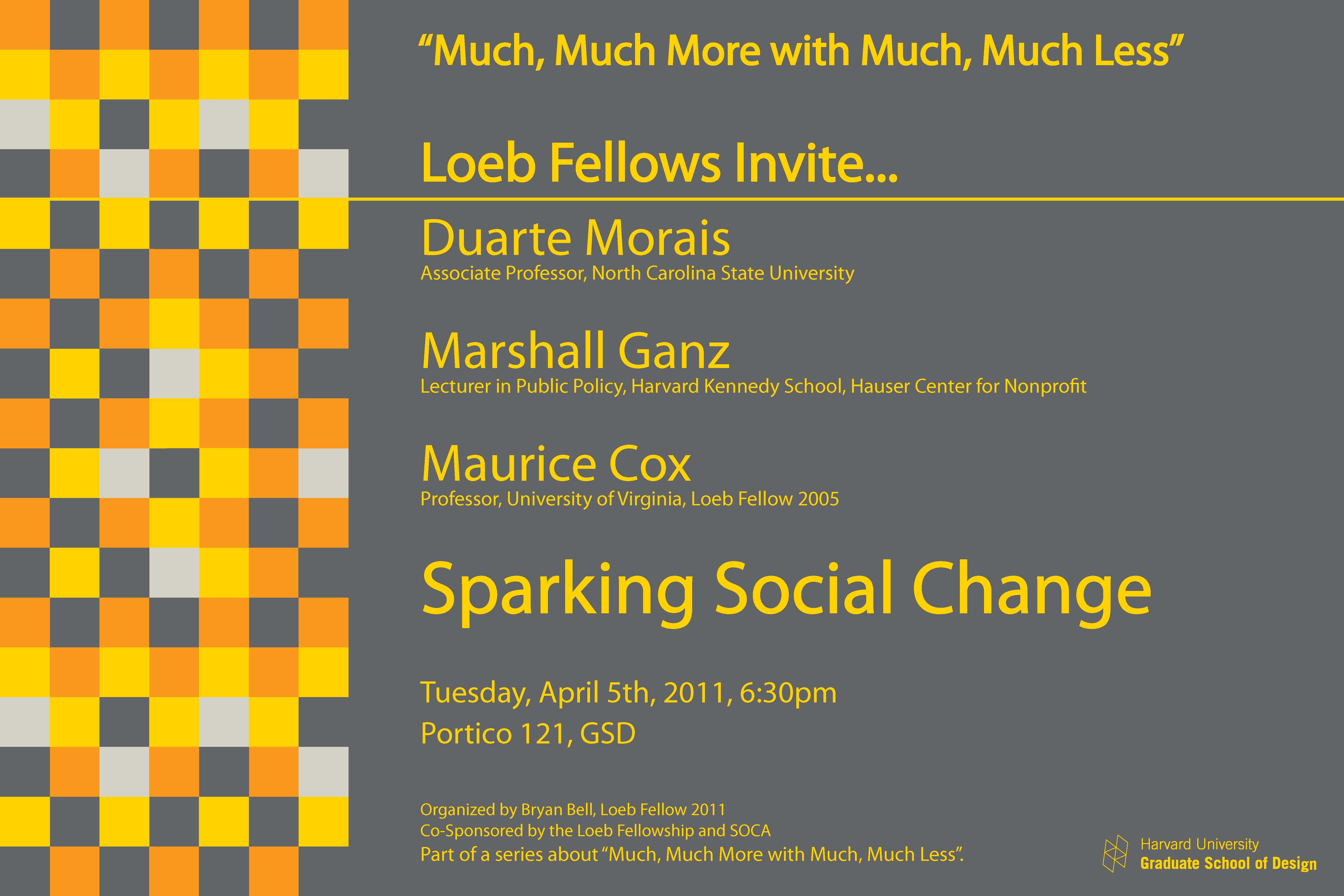
“Loeb Fellows invite…” seminar on Sparking Social Change through Design
Tuesday, 5th April 2011 at 6:30pm
Harvard Graduate School of Design, Portico Room 121
48 Quincy Street, Cambridge, MA 02138
Moderator
Maurice Cox, UVAPanelists
Marshal Ganz, Harvard Kennedy School
Duarte Morais, North Carolina State University -
Weekly update
7th-13th March 2011
Monday
Discussions with Utile Architecture & Planning regarding the redesign of Boston’s City Hall Plaza.Tuesday
Meeting with Alan Penn and Steven Schooling re Space Syntax Business Plan.Mid Term Reviews with Prof Rahul Mehrotra’s Mumbai Studio students.
Dinner with Loeb Fellows and Loeb Alumnus Damon Rich.
Wednesday
Meeting with Ed Parham re Space Syntax Business Plan.Thursday
Meeting with Utile Architecture & Planning re Boston, City Hall Plaza..Dinner with Loeb Fellows and special guest Mohsen Mostafavi, Dean of the Harvard University Graduate School of Design.
Friday
Presentation on Rotterdam’s Solid Waste Collection system to Dr Joyce Rosenthal’s class on Environmental Planning.Saturday
Visit to Jamestown, Rhode Island.Sunday
Visit to Newport, Rhode Island. -
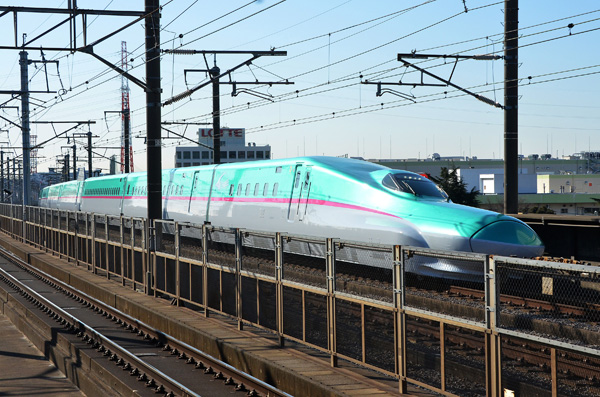
GraphicDesign confidence & WordPlay in ad for new Shinkansen
 #GraphicDesign confidence & #WordPlay for new Japan #Shinkansen. Thanks @seijitakamatsu http://yfrog.com/h719034876j
 -
In urban design & military operations – effective networks are more important than multiple connections
Following last week’s post on the subject, National Defense Magazine provides another example that highlights the risks of multiple connections and the benefits of an effective network:
U.S. Troops Loaded With Technology, But Can’t Harness the Power of the Network
A couple of quotes from the piece:
Key to this strategy is to sync up disparate programs that are important to the network, but so far have not been integrated. The Army’s acquisition bureaucracy is organized to manage stand-alone widgets and weapons, not an interconnected mesh of systems.
“The network is now the Army’s highest modernization priority,” Chiarelli (Gen. Peter W. Chiarelli, Army vice chief of staff) says. Having every soldier plugged into the tactical network and giving them means to access and distribute information would give the Army a “tremendous advantage that we never had before,” he adds.
-
Behind the sober facade – it’s a fun house!
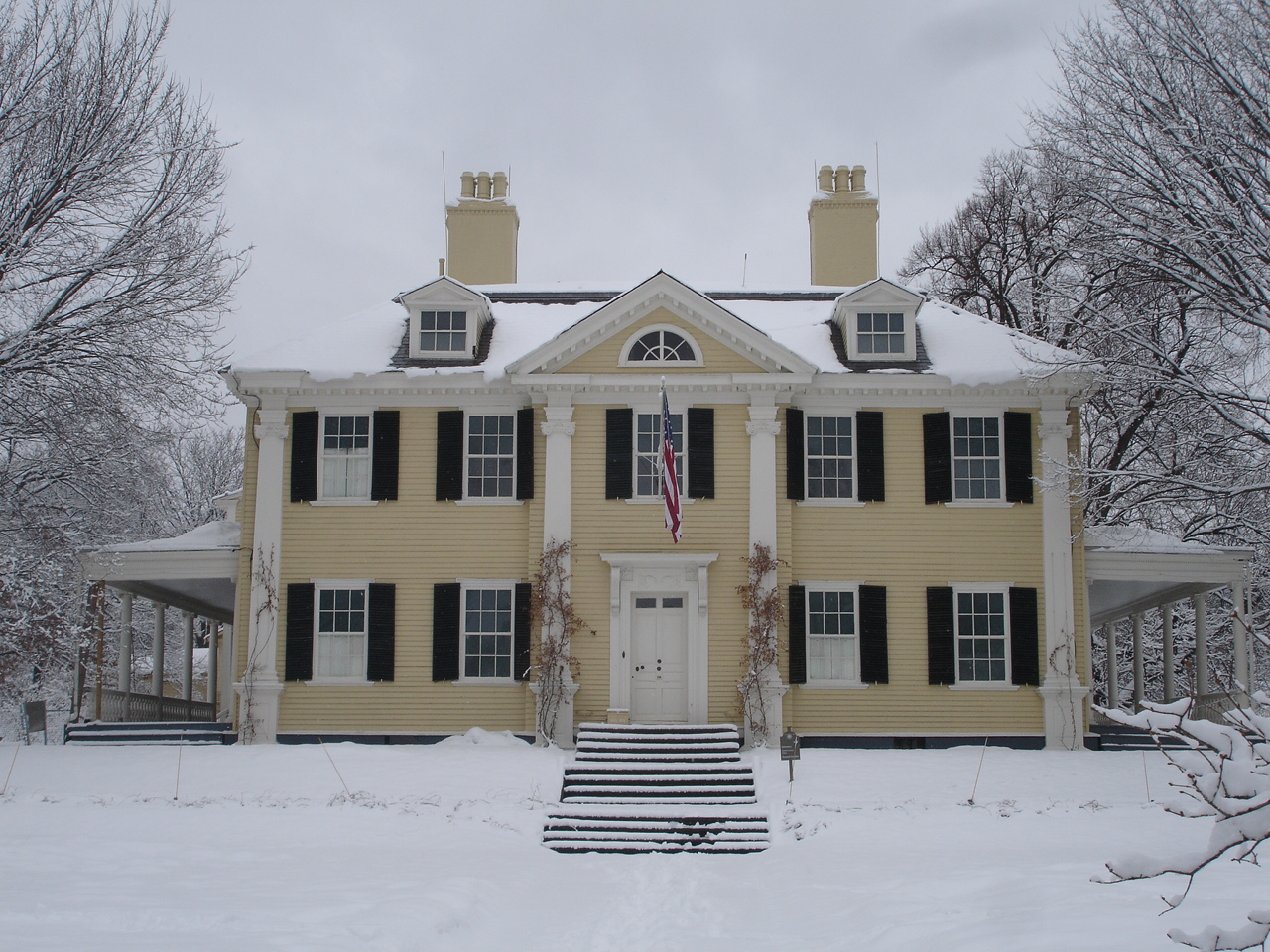
 Cambridge, MA is a city of formal, historic architecture. Harvard Yard and Brattle Street (pictured) are its poster children.
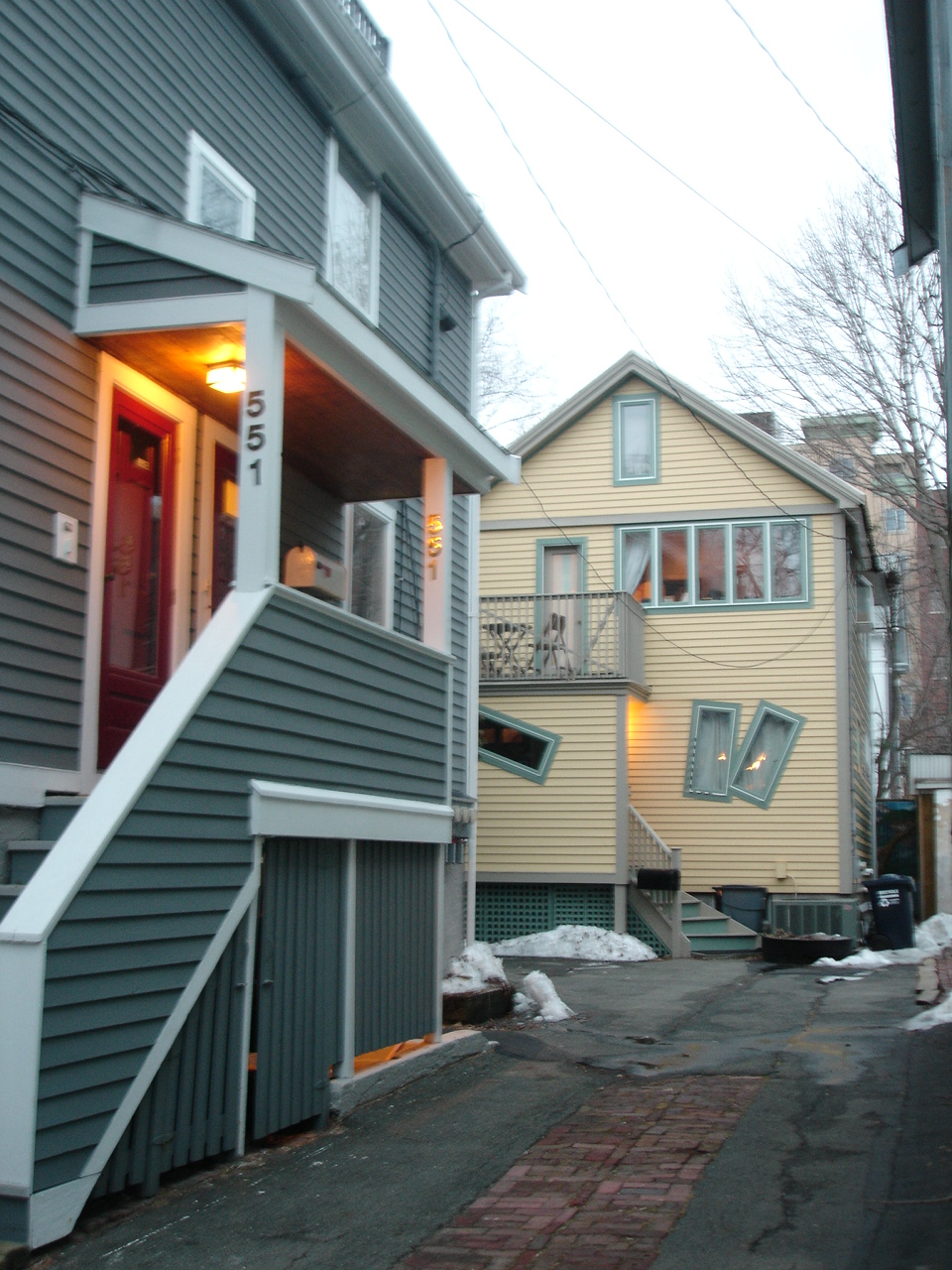
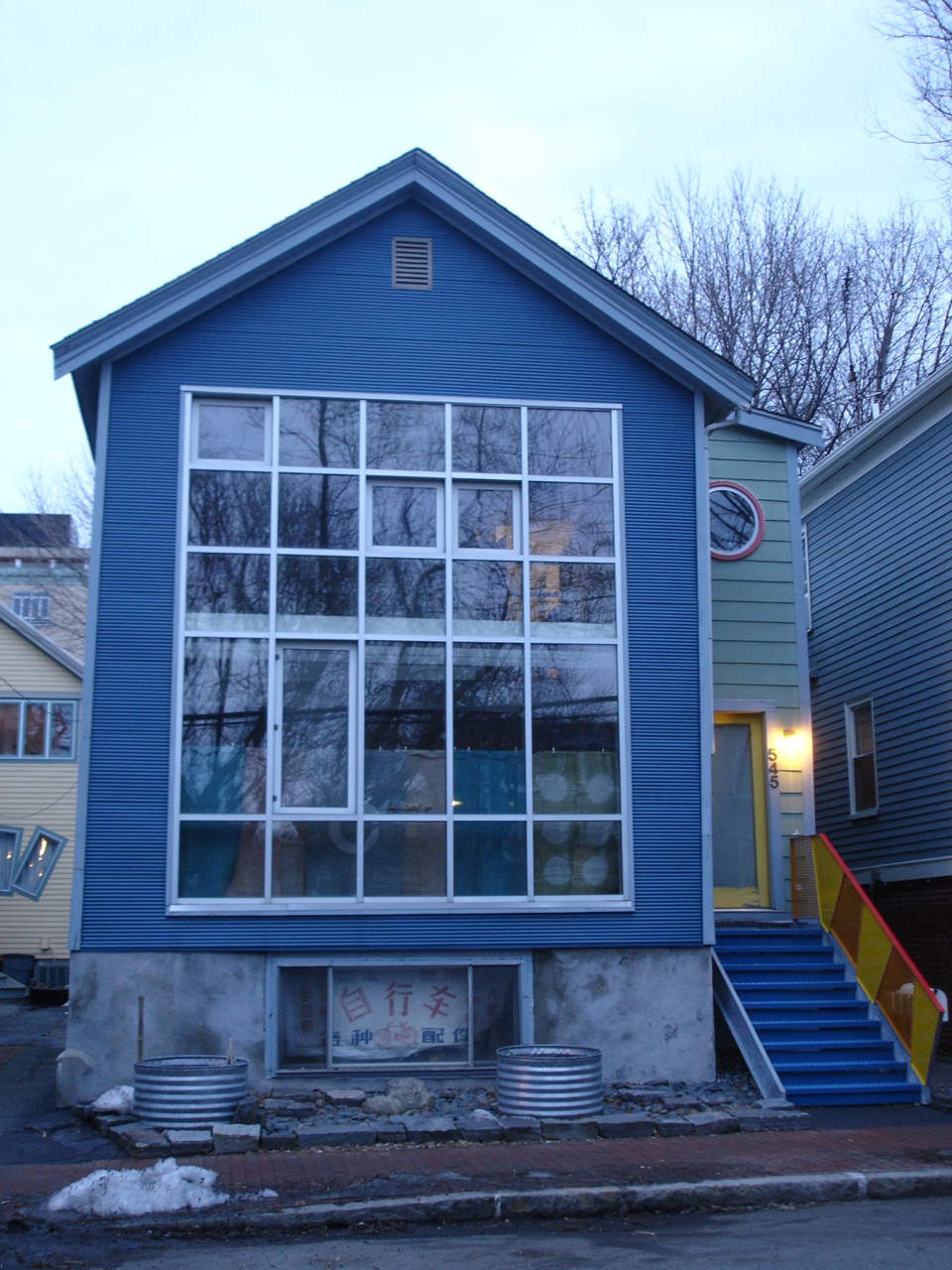
Yet, away from these greats, there are many buildings that are simply fun.
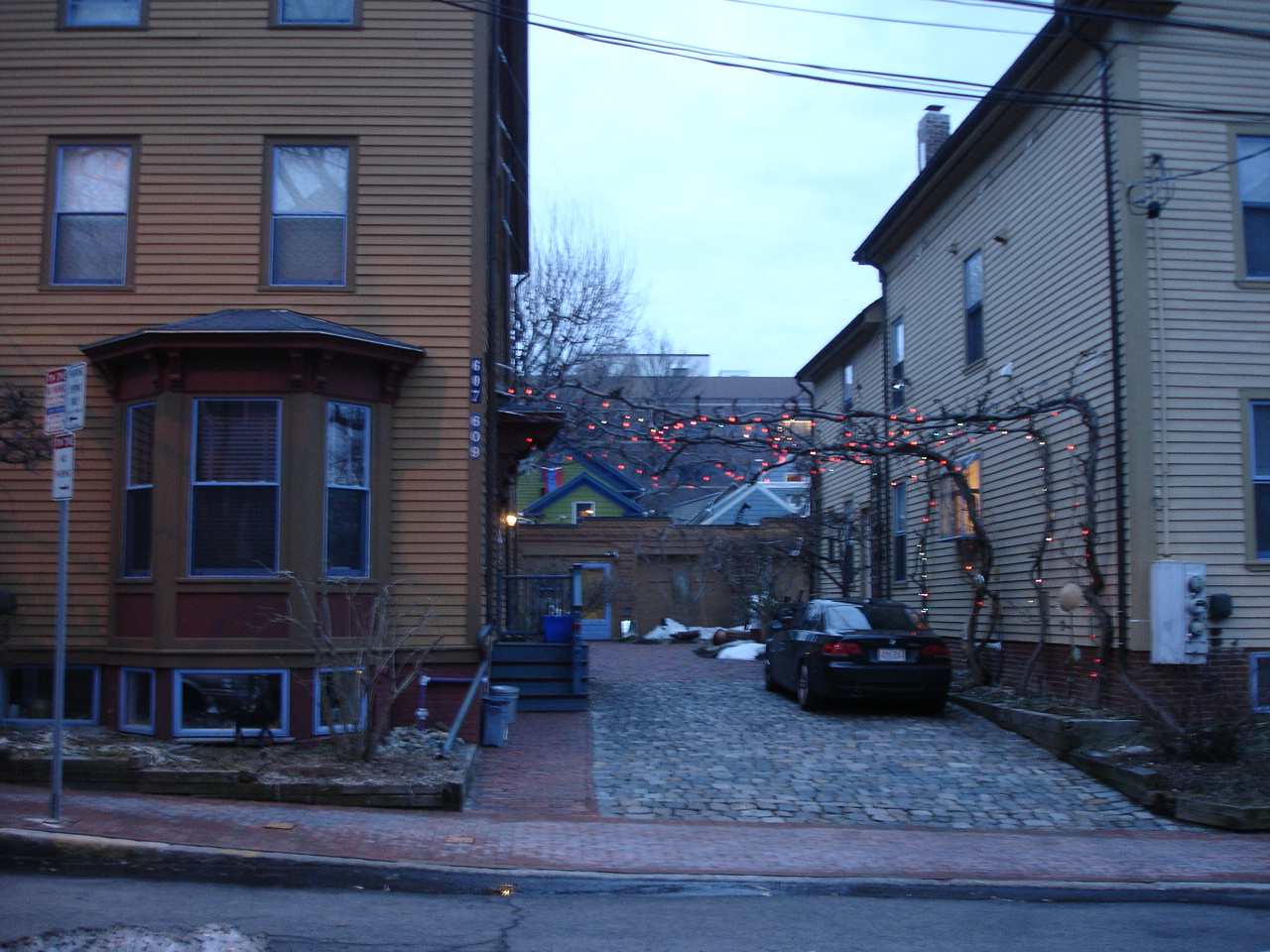
One block back from Mass Ave, Franklin Street is the setting for a cluster of quirky, joyous homes. From a distance, their politely pitched rooftops blend into the residential skyline:

But, up close, they reveal themselves to be more than ordinary:

-
Matter, Material, Materiality
 Matter, Material, Materiality: Thoughts on the Social Life of Design
Arjun AppaduraiPiper Auditorium, Harvard University Graduate School of Design
2nd march 2011A rich and widely placed lecture.
Limitation
Architecture as the means of limiting possibilities of fashion. Planning as the means of limiting the possibilities of architecture.Intangible infrastructure
The effortful production of everyday peace and its other outcomes: conviviality, warmth.Ordinary inputs
The involvement of everyday people in the process of planning and design is a reality, not least since it is the ordinary that occupies the built product of the process. Still an imperative to improve the processes by which architecture and planning are delivered. -
Connectivity is only the beginning – networking is the goal
 For digital users
2010 was the year to get connected; 2011 will be the year to become networked.
It is one thing to buy an iPhone, join Facebook and Twitter, get a blog, friend and follow. It is another to keep it all going.Already, people are being encouraged to unplug. But why unplug when it is possible to network? How? The solution is to link Twitter and Facebook to a blog; to connect the blog to LinkedIn, taking advantage of the interconnections so that things are only done once.
In other words, connectivity is only the beginning – networking is the goal. And not just for tech geeks but for all users of urban places…
 For urbanists
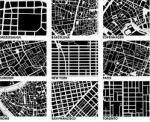
The 20th century was about cities getting connected; the 21st will be about cities becoming networked. (more…) -
Performance planning – beauty has a functional component
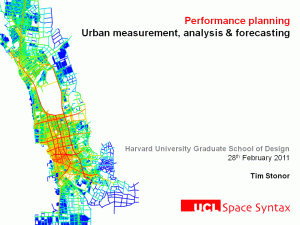 I spoke yesterday to Prof Jerold Kayden’s “Design Law Policy” class at the Harvard University Graduate School of Design.
My presentation “Performance planning – urban measurement, analysis & forecasting” can be downloaded from Slideboom. (more…)
-
Spatial transformation – Berlin
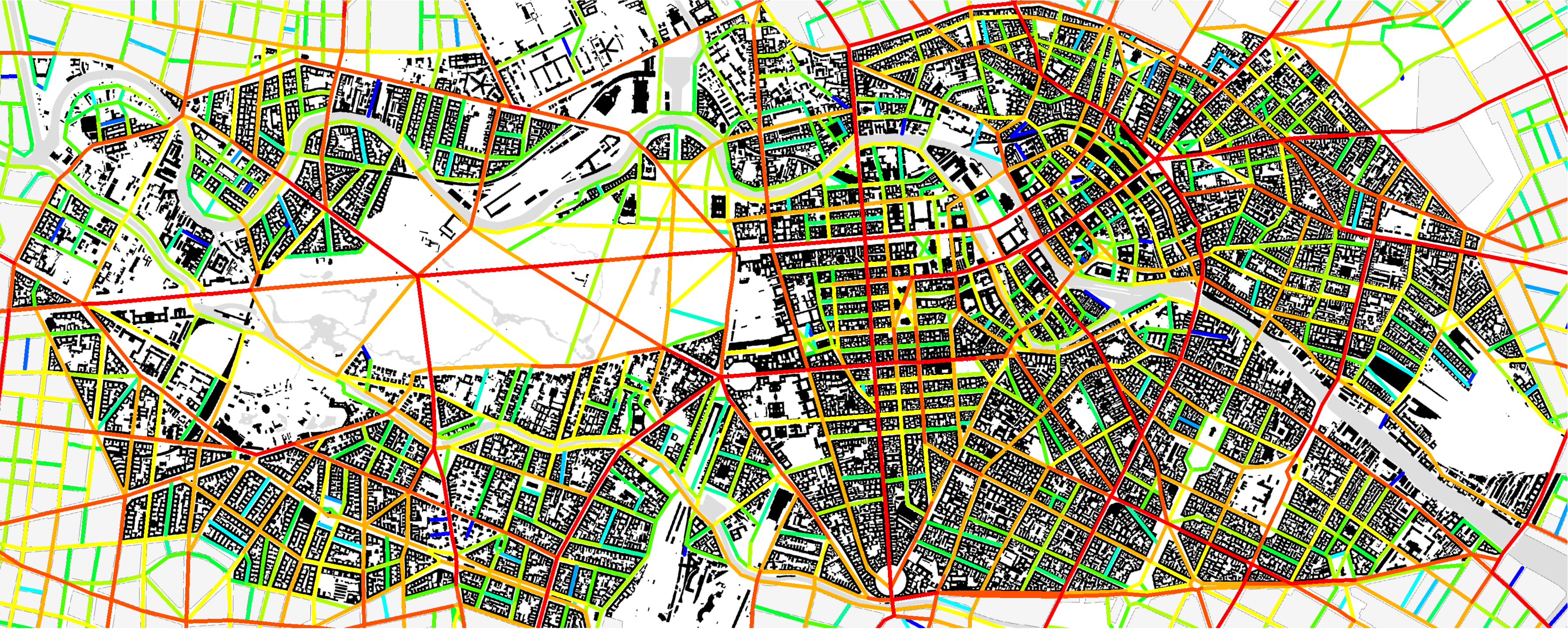
The following images of Berlin have been prepared by Anna Rose and Christian Schwander at Space Syntax Limited as part of a wider study of the city. They show the pattern of “spatial integration” in Berlin at three key periods in history: 1940, 1989 and 2011. The colours read like a temperature scale, with highest levels of integration in red, orange then yellow, and lower levels of integration in green, blue then dark blue. Spatial integration measures the degree to which an urban street is connected into the overall street network. Connectedness is a key influence on the social, economic and environmental performance of urban places. The effects of the post-war division are clear, with the once integrated centre becoming disconnected until Reunification after 1989.
Anna Rose gave a keynote presentation on the spatial transformation of Berlin on 3rd March at the Berlin Kulturforum.
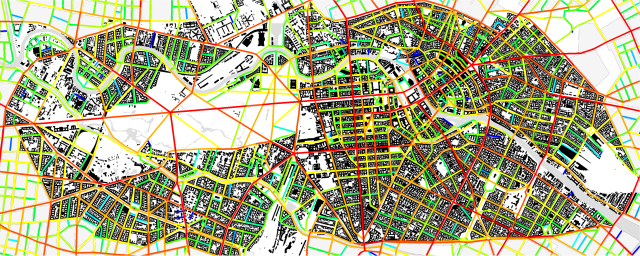
Berlin 1940 
Berlin 1989 
Berlin 2010 -
Giving it all away? Space Syntax & the future of urban planning software
Notes for a lecture to be given at the Lincoln Institute of Land Policy, 23rd March 2011
Themes
With notable exceptions, the current use of technology in planning and, especially, urban design/architecture practice is medieval. More visual than analytic. More about the “Wow!” than the “Why?”, the “Which?” or the “Will it?” Example of animation in traffic models – “Our clients like to see them move!”
Urban imperative – rapid scaling up of urban centres – provokes need for new thinking.
We need to look more at how places work than how they look.
We need to bring academic research into practice and for academia to be better led by the needs of practice.
We need to think about online social networks as well as “real-world” physical/spatial networks. Indeed real world is as much online as physical/spatial.We need to share our data. The future will be made by great partnerships, not great individuals. It has arguably ever thus been.
Open source makes commercial as well as ethical sense as the route to collaboration.
Space Syntax as the case study. (more…)