Category: Social

  • The urban cortex

    The urban cortex

    A talk given at Lombardini22 architects in Milan on 13th May 2025.

    The idea I’d like to explore this evening is that cities serve a higher purpose than we typically credit them with, and this idea is that cities are natural extensions of the human brain. Far from being artificial, alien objects, cities work with us, their users, to help us solve the problems of our times. Cities are extensions of our brains and, just like our brains, cities are sophisticated computers.

    At least they are, if we design them well. 

    Great cities are not just beautiful to look at and stimulating to be in. They are also highly efficient human transactions machines: bringing people together to form relationships and generate outcomes. Cities are the outermost layer of our common existence. Hence the title of this talk: the ‘urban cortex’.  

    One challenge when discussing cities is that urban commentators often begin by describing cities as chaotic, that their street networks are ‘labyrinthine’. This is a lazy approach to urbanism – and not one that we share at Space Syntax. Instead, we’ve spent the last 50 years studying the apparent chaos of cities and discovering regularities within them – of spatial layout, of land use distribution, of density, mobility and the distribution of inequalities. 

    These discoveries help us both to understand cities and to better design them. 

    Cities are not chaotic. We don’t build them by chance. Within their apparently labyrinthine randomness there are structures that organise the ways we move through cities – and interact with each other within them.

    There are regularities that allow us to understand cities – not just as urban scientists might pick them apart but as every day users make sense of the places they’re in:

    • how they feel comfortable in them
    • feel like they want to visit and explore them
    • meet people in them
    • go to work in them
    • invest their time and their money 
    • have fun
    • feel excitement. 

    This is the ‘urban buzz’ that draws people to cities.  

    (more…)
  • What will cities look like 30 years from now?

    What will cities look like 30 years from now?

    I joined a carbon reduction event yesterday where, by way of introducing ourselves, we were each asked to predict the future: what did we think we would see more of in 2050 – in terms of objects, experiences and services. A neat little ice-breaker if ever there was one.

    Here are my top-of-the-head responses:

    1. Object

    Green, shaded main streets

    ⁃ fronted by shops at ground level with people living above them

    ⁃ lined by trees that provide shade, lower air temperatures, disperse strong winds and encourage walking

    ⁃ forming the centres of local neighbourhoods that are built relatively densely but that are also intensely green (green walls, green roofs, green verges

    ⁃ connected into a secondary network of slow streets that people can walk, cycle and drive along.

    2. Experience

    Conviviality: the “Urban Buzz”

    – people standing, sitting, talking and generally being present with one another, forming local communities.

    3. Service

    Data-driven urban planning & design

    – harnessing machine learning and AI-driven algorithms to create future plans and predict their impacts.

    The first two will help address the Climate Emergency by reducing transport emissions. The third will threaten the established authority of the architectural and urban planning professions, which will need to adapt to survive by accelerating their uptake of digital tools.

  • Silver linings: how design can exploit the virus

    Silver linings: how design can exploit the virus

    A “to do” list for urban planners, architects & interior designers, in response to the coronavirus.

    In towns & cities:

    • reduce traffic speeds to 20mph/30kph to discourage speeding on empty streets during lockdown & to keep the air clean, the sound low & the accidents down after the “return”.

    On wide streets:

    • broaden footways to improve physical distancing in the short term & encourage pedestrian flow in the long
    • then narrow roadways further with cycle lanes to support physical activity during lockdown & active commuting on the return.

    In public spaces:

    • provide more shade, more seats, more WiFi
    • place more seats on broadened footways so calls can be answered & people can convert from moving to sitting down…
    • …and so “I’ll call you back” becomes “Just give me a second to sit down.”

    (more…)

  • We, robots

    We, robots

    The subject of robotics is multi-dimensional, disruptive & urgent.

    In my summing up at the Public Debate of the Robotics Atelier at the Norman Foster Foundation, I identified three types of robot:

    Type 1_The robot of repetitive tasks

    – this kind of robot will end many kinds of manual jobs that people currently have in factories.

    Type 2_The robot of super-human activity

    – doing jobs that no human can do: because they are, for example, in outer space, under water, in hazardous places; or because they require such precision that they are beyond human ability.

    Type 3_The robot of provocative imagination

    – this robot engages most intimately with human existence, suggesting ideas, suggesting shapes, suggesting behaviours that were previously unknown. Another word for this could be the “design robot”.

    Or even the “life support robot” – a machine, an entity that lives with us, whether it is attached to us, inside us or walking beside us. It cares for us.

    Whereas the first kind of robot – the robot of repetitive tasks – is the most straightforward, it isn’t at all the least important because it may have the most profound impacts on current industrial practices and, as a consequence, on social and economic structures.

    But the life support robot is the most intriguing/challenging. It conjures up images of an animal on the shoulder, the daemon in The Golden Compass – enhancing/extending our quality of life and provoking thoughts/actions we might otherwise not have made.

    My takeaway from the Robotics Atelier at the Norman Foster Foundation is that we need to be more nuanced in our discourse. Robotics means different things to different people and we must acknowledge these differences in order to have meaningful debate.

  • Intense relationships: measuring urban intensity

    Enriching design practice by the mapping of human behaviour patterns could transform urban space

    An article published in the Architectural Review on 30th April 2018.

    There’s much debate about how to measure density – dwellings per hectare, bedrooms per hectare or people per hectare; including or excluding major highways, parks and open spaces; the permanent population only or the transient one too? 

    While this gives urban planners something to disagree about, it risks missing the point: great urban places are not created by density; they’re created by intensity. The difference matters. When people describe the buzz of a market they don’t say, ‘Wow – it was so dense’. They’re much more likely to say how intense it was. Density is a word used by planners. Intensity is a word that real people use, and perhaps because it describes the outcomes that people experience rather than the inputs that have gone into creating them. It’s the outcomes that are ultimately more important.

    But planning professionals like density. Even though density doesn’t capture the essence of what it feels like to be somewhere, the term appeals to professional instincts. It describes the raw ingredients that planners have to handle and, once you choose which version of the formula to use, density is easy to measure. It involves a simple calculation of straightforward urban quantities such as the number of people, of houses or of bedrooms, all divided by the geographic area over which those ingredients occur. Easy.

    By contrast, intensity seems more difficult to pin down, not least because it appears to have a subjectively emotional dimension; it speaks of feelings, responses, stimuli; raising problems about how it can be measured. But intensity is also a response to context, to place and above all to people – and here we find clues to its measurement.

    (more…)
  • Sustainability & resilience – a SMART approach

    Sustainability & resilience – a SMART approach

    1. Aspects of sustainability/resilience: SMART outcomes
    Social – improvements in formation & retention of social connections

    Environmental – increases in renewable energy production and reductions in energy demand

    Economic – increases in land value creation

    Health – improvements in public health outcomes

    Education – improvements in achievements/qualifications

    Safety – reductions in offending & reoffending.

    Environmental
    Urban carbon footprint is made up of:
    1. Building carbon.
    2. Transport carbon.

    Urban carbon reduction can be achieved by:
    1. Building carbon reduction – intelligent building services: heating/cooling, lighting.
    2. Transport carbon reduction – walking, cycling, public transport & less private vehicle use.

    2. Process specification: SMART inputs
    1. Integrated Urban Modelling of existing building performance and transport performance.
    2. Predictive Urban Modelling of expected development impacts.

    3. Asset requirements for SMART approach
    1. Pervasive data sensing
    2. Data mapping – centrally coordinated & then distributed eg open platform distribution
    3. Data analysis – undertaken by city, academia & industry then shared
    4. Planning & design response – use of data to create development proposals
    5. Development proposal testing – using the Integrated Urban Model.

  • Sustainable cities of the future – sketch

    Notes for keynote at UK Green Building Council Annual City Summit, Birmingham.

    1. Spatial planning & human behaviour implications of sustainability – reduction of transport carbon through shift towards walking, cycling & public transport

    2. A massive shift needed in transport + land use planning, urban + landscape design, architecture. Professional inertia. Turning the supertanker.

    3. A massive opportunity. Reason to turn.

    4. Lessons from the past eg Pompeii, Brindley Place.

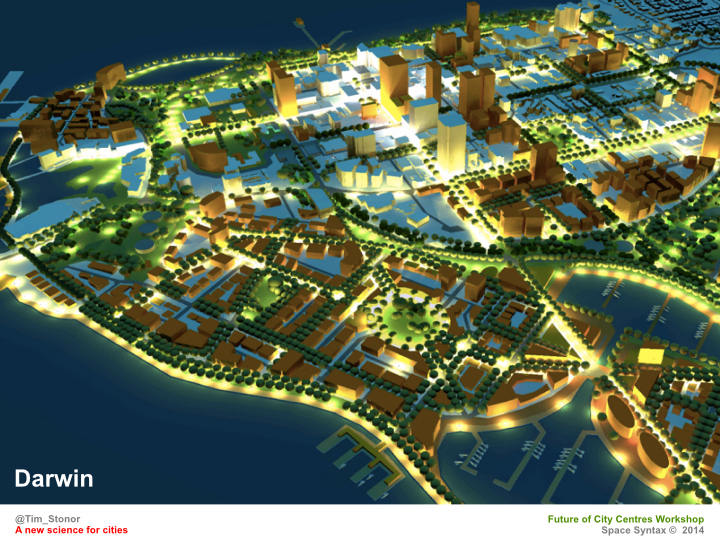
    5. Examples from the present eg Darwin, London SkyCycle, Birmingham Charette.

    6. UK government: Smart & Future cities agenda is a sustainability agenda.

    7. Social inequalities dimension of sustainability.

    8. Need to act at all scales simultaneously ie there’s work for all of us to do.

    9. Challenge for modelling.

    10. Challenge for research.

    11. Challenge for practice: design, development & real estate investment.

    12. Already being acted on. The supertanker is turning.

  • Permeability & connectivity: a tale of two cities

    Permeability & connectivity: a tale of two cities

    Notes from a response to questions from the Strelka Institute. 

    How would you describe the situation with the permeability and connectivity of city spaces today?

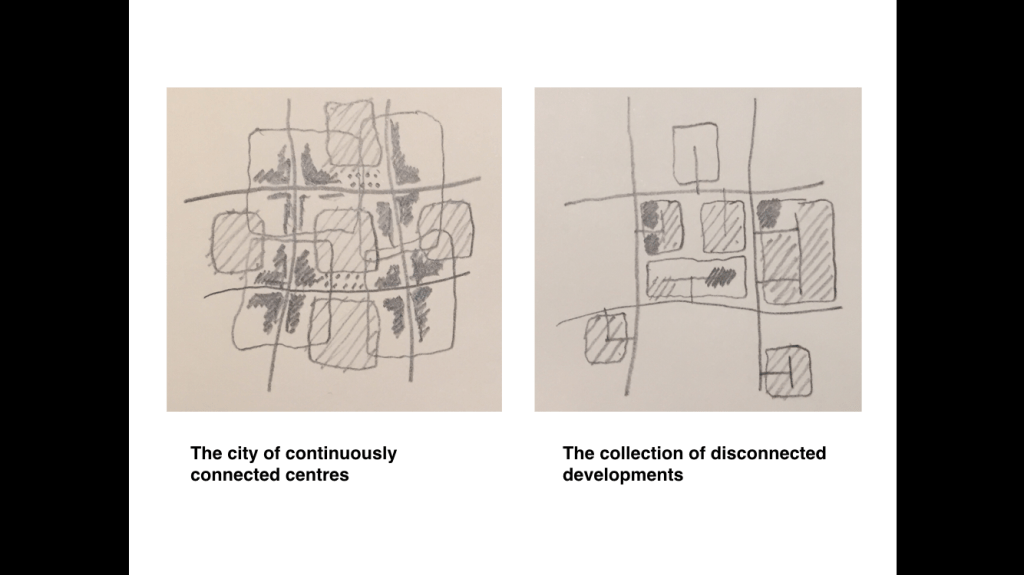
    There is no single state of permeability and connectivity in the contemporary city. Instead we find two main types of urban layout: first, the finely grained, continuously connected street network in the historic city and second, the system of largely impermeable housing estates separated by fast-moving roads in the 20th century city.

    In the historic city, space is well used. Most space use is movement and most movement is through movement. Movement supports commercial activities, which locate themselves on the principal streets where footfall is greatest. Movement brings people to places of opportunity – to buy, sell, exchange and interact. Effective exchange and interaction drives urban economies, social networks, cultures and innovations.

    In the 20th century city, the large, impermeable blocks of the housing estates do not encourage through movement. People move around the estates rather than through them. As a result, commercial activity is undermined, with its market divided between people moving locally inside the estate and those moving globally around it. Commercial activities are more likely to fail, especially inside estates where the marketplace is too weak. Instead, shops form at the entrances to the estates and on the surrounding roads. Since these roads have often been designed to favour the car, the shops are likely to be car-based, with large parking lots that further separate local people from them.

    A further, social consequence of this is that local people do not see people from outside the estate on the regular basis that people in traditional streets take for granted. The effect of this is to create social isolation and fear of strangers in estates.
    The irony is that the inward-looking urban block was created purposefully to foster a stronger community spirit. Traditional streets were considered to be noisy, dirty and dangerous. 20th century town planning’s idea was that, if life could be created away from streets then people would be cleaner, happier and safer.

    It is the greatest tragedy of 20th century international planning that its well-intended model of urban living has failed. Indeed it has done the opposite: creating highly negative social and economic outcomes for all people with perhaps the exception of the super rich for whom social and economic relations are formed in different spatial contexts.

    Connectivity is closely connected with the structure of property ownership, how will it change in the next 5 years? Will it shift towards privatisation of public spaces? And what will be the case 20 years from now?

    Undoubtedly the next decade will see more private spaces set within gated communities. Such forms of urbanism are still favoured by developers and aspirational residents for whom the idea of living in a cleaner and supposedly safer environment is expected to make them happier. The history of 20th century failure may not be considered to be relevant, perhaps because of a belief that it happened somewhere else, or in a different socio-political era, or because new digital communications technologies can effectively span the spatial divide between such places and their urban settings.

    At the same time, the resurgence of traditional street design will see more places created that look more like the continuously connected form of the historic city. This trend can be seen in cities as diverse as Beijing, London and Dubai, where permeable street networks have been created by commercial property developers as well as public municipalities precisely because they are seen to deliver places that are popular with people. The social and economic benefits of a street-based approach have been witnessed with a combination of satisfaction and surprise.

    Perhaps the most significant impact on the form of urbanism in the future city will come from the digital technologies that will record and analyse the outcomes of both approaches – the gated community and the open street network – and demonstrate with evidence how each performs.

    My clear view is that the continuously connected street network will outperform the gated community in terms of Urban GVA, making a greater contribution to the overall social and economic value of the city. The emerging Science of Cities, in which my company Space Syntax has been a pioneer, is one of the key areas of future urban practice that will cut through the inaccurate claims that have been made about the benefits of estates – claims that have been promoted by architects and urban planners throughout the 20th century, based on the passion of their beliefs rather than on the evidence of facts. Urban analytics will transform urban practice over the next 20 years, shaping a new, evidence-rich approach to architecture and town planning and, crucially, returning a highly effective, street-based form of urbanism to the position it had held for centuries before professionalised town planning imagined it could do better.

    During our work for the classification of Moscow streets we highlighted three different zones of the city: centre (inside the Garden Ring), middle zone (between the Garden and the Third Transport Rings), and periphery (outside the Third Ring). The pattern is completely different in these zones. Could you comment on the implication of global trends of connectivity in the city on different zones in Moscow?

    No city is the same from its centre to its edge. Or, more precisely, from its centres to the edges of those centres because cities are formed of multiple centres that create a system of connected urban quarters. The quality of the connections between centres is a fundamental determinant of overall urban performance, having a strong bearing on whether people are more likely to walk and cycle between neighbourhoods and whether those links will be effective places for social and economic activity. When centres are continuously connected to each other through a set of connections with a regular grain then it is likely that many, if not all of these will be suitable for walking and cycling as well as driving along.

    Cities like London and Paris are composed of multiple centres that have distinct centres of differing characters yet are continuously connected to each other. Indeed it is the magic of such cities that it is possible to move from one centre to the other in such a subtle way that you are uncertain exactly when you have left one centre and entered another. The connective “tissue” between centres is typically comprised of residential streets, which therefore link to – and carry movement belonging to – multiple centres. People may identify more with one centre than others but they are provided with a choice of more than one. And,min doing so, they interface with people from more than one centre. The benefits of this arrangement are simultaneously social and economic.

    Such choice is denied by the 20th century city of separated estates. People living in one estate have limited, if any direct access to the centres of other estates. Increasingly, the roads that connect between estates are hostile to pedestrians and cyclists. Social and economic life is suppressed.

    All cities are systems of linked centres that each work in individualistic, local ways but that also form an overall city system. Within this city system, the centres have a hierarchy with more central centres typically supporting greater economic activity than centres at the edge. This is not only because more central centres are larger but also because these centres are surrounded by a larger number of other centres than are peripheral centres.

    In the case of Moscow, Space Syntax analysis would be used to examine the hierarchy of centres, the quality of the connections between them and the degree to which spatial connectivity is directly related to social and economic performance. Data on economic performance – such as land value, property transactions, commercial performance, retail sales – would be correlated with measures of spatial connectivity – such as spatial centrality (choice) and betweenness (integration) at a range of spatial scales. These Big Data sets would be interrogated in order to form a diagnosis of the current spatial conditions. On the basis of this diagnosis, a set of spatial planning principles would be created that would lead to the production of a spatial vision for the city. We anticipate that this form of data-rich, evidence-informed planning will become normal in the next 20 years.

    While improving and redeveloping city streetscape how should trends in the connectivity and permeability of city space be taken into account? 

    Space Syntax analysis shows how patterns of spatial connectivity have profound influences on the social and economic performance of all cities. The hierarchy of spatial connections influences:
    movement patterns of cars, cycles and pedestrians

    – public transit demand

    – land use performance

    – land value

    – transport emissions.

    Future urban plans should therefore be created with a special emphasis on the design of the spatial layout of the city. Opportunities should be identified to strengthen the network of streets and open spaces, pursuing an overall objective to create a city of continuously connected centres. Constraints should equally be identified so that reasonable plans can be made.

    “Spatial geometry” standards should be set for the number and frequency of connections as well as for the geometrical means by which centres can be most effectively connected ie first, a small set of longer, more direct connections (the “foreground grid” of boulevards and high streets) that will carry larger volumes of people and therefore be suitable for commercial uses and second, a large set of smaller, less direct connections (the “background grid” of local streets) that will carry smaller volumes of principally residential movement.

    Once these spatial geometry standards have been established then further standards of urban design quality should be set – but not before. High quality urban design in the form of green landscape, seating, signage me surface treatment will not create high quality urban performance if the spatial layout geometry is weak.

    The living city is built on human interaction. Without this, the city is dead. Human interaction relies on effective movement corridors and effective places of human transaction. Effective street connectivity is a critical determinant of the living city.

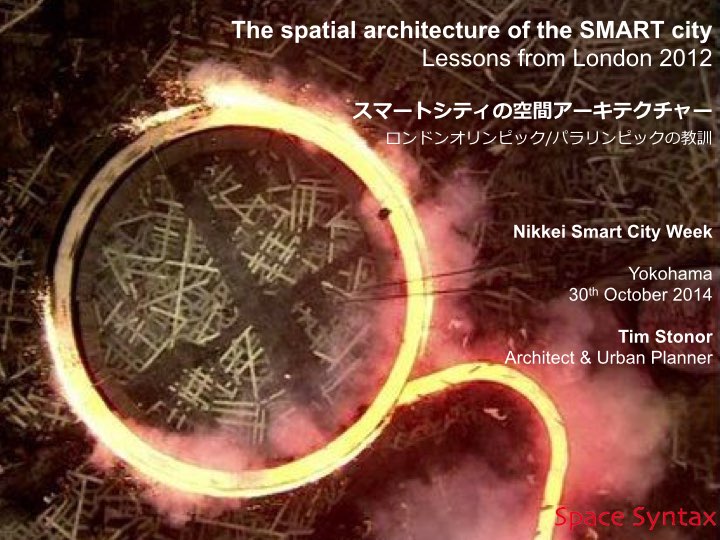
  • The spatial architecture of the SMART city

    The spatial architecture of the SMART city

    Tim Stonor_The spatial architecture of the SMART city_Japanese_141028.001

    Download this presentation.

    Good morning. It is a pleasure and an honour to have been invited to give this presentation today at the Nikkei Smart City Week conference. The subject of my talk is architecture – not only the architecture of buildings but, also, the architecture of public space: the space that we move through and live our lives in; the glue that binds us together.

    Tim Stonor_The spatial architecture of the SMART city_Japanese_141028.002

    In the first part of my presentation I will address three key questions:

    First, what is a Smart City?

    Second, how can a Smart City be planned & governed?

    Third, where is the place for technology in the Smart City?

    And I will relate each of these questions to the architecture of space.

    Tim Stonor_The spatial architecture of the SMART city_Japanese_141028.003

    In the second part of my presentation I will describe the very significant effort that the UK is making to plan for its urban future, embracing the opportunities that new technologies provide.

    Tim Stonor_The spatial architecture of the SMART city_Japanese_141028.004

    In the third part of my presentation I will describe the use of computer modelling techniques in the creation of the London 2012 urban masterplanning process. (more…)

  • Forwards to the past! Technology’s greatest triumph

    WhatdidItellyou-HQ

    Rick

    There are so many reasons why what you have set out below is interesting. But I think I can take a different position to the one that you are developing.

    My approach will be that, far from taking the human mind, behaviours, and cultural norms beyond where they have ever been before, the true value of modern technology, analytics and predictive capacity will be for cities and civilisations to recover the unbelievable sophistication that they once had. (more…)

  • Building a Smart City modelling team

    Integrated Urban Model

    .

    Cities planning their future are increasingly turning to the production of Integrated Urban Models. These are tools that bring together various datasets on different asoects of urban performance, from the behaviour of people to the flows of energy, water and other utilities. The aim is to better predict the future of cities by better understanding how they are currently working.

    This is a nascent but rapidly developing field in which knowledge is emerging and evolving at a pace. Given the complexity of cities it is a good idea to involve many specialists in different subjects, led by an Urban Modelling Advisory Panel (UrbanMAP).   (more…)

  • From cities of movement to places of transaction

    Summary of Tim Stonor’s talk at the World Cities Summit, Singapore, 3rd June 2014

    From cities of movement to places of transaction – a new mobility focus for city leaders, planners and everyday users

    Key responsibilities for cities
    1. Imagining the future of cities and mobility.

    2. Designing integrated, people-focused planning to sustain cities.

    3. Measuring the social, economic and environmental value created by the movement, interaction and transaction of people.

    The fundamental purpose of cities
    Cities are for transaction: economic and social transaction. People come to cities to trade. It is why we have cities – they are intensifications of opportunities to trade. The public realm of the city – its network of streets and spaces – is where much of this trade occurs: a “transaction machine” which, like any machine, is more or less efficient depending on how it is engineered. (more…)

  • Smart City Planning & Design Principles

    Smart Cities are smart in two ways. First, they harness technologies to improve the way that urban places are led and managed. Second, they create better outcomes for the people that use them. This two-pronged approach applies to all aspects of Smart Cities.

    When it comes to the planning and design of Smart Cities, technology can improve:

    1. the performance of the places that are produced by planning and design (the outcomes)

    2. the processes involved in creating plans and designs (the inputs).

    A Smart City approach should direct the capabilities of urban planners and designers to:

    1. facilitate effective human transaction in new and existing places

    2. provide access to places of transaction, both physical and digital: on-land and on-line

    3. support the mobility required to access these places of transaction by providing networks of connectivity for all modes of transport, both physical (walking cycling rolling driving) and digital

    4. take an outcomes-oriented (ie transactions & emissions) approach first and foremost, aware of the inputs required (ie materials, energy & mobility) to achieve these desired objectives

    5. provide effective analytic and forecasting tools aimed at social economic and environmental impacts.

  • How should the Transport industry change?

    First, by seeing the purpose of Transport as the facilitation of human transaction and not only as the movement of people/goods and the construction of roads, rails and runways.

    Second, that the economic benefits of transport investments are measured not as savings in time but as the creation of opportunities.

    Third, that when you say transport, people think walk and cycle as well as drive and ride.

    Fourth, that digital transportation if considered alongside physical transportation by the same people working within the same teams/departments.

    Fifth, that the accuracy of transport forecasts is improved – too many initiatives don’t work the way they were meant to and, of these, many create unintended negative consequences such as traffic congestion, illness and social isolation.

  • MSc Advanced Architectural Studies – graduate employability

    A talk given at the 40th Anniversary celebrations of the MSc in Advanced Architectural Studies – the “space syntax” MSc at University College London, 3rd September 2013.

    Good evening, everyone.

    Let me begin by paying tribute to the genius of Bill Hillier and Julienne Hanson. Not only for pioneering a theory – the theory – of architecture, but also for finding a way to teach it that has had such an effect on us all.

    I’ve been asked to speak this evening about the issue of employability: does taking the MSc in Advanced Architectural Studies either enhance or inhibit the job propsects of its graduates?

    Here’s what I want to say:

    First, I’d like to review the perceived problem of Space Syntax – why it’s sometimes viewed with skepticism and how that impacts at interview; second, the nonsense of this criticism: why do I even need to be up here to defend the course; third, the “Hang on, maybe there’s an element of truth here” moment; and finally a belief that we can’t rest on our laurels. (more…)

  • Integrated Urban Modelling – Space Syntax’s approach

    I’ve written before about the benefits of using science-based models in the planning and design process. I’ve raised concerns about the frequent lack of objective analysis in urban and building projects, and the risks this creates in decision-taking. Basing important decisions on gut instinct and experience, then willing on success with little more than hype, just isn’t good enough.

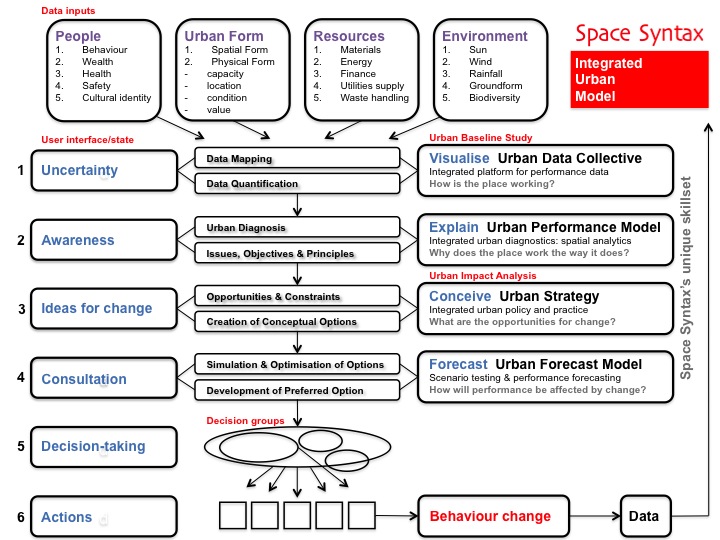
    Integrated Urban Model

    Here is a diagram that summarises Space Syntax’s approach to urban modelling. It’s a staged process: collecting datasets; analysing them to identify relationships between urban form and urban performance; drawing out key issues and developing creative ideas – all the time using the model to test proposals. The approach is transparent and communicative – helping stakeholders participate in the process and, most importantly, helping people take decisions that lead to actions and changed behaviours.

    It’s more than a pipedream – we’ve been using the model on projects for over 25 years, evolving it through continuous application. And we’ll continue to do so, adapting to the ever richer data context that digital urbanism provides.

    And always remembering that the ultimate objective is the creation of behaviour change to the benefit of human wealth, health and education.

    Download the presentation

  • Are streets the answer – yes, but…

    Yesterday’s launch by think tank Policy Exchange of a report calling for the removal of inner-city high rise estates and their replacement with streets is a welcome contribution to discussions about the design of future cities. The report, authored by Create Streets, concludes that high rise estates are unsafe, antisocial and economically substandard. By proposing to replace estates with streets, the authors claim they are responding to residents’ concerns. They also say that well designed streets can provide just as much housing as sprawling estates.

    The argument for street-based living appears to be straightforward: people like streets and they deliver economically. Yet it isn’t as simple as this and the report quite rightly references research by Savills, Space Syntax and the Brookings Institute that shows the importance of street layout. There are better, well-connected, well used streets and less good, disconnected, poorly used streets. (more…)

  • Old Street – putting the genie back in the bottle?

    photo

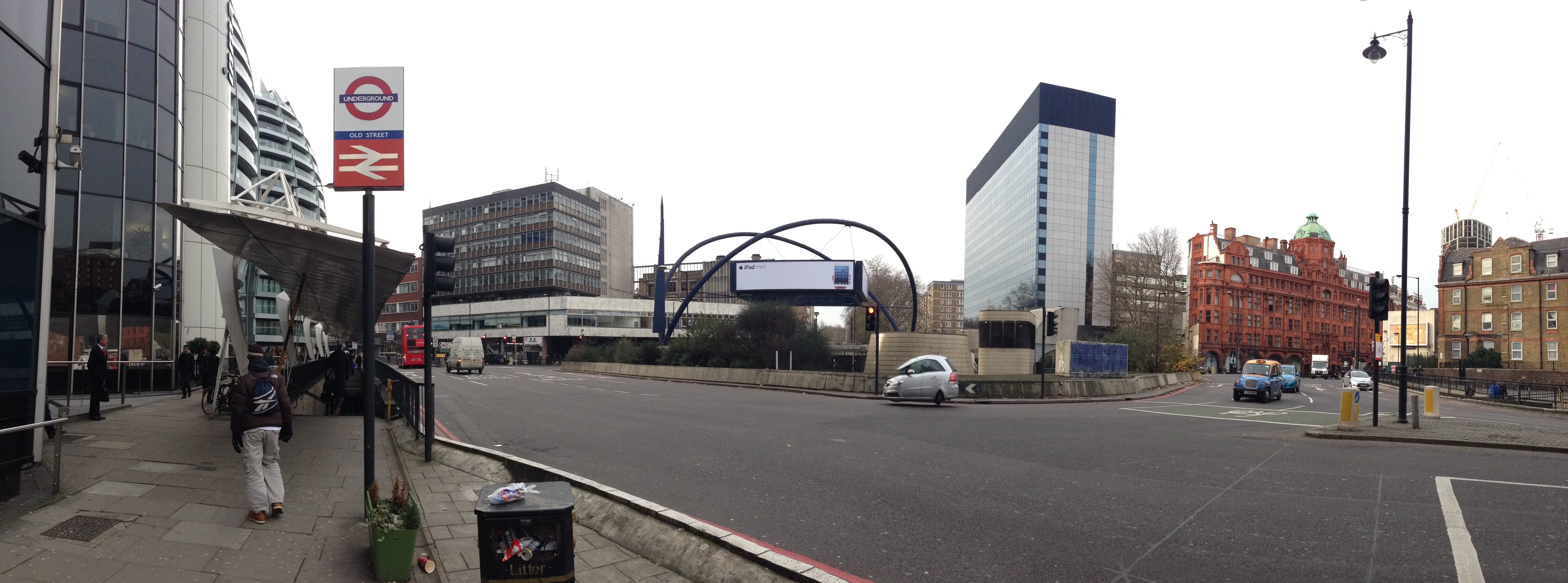
    Old Street Roundabout is a heady intersection of urban movement flows: on foot, on cycles and in vehicles, including the Tube. But it is currently a mess, out of place within the surrounding network of generally convivial streets. In order to appreciate the severely negative condition of the place you only have to walk to Old Street Roundabout from a few hundred metres in any direction to witness the sudden, dramatic degradation of public space, the increase in traffic speeds and the disappearance of pedestrians into subways.

    Yet, as a nexus of movement, the Old Street junction has the urban design foundations – the DNA of urbanism – to be a great public space, serving the local area as well as acting as a global emblem of Tech City. Not a valley, glen or vale but a truly urban object: a forum, a plaza, a piazza, a market place a square: Old Street Square. Or even, in keeping with the open source/open access aspirations of many in the technology community: Old Street Commons. For this to happen, the public realm of the Old Street junction needs to be overhauled. Radically. (more…)