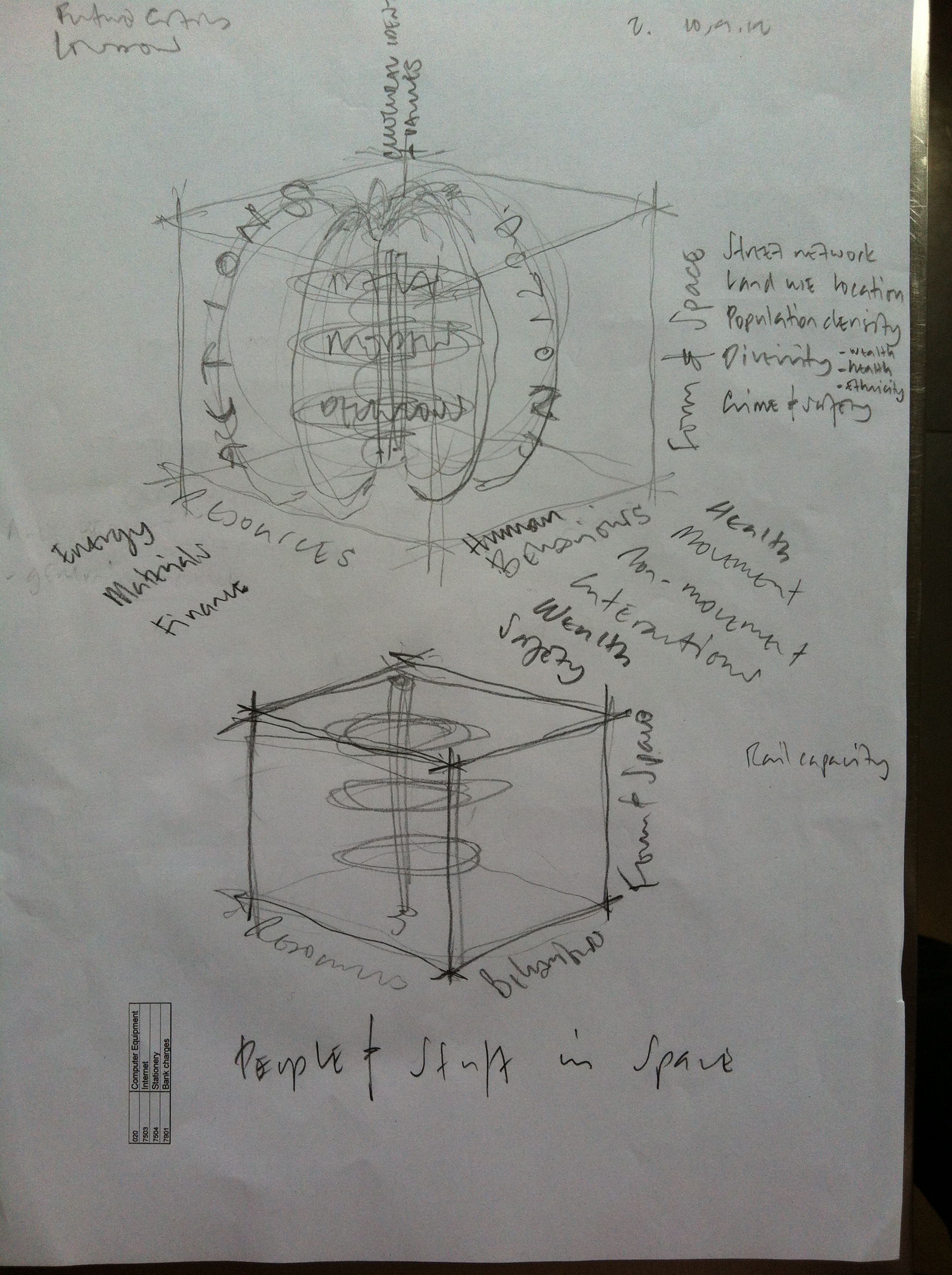
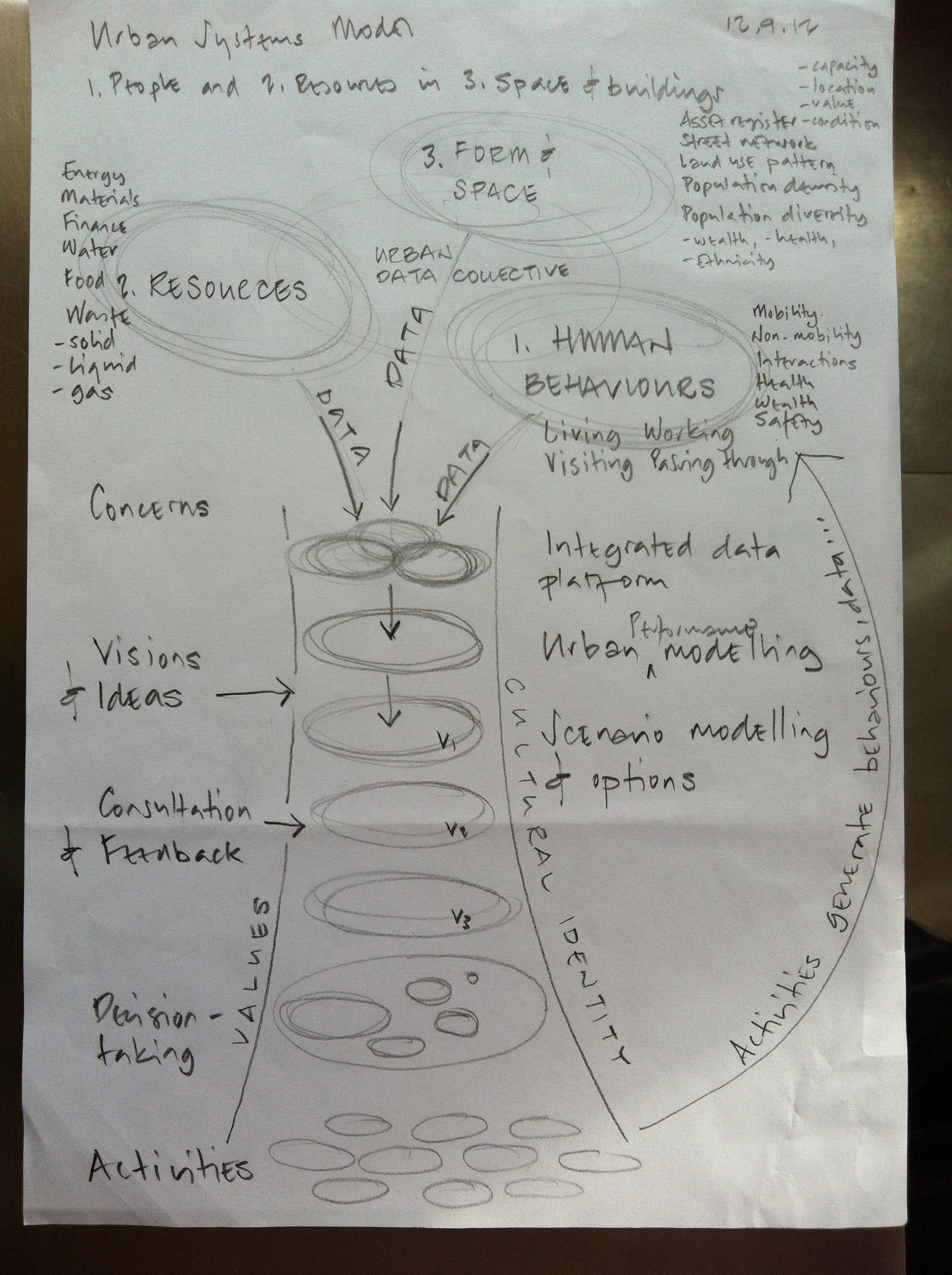
Category: Innovation

  • The urban cortex

    The urban cortex

    A talk given at Lombardini22 architects in Milan on 13th May 2025.

    The idea I’d like to explore this evening is that cities serve a higher purpose than we typically credit them with, and this idea is that cities are natural extensions of the human brain. Far from being artificial, alien objects, cities work with us, their users, to help us solve the problems of our times. Cities are extensions of our brains and, just like our brains, cities are sophisticated computers.

    At least they are, if we design them well. 

    Great cities are not just beautiful to look at and stimulating to be in. They are also highly efficient human transactions machines: bringing people together to form relationships and generate outcomes. Cities are the outermost layer of our common existence. Hence the title of this talk: the ‘urban cortex’.  

    One challenge when discussing cities is that urban commentators often begin by describing cities as chaotic, that their street networks are ‘labyrinthine’. This is a lazy approach to urbanism – and not one that we share at Space Syntax. Instead, we’ve spent the last 50 years studying the apparent chaos of cities and discovering regularities within them – of spatial layout, of land use distribution, of density, mobility and the distribution of inequalities. 

    These discoveries help us both to understand cities and to better design them. 

    Cities are not chaotic. We don’t build them by chance. Within their apparently labyrinthine randomness there are structures that organise the ways we move through cities – and interact with each other within them.

    There are regularities that allow us to understand cities – not just as urban scientists might pick them apart but as every day users make sense of the places they’re in:

    • how they feel comfortable in them
    • feel like they want to visit and explore them
    • meet people in them
    • go to work in them
    • invest their time and their money 
    • have fun
    • feel excitement. 

    This is the ‘urban buzz’ that draws people to cities.  

    (more…)
  • World Cities Summit: leveraging the science of cities

    World Cities Summit: leveraging the science of cities

    As an architect & urban planner my principal concern is to make cities work for people. This means understanding how their streets connect to either encourage low carbon transport such as walking and public transport. Or, if they’re disconnected, do they lock in car dependence and its carbon impacts?

    (more…)
  • Is physical distancing possible on city streets?

    Is physical distancing possible on city streets?

    Until a vaccine is found for COVID-19, and perhaps beyond, it will be important to practise physical distancing in towns and cities.

    Whether this is possible will come down to the “carrying capacity” of the urban infrastructure: in particular, the relationship between Pedestrian Supply in the form of sufficiently wide footways and Pedestrian Demand in terms of the need for people to walk, whether that is to work, home, school, the shops or for leisure and pleasure.

    Both supply and demand are calculable using tools from tape measures to multi-variable modelling algorithms.

    Screenshot 2020-04-28 at 17.40.49

    Much well-deserved attention has been paid to the Sidewalk Widths NYC project, a digital map that “is intended to give an impression of how sidewalk widths impact the ability of pedestrians to practice social distancing.” By measuring the available width of footways, the map indicates which footways may or may not be suitable for physical distancing.

    Sidewalk width provides an important piece of the “Pedestrian Supply” equation. However, it is not on its own capable of answering the central question: is physical distancing possible?

    First because it is a one-dimensional measure and physical distancing is at least two-dimensional: it may be possible to keep 6 feet to the side of someone else, but is it possible to keep 6 feet in front and 6 feet behind? Given the length of many streets in New York City it may seem apparent that there is plenty of space to go around but the generously wide sidewalks of Times Square demonstrate that, under normal circumstances it is possible for these to be swamped with human activity and, as a result unsuitable for physical distancing under the new normal. Furthermore, it may be possible to observe distancing while walking mid-block but what happens at street intersections? Is there space to queue? Are the street lights synchronised to let one “platoon” of users cross before the next arrives behind them? Is flow predominantly one-directional (which it may often, but not always, be in the rush hour) or two-directional (as it can be at lunchtime)? One-way flows may have less of the “ordered chaos”, the urban ballet of two-way flows and so one-way flows may be more efficient.  (more…)

  • No board rooms, no desks. The office of the future…

    No board rooms, no desks. The office of the future…

    Images of future offices, with physically distanced workstations to separate desk-bound workers, seem to miss the point. Offices aren’t for staying apart – they’re for coming together. But how can that be organised in a post-COVID world?

    Offices have desks because we’ve long thought that people couldn’t or shouldn’t work from home. Attitudes were changing slowly, with progressively greater levels of home working in recent years. Now, enforced lockdown has shown, in a short space of time, that for many of us it’s entirely possible to do much of our work from the place we live.

    This is especially so when we’ve got the right kit and the right applications, and when we’ve moved sufficiently well along the learning curve to use our tech properly. And home working is likely to be even easier when, for many, the kids are back at school and home is an emptier, quieter and less disruptive place to be.

    To continue to be relevant, to be attractive to people who are used to the comforts of home working, offices should no longer be boxes where people sit further apart from each other. Instead, they need to be places for doing what can’t be as easily done at home:

    ⁃ serendipitous encounter outside of planned meetings

    ⁃ overheard conversations that prompt interruptions, discussions and, as a result, new ideas

    ⁃ introductions between the person you’re with and the person you bump into. (more…)

  • Silver linings: how design can exploit the virus

    Silver linings: how design can exploit the virus

    A “to do” list for urban planners, architects & interior designers, in response to the coronavirus.

    In towns & cities:

    • reduce traffic speeds to 20mph/30kph to discourage speeding on empty streets during lockdown & to keep the air clean, the sound low & the accidents down after the “return”.

    On wide streets:

    • broaden footways to improve physical distancing in the short term & encourage pedestrian flow in the long
    • then narrow roadways further with cycle lanes to support physical activity during lockdown & active commuting on the return.

    In public spaces:

    • provide more shade, more seats, more WiFi
    • place more seats on broadened footways so calls can be answered & people can convert from moving to sitting down…
    • …and so “I’ll call you back” becomes “Just give me a second to sit down.”

    (more…)

  • Intelligent mobility: risks & rewards

    第一页   技术就是答案
    Slide 1       Technology is the answer

    Slide01

    1966年,塞德里克·普莱斯说,我喜欢一开始就对新技术进行一点质疑。当然,“技术就是答案”。他也强调:“不过问题是什么?”。
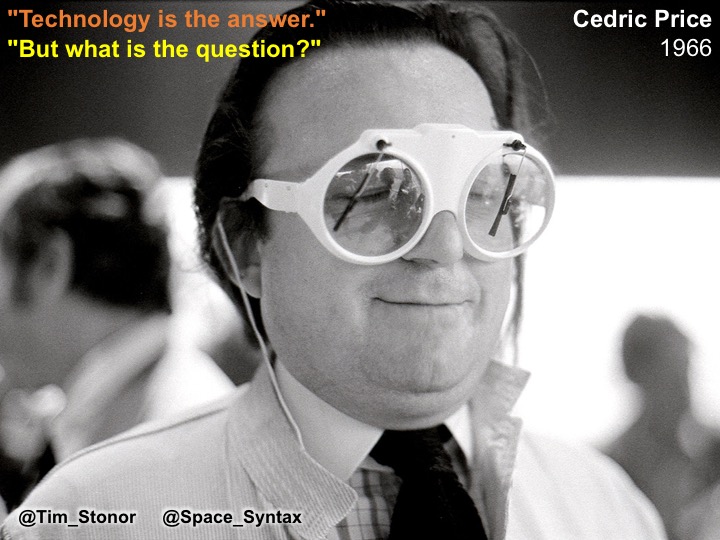
    I’d like to begin with a little scepticism about new technology. Of course “Technology is the answer“, said Cedric Price in 1966. He also said, “But what is the question?”

    这些问题就是我们试图去获得无人驾驶技术。
    What are the questions that we are trying to answer in the pursuit of autonomous vehicle technologies?

    我认为仅仅从驾驶员的角度去谈论智慧出行,并不充分。 我喜欢从整个城市的角度去考虑收益。如果我们过度关注车辆而不是城市,那么风险也是需要考虑的。
    I don’t think it’s enough to talk about intelligent mobility from the perspective of the driver alone. I’d like us to think about its benefits for cities as a whole. And the risks too, if we focus too much on the vehicle and not enough on what’s around it: the city. (more…)

  • Notes from first ULI UK Tech Forum

    1. We need to have a clear definition of technology. Physical as well as digital technology. Users and uses as well as creators and providers. Pre-construction, construction, post-construction. 

    2. Because we’ve always had technology:

    a. Writing (wooden stylus & wax tablet) movement

    b. Air conditioning – occupancy

    c. Underfloor heating – occupancy

    d. The shower – personal

    e. Bicycle – movement

    f. Revolving door – occupancy

    g. The elevator – occupancy

    h. The car – movement

    i. Solar panels – occupancy

    j. The Internet – movement & occupancy

    k. Autonomous vehicles – movement

    l. Drones – movement

    m. Photofungal trees – place
    We’ve always had technology. It’s always changed. Perhaps the pace is accelerating globally (but we shouldn’t forget the industrial revolution). 

    3. What hasn’t changed is the fundamental purpose of cities: social and economic trade. 

    4. In the future, autonomous vehicles will change the nature of movement. They will permit people to be far more productive while they drive. 
    5. Another key, and consequential, change will be in the nature of physical connections, transformed from highways to streets. Connectivity (as Chris Choa suggested) as an asset. 

    6. Therefore the street as an asset. The piazza as an asset. Not just the buildings that line them. The suburban business park will go the way of the dinosaurs. 

    7. The nature of online interaction is a further area of significant new change. 

  • Permeability & connectivity: a tale of two cities

    Permeability & connectivity: a tale of two cities

    Notes from a response to questions from the Strelka Institute. 

    How would you describe the situation with the permeability and connectivity of city spaces today?

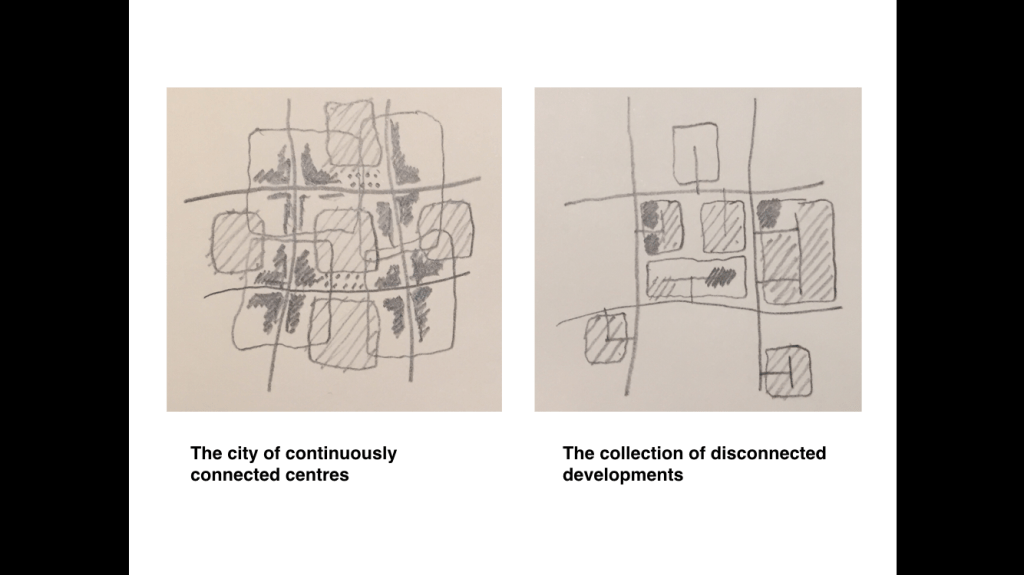
    There is no single state of permeability and connectivity in the contemporary city. Instead we find two main types of urban layout: first, the finely grained, continuously connected street network in the historic city and second, the system of largely impermeable housing estates separated by fast-moving roads in the 20th century city.

    In the historic city, space is well used. Most space use is movement and most movement is through movement. Movement supports commercial activities, which locate themselves on the principal streets where footfall is greatest. Movement brings people to places of opportunity – to buy, sell, exchange and interact. Effective exchange and interaction drives urban economies, social networks, cultures and innovations.

    In the 20th century city, the large, impermeable blocks of the housing estates do not encourage through movement. People move around the estates rather than through them. As a result, commercial activity is undermined, with its market divided between people moving locally inside the estate and those moving globally around it. Commercial activities are more likely to fail, especially inside estates where the marketplace is too weak. Instead, shops form at the entrances to the estates and on the surrounding roads. Since these roads have often been designed to favour the car, the shops are likely to be car-based, with large parking lots that further separate local people from them.

    A further, social consequence of this is that local people do not see people from outside the estate on the regular basis that people in traditional streets take for granted. The effect of this is to create social isolation and fear of strangers in estates.
    The irony is that the inward-looking urban block was created purposefully to foster a stronger community spirit. Traditional streets were considered to be noisy, dirty and dangerous. 20th century town planning’s idea was that, if life could be created away from streets then people would be cleaner, happier and safer.

    It is the greatest tragedy of 20th century international planning that its well-intended model of urban living has failed. Indeed it has done the opposite: creating highly negative social and economic outcomes for all people with perhaps the exception of the super rich for whom social and economic relations are formed in different spatial contexts.

    Connectivity is closely connected with the structure of property ownership, how will it change in the next 5 years? Will it shift towards privatisation of public spaces? And what will be the case 20 years from now?

    Undoubtedly the next decade will see more private spaces set within gated communities. Such forms of urbanism are still favoured by developers and aspirational residents for whom the idea of living in a cleaner and supposedly safer environment is expected to make them happier. The history of 20th century failure may not be considered to be relevant, perhaps because of a belief that it happened somewhere else, or in a different socio-political era, or because new digital communications technologies can effectively span the spatial divide between such places and their urban settings.

    At the same time, the resurgence of traditional street design will see more places created that look more like the continuously connected form of the historic city. This trend can be seen in cities as diverse as Beijing, London and Dubai, where permeable street networks have been created by commercial property developers as well as public municipalities precisely because they are seen to deliver places that are popular with people. The social and economic benefits of a street-based approach have been witnessed with a combination of satisfaction and surprise.

    Perhaps the most significant impact on the form of urbanism in the future city will come from the digital technologies that will record and analyse the outcomes of both approaches – the gated community and the open street network – and demonstrate with evidence how each performs.

    My clear view is that the continuously connected street network will outperform the gated community in terms of Urban GVA, making a greater contribution to the overall social and economic value of the city. The emerging Science of Cities, in which my company Space Syntax has been a pioneer, is one of the key areas of future urban practice that will cut through the inaccurate claims that have been made about the benefits of estates – claims that have been promoted by architects and urban planners throughout the 20th century, based on the passion of their beliefs rather than on the evidence of facts. Urban analytics will transform urban practice over the next 20 years, shaping a new, evidence-rich approach to architecture and town planning and, crucially, returning a highly effective, street-based form of urbanism to the position it had held for centuries before professionalised town planning imagined it could do better.

    During our work for the classification of Moscow streets we highlighted three different zones of the city: centre (inside the Garden Ring), middle zone (between the Garden and the Third Transport Rings), and periphery (outside the Third Ring). The pattern is completely different in these zones. Could you comment on the implication of global trends of connectivity in the city on different zones in Moscow?

    No city is the same from its centre to its edge. Or, more precisely, from its centres to the edges of those centres because cities are formed of multiple centres that create a system of connected urban quarters. The quality of the connections between centres is a fundamental determinant of overall urban performance, having a strong bearing on whether people are more likely to walk and cycle between neighbourhoods and whether those links will be effective places for social and economic activity. When centres are continuously connected to each other through a set of connections with a regular grain then it is likely that many, if not all of these will be suitable for walking and cycling as well as driving along.

    Cities like London and Paris are composed of multiple centres that have distinct centres of differing characters yet are continuously connected to each other. Indeed it is the magic of such cities that it is possible to move from one centre to the other in such a subtle way that you are uncertain exactly when you have left one centre and entered another. The connective “tissue” between centres is typically comprised of residential streets, which therefore link to – and carry movement belonging to – multiple centres. People may identify more with one centre than others but they are provided with a choice of more than one. And,min doing so, they interface with people from more than one centre. The benefits of this arrangement are simultaneously social and economic.

    Such choice is denied by the 20th century city of separated estates. People living in one estate have limited, if any direct access to the centres of other estates. Increasingly, the roads that connect between estates are hostile to pedestrians and cyclists. Social and economic life is suppressed.

    All cities are systems of linked centres that each work in individualistic, local ways but that also form an overall city system. Within this city system, the centres have a hierarchy with more central centres typically supporting greater economic activity than centres at the edge. This is not only because more central centres are larger but also because these centres are surrounded by a larger number of other centres than are peripheral centres.

    In the case of Moscow, Space Syntax analysis would be used to examine the hierarchy of centres, the quality of the connections between them and the degree to which spatial connectivity is directly related to social and economic performance. Data on economic performance – such as land value, property transactions, commercial performance, retail sales – would be correlated with measures of spatial connectivity – such as spatial centrality (choice) and betweenness (integration) at a range of spatial scales. These Big Data sets would be interrogated in order to form a diagnosis of the current spatial conditions. On the basis of this diagnosis, a set of spatial planning principles would be created that would lead to the production of a spatial vision for the city. We anticipate that this form of data-rich, evidence-informed planning will become normal in the next 20 years.

    While improving and redeveloping city streetscape how should trends in the connectivity and permeability of city space be taken into account? 

    Space Syntax analysis shows how patterns of spatial connectivity have profound influences on the social and economic performance of all cities. The hierarchy of spatial connections influences:
    movement patterns of cars, cycles and pedestrians

    – public transit demand

    – land use performance

    – land value

    – transport emissions.

    Future urban plans should therefore be created with a special emphasis on the design of the spatial layout of the city. Opportunities should be identified to strengthen the network of streets and open spaces, pursuing an overall objective to create a city of continuously connected centres. Constraints should equally be identified so that reasonable plans can be made.

    “Spatial geometry” standards should be set for the number and frequency of connections as well as for the geometrical means by which centres can be most effectively connected ie first, a small set of longer, more direct connections (the “foreground grid” of boulevards and high streets) that will carry larger volumes of people and therefore be suitable for commercial uses and second, a large set of smaller, less direct connections (the “background grid” of local streets) that will carry smaller volumes of principally residential movement.

    Once these spatial geometry standards have been established then further standards of urban design quality should be set – but not before. High quality urban design in the form of green landscape, seating, signage me surface treatment will not create high quality urban performance if the spatial layout geometry is weak.

    The living city is built on human interaction. Without this, the city is dead. Human interaction relies on effective movement corridors and effective places of human transaction. Effective street connectivity is a critical determinant of the living city.

  • Cargo bikes are an urban game-changer

    Cargo bikes are an urban game-changer

    Cargo bikes are an urban game-changer. The combination of online retail and out-of-town mega-distribution centres means that town centre retail must transform. Shops don’t need so much storage space because goods can be sent straight from depot to home. That storage space can be repurposed as retail or office space, bringing new life back to town centres.
    Trucks can interchange with cargo-bikes at the edge of town.
    Town centres don’t need large swept curves at traffic junctions, making it easier for pedestrians and cyclists to move.

     
    Towns can be designed for slow but effective movement, with all the opportunities for socially and economically beneficial interaction that slow movement supports.

  • Integrated Urbanism – Massachusetts & the United Kingdom Partnership Forum

    Introduction
    Good afternoon Governor Patrick, visiting delegates and colleagues from the UK. As a recent resident of Massachusetts myself, it is a special pleasure to speak alongside the Governor on the subject of data and cities: and to share some remarks on the common interest in this room: the science of cities.

    Massachusetts and the United Kingdom Partnership Forum

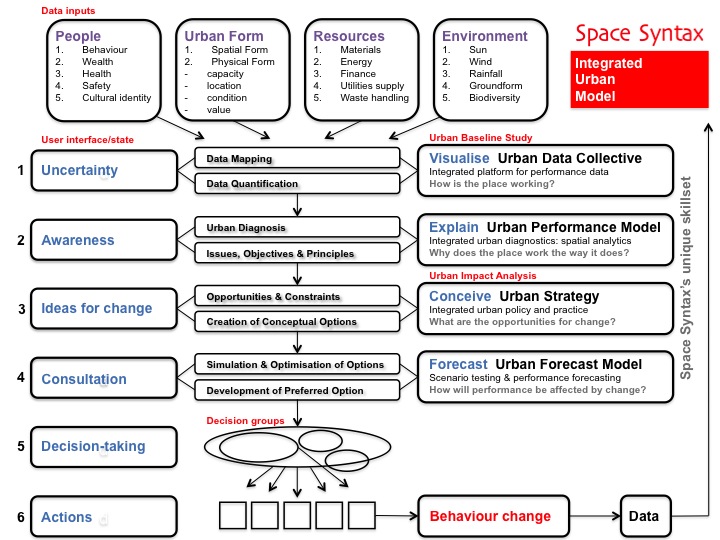
    A few words about me: I am an architect and an urban planner in private practice. My company, Space Syntax is a consulting company that specialises in predictive analytics – using data science to forecast the impact of urban planning decisions – the “what goes where and how does it all connect together” – on urban impacts such as mobility, interaction, wealth, health and personal safety. (more…)

  • Smart City Planning & Design Principles

    Smart Cities are smart in two ways. First, they harness technologies to improve the way that urban places are led and managed. Second, they create better outcomes for the people that use them. This two-pronged approach applies to all aspects of Smart Cities.

    When it comes to the planning and design of Smart Cities, technology can improve:

    1. the performance of the places that are produced by planning and design (the outcomes)

    2. the processes involved in creating plans and designs (the inputs).

    A Smart City approach should direct the capabilities of urban planners and designers to:

    1. facilitate effective human transaction in new and existing places

    2. provide access to places of transaction, both physical and digital: on-land and on-line

    3. support the mobility required to access these places of transaction by providing networks of connectivity for all modes of transport, both physical (walking cycling rolling driving) and digital

    4. take an outcomes-oriented (ie transactions & emissions) approach first and foremost, aware of the inputs required (ie materials, energy & mobility) to achieve these desired objectives

    5. provide effective analytic and forecasting tools aimed at social economic and environmental impacts.

  • Urban data: some risks – unnecessary complexity and shallow artistry

    As a user of urban data I know the benefits that can be gained from visualising information on city form and city performance. But… and this is the but… these benefits only flow if the visualisation is followed up with analysis of that data – analysis that seeks out patterns, correlations and associations in order to make sense of the data. Then, on the basis of this analysis, it is possible to inform urban planning and design decisions – indeed I find that good analysis inspires design thinking, pointing the user in certain directions.

    The approach we have developed at Space Syntax is to be simultaneously a) “data-light”, b) analysis intensive and c) outcomes oriented. I appreciate that we are using our Integrated Urban Models in specific contexts – usually in the crafting of public space designs, urban masterplans and, increasingly, regional strategies – but I believe these principles apply to whatever kind of modelling is being undertaken.

    One of the weaknesses of urban transport modelling, for example, has been its “data intensity” – its use of multiple variables, coupled with a degree of data “manipulation” – at least this is what I’m told. The result is expensive, time-consuming modelling.

    Another trend I detect is “data-as-art” – making visualisations, usually animated, of data flows. These create seductive imagery but I do question their purpose – because the analysis is often missing.

    And therefore, for both of these reasons (data intensity and data-as-art) I worry that cities pursuing urban data initiatives may find that these become extremely complicated, expensive and unwieldy – if aesthetically charming – and I wonder what such data strategies would do to further the cause of cities. They will, no doubt though, reward their creators.

  • Teaching urban design – a sketch for a new approach

    Sketch…
    Space Syntax is keen to play a role in initiatives that embed the Space Syntax approach in everyday urban practice. The watchword is “dissemination”. Our aim is to create a professional landscape that uses Space Syntax as an everyday approach to the planning, designing and general governance of places.

    Here are some of my thoughts about the potential structure of an urban design course, which are largely about using this as an opportunity to break down many of the barriers that conventionally get in the way of good urban design:

    1. combine art and science: especially the importance of a science-informed approach to urban design, which is often missing

    2. combine creative and analytic/disciplines: bring together designers and analysts in an intellectual cocktail

    3. combine design, planning, infrastructure engineering, finance, governance, legals

    4. put the human being at the heart of it all (more…)

  • Smart cities – why, what, how, how?

    Some advice for people promoting a Smart City approach. Prepare your answers to the following questions:

    1.      Why do we need “smart” and do we even need cities any more?

    First, provide a clear and simple explanation of why cities are important ie what they do that is special: they arrange physical buildings within spatial networks to create intensifications of opportunities for people to interact and transact, socially and economically. Acknowledge the interdependencies between cities, towns and villages but emphasise the primacy of cities.

    Second, explain how this process is facilitated by the propinquity and connectivity that cities offer – traditionally physical connectivity and, increasingly, digital.

    Third, describe the threats to the efficiency of cities: gradual, sprawling growth; over-reliance on private cars.

    Fourth, describe the consequences of inefficiency: economic inefficiency, social isolation, unhealthy living, short-term investment, environmental degradation.

    Fifth, speculate on the further risks associated with a “same as usual” approach. (more…)

  • Smart Cities World Expo – speaking notes

    Spatial layout influences
    Human behaviour:

    1. Movement

    2. Awareness

    3. Interaction

    4. Transaction.

    Spatial layout benefits
    1. Economy
    – productivity
    – innovation
    – building & campus performance

    2. Health
    – active travel
    – access to healthcare
    – building & campus performance

    3. Social cohesion
    – the spatial network creates the social network

    4. Safety
    – property theft
    – personal attack

    5. Environmental performance

    6. Educational achievement
    – access to education
    – building & campus performance

    7. Cultural identity

    Spatial layout
    Is defined by:

    1. Location

    2. Linkage

    3. Layout

    4. Land use

    5. Landscape

    These are each measurable commodities/parameters. They are the building blocks of human behaviour and, ultimately, cultural identity.

    Our proposal
    To put spatial analysis at the heart of city systems integration. As the common ground. As the core code of the urban operating system.

    A smart city
    Is one which:

    1. recognises the fundamental role of Spatial Layout Design

    2. embraces a technology-driven approach to Spatial Layout Analysis

    3. embeds Spatial Layout Analysis in the Planning and Management of the city

    4. evaluates investment decisions using Spatial Layout Analysis.

  • Going to “work” is actually going to “interact”

    Why is people movement important in buildings?
    In a knowledge economy, the key role of buildings is the production and dissemination of new knowledge to drive innovation.

    Awareness leads to interaction leads to transaction.

    Spatial layout works with management style to create a “spatial culture”.

    Corner offices v corridors
    People should sit based on need not based on status. Needs change during the day and during the week so people should move. Offices should provide different kinds of work environment. Open plan and busy when you need more interaction. Corner office/cellular when you need less. Management should permit workers to choose where they want to sit – this is part of trusting workers to perform and businesses will perform better as a result of having great space and great people.

    Effects of technology
    Technology will not replace the office because what matters is making “first contact” and this is harder online – much easier face to face.

    Going to work is about going to interact.