Download my presentation
“Designing mobility for democracy: the role of cities”
#demobility
Thursday, 14th April 2011 from 1pm to 5pm
NYU, Kimmel Center, Eisner & Lubin Auditorium
60 Washington Square South, New York
 Summary
Given the title of this event: “Designing mobility”, I want to turn to the subject of design and the role of architects. The key message of this presentation is that cities need architects, not only to design the buildings that fit into them but also for the networks of space that connect them together. Why? Because architects have a special skill: to resolve complex problems into elegant solutions. And the spatial network of the city is a complex design problem.
However, before they can really help, architects need to “get” cities. The problem for cities is that architects are not sufficiently familiar with the way cities work and therefore the design principles they need to work with to make cities more effective as places of human transaction.
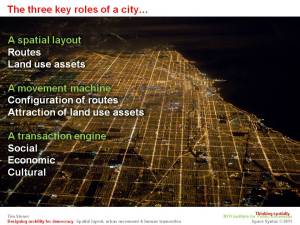 So what is the role of a city?
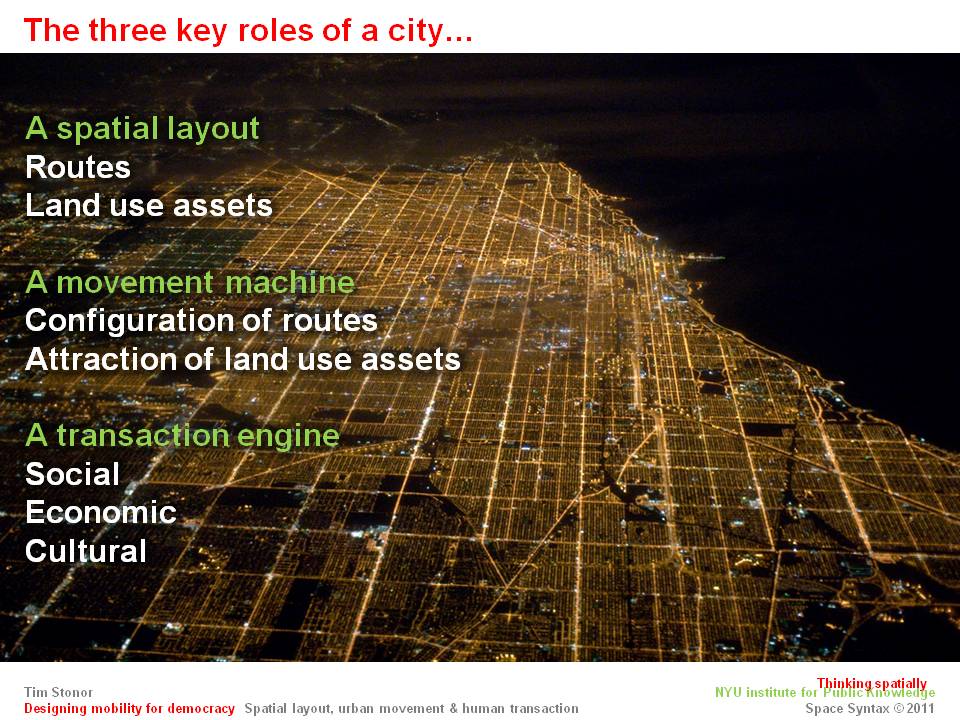
A city should act in three key ways:
1. as a spatial layout – of routes (streets and paths) and of land use assets
2. as a movement machine, organised by the configuration of the route network and the attraction of the land uses assets
3. as a transaction engine, generating and accommodating social, economic and cultural exchange.
A city is therefore a place of production and reproduction.
When cities don’t work a whole series of assumptions are typically loosed into the policy framework. Perhaps the greatest and most damaging of these is that that they lack transport infrastructure. Witness Sydney’s aerial people mover or the radical and crude plumbing of highway arteries into the capillary network of historic cities, especially here in the US.
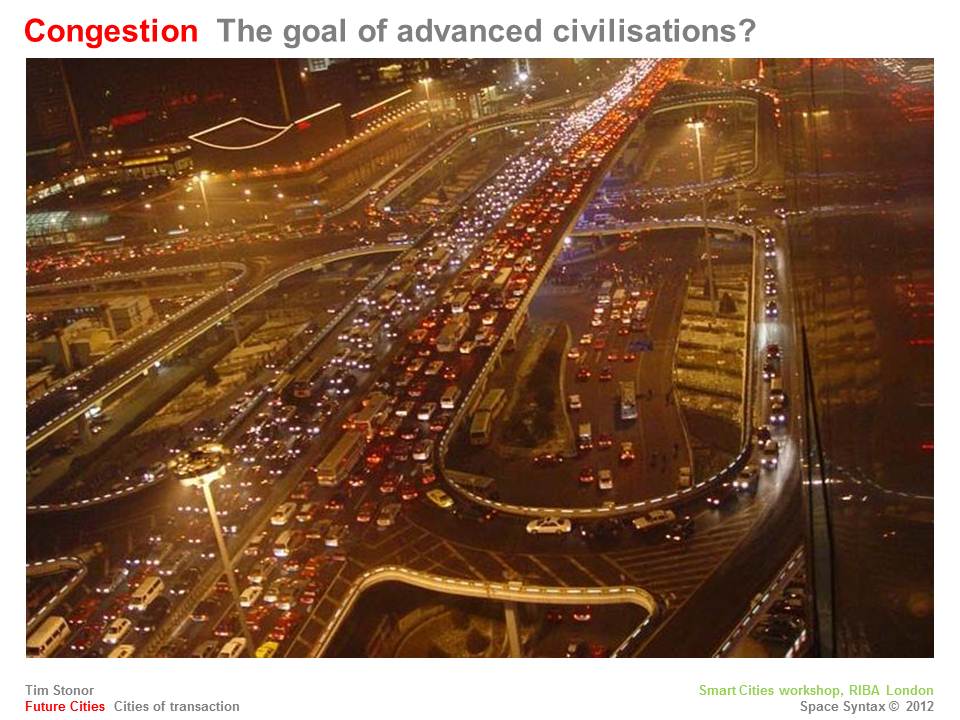
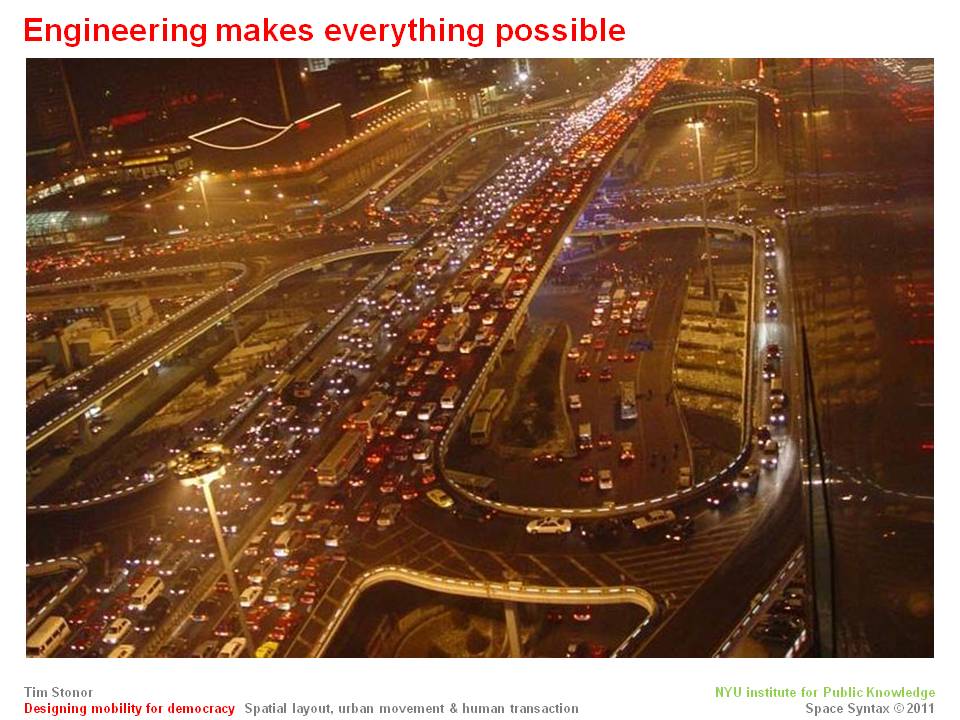
 Often the last thing that troubled places need is more transport infrastructure, especially when it is about moving people large distances. Engineering shows us that we can move human beings in pretty much any way we please, whether it’s to the moon or into the hearts of historic places, like here in Beijing.
 As Sartre remarked, “Everything has been figured out, except how to live.”
Heroically engineered mobility in the form of great road intersections such as that in Beijing is – with notable exceptions – the default response of the global transportation community and therefore of the political system. Witness the federal response to the current economic recession and the bent towards building and fixing highways.
In this talk I want to argue that, if cities are to fulfill those three roles I set out they need to provide a new kind of mobility. And this is not, as Enrique Peñalosa said, only a problem of government. it is also a problem of design. And a problem of design theory at that.
(more…)







 Tim Stonor
