Author: Prof Tim Stonor

  • Silver linings: how design can exploit the virus

    Silver linings: how design can exploit the virus

    A “to do” list for urban planners, architects & interior designers, in response to the coronavirus.

    In towns & cities:

    • reduce traffic speeds to 20mph/30kph to discourage speeding on empty streets during lockdown & to keep the air clean, the sound low & the accidents down after the “return”.

    On wide streets:

    • broaden footways to improve physical distancing in the short term & encourage pedestrian flow in the long
    • then narrow roadways further with cycle lanes to support physical activity during lockdown & active commuting on the return.

    In public spaces:

    • provide more shade, more seats, more WiFi
    • place more seats on broadened footways so calls can be answered & people can convert from moving to sitting down…
    • …and so “I’ll call you back” becomes “Just give me a second to sit down.”

    (more…)

  • The Auranga Story: create streets = create jobs

    The Auranga Story: create streets = create jobs

    Research by Mike Cullen of Urbacity has shown that:

    Out-of-town malls generate 0.5 non-retail jobs per retail job created.

    Mall-dominated towns generate 1.2.

    Street-based retail generates 2.6

    Answer = build street-based retail

    As if we didn’t know enough already about the social, economic and environmental benefits of connected, mixed-use urbanism, Cullen’s research provides one more good reason to plan towns and cities around beautiful, shaded, slow, thriving streets.

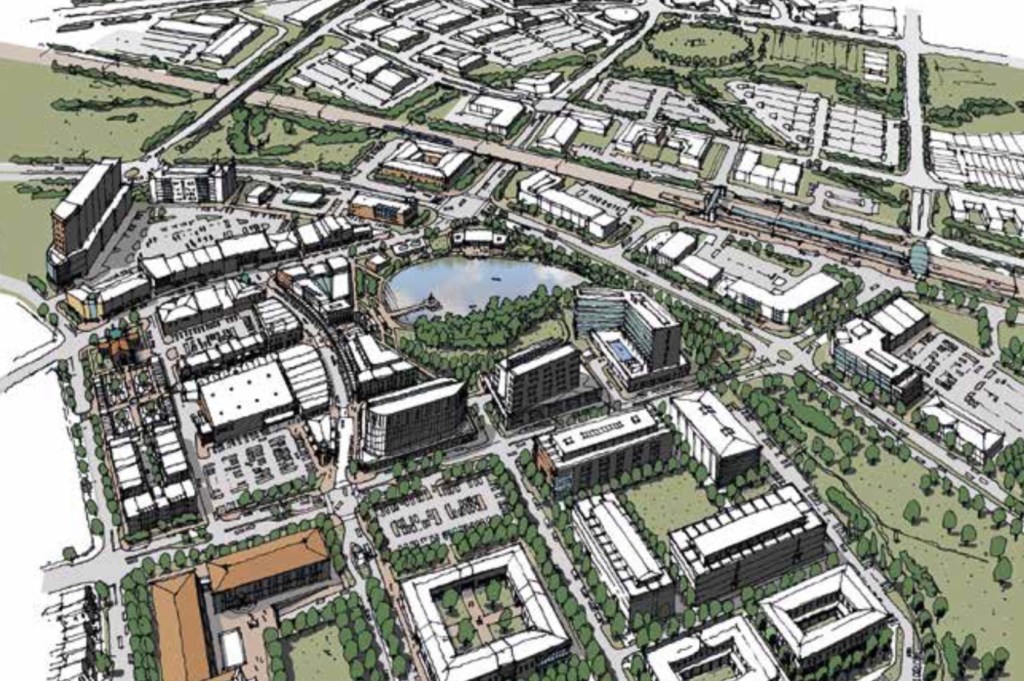
    Space Syntax is working with Urbacity in support of Design Urban in its masterplan for Auranga, a new urban settlement to the south of Auckland. Developed by Made, Auranga breaks the mould of car-based sprawl by co-locating residential and employment uses around a tight-knit, walkable town centre and rail station.

    Read more about the Auranga development.

    Image (c) Design Urban

  • Reflecting ourselves in the city

    Reflecting ourselves in the city

    What can the form of cities tell us about the structure of the brain? And what can the structure of the brain tell us about the form of cities? These are questions that I’d like to address in this talk. In summary, I believe we can learn a good deal about the interaction between the mind and the urban places in which the global majority of people now lives.

    After all, the city is the largest intentional product of the human species. We’ve had them for millennia and, in them, we’ve manifested our societies, created our industries and developed our cultures. They are the product of our imaginations, the places where we take decisions – and they are the inspiration for new thought. The link, I want to suggest though, is not just contextual. It’s much deeper than that. (more…)

  • Beyond placemaking: 7 dimensions of “Place Performance”

    Beyond placemaking: 7 dimensions of “Place Performance”

    Notes from a talk at the Bartlett Real Estate Institute, University College London, 24th April 2019.


    Placemaking is the art and science of planning and designing spaces for human activity, however that is done: ‬

    – by a single hand (usually not a good approach) or by multiple hands (usually a good approach)

    – by academics, professionals and non-professionals. ‬‬

    ‪But beyond placemaking is “place working”, or “place functioning”, or “place performance”: when the planning, design and construction work is finished and the place becomes operational. When it fills with the mysterious liquid called human behaviour. ‬‬‬

    And key to which is human transaction: the everyday social and economic exchanges that take place between people – these transactions not only sustain lives but bring about inventions that shape cultures.

    Place Performance has many dimensions. Here are seven that I have seen work in practice: (more…)

  • Transport & housing: tools, standards, principles

    Transport & housing: tools, standards, principles

    Notes for presentation at Transport & Housing conference:

    https://www.transportxtra.com/tx-events/?id=2400

    To understand where we are & where we need to go, we first need to understand where we come from. And where we come from is a relationship with the car that has fragmented cities & damaged lives.

    Transport & housing

    Big problems:

    – obesity

    – mental health

    – social unrest.

    The irony. The paradox.

    We have never been as connected.

    We have never been as spatially segregated. (more…)

  • We, robots

    We, robots

    The subject of robotics is multi-dimensional, disruptive & urgent.

    In my summing up at the Public Debate of the Robotics Atelier at the Norman Foster Foundation, I identified three types of robot:

    Type 1_The robot of repetitive tasks

    – this kind of robot will end many kinds of manual jobs that people currently have in factories.

    Type 2_The robot of super-human activity

    – doing jobs that no human can do: because they are, for example, in outer space, under water, in hazardous places; or because they require such precision that they are beyond human ability.

    Type 3_The robot of provocative imagination

    – this robot engages most intimately with human existence, suggesting ideas, suggesting shapes, suggesting behaviours that were previously unknown. Another word for this could be the “design robot”.

    Or even the “life support robot” – a machine, an entity that lives with us, whether it is attached to us, inside us or walking beside us. It cares for us.

    Whereas the first kind of robot – the robot of repetitive tasks – is the most straightforward, it isn’t at all the least important because it may have the most profound impacts on current industrial practices and, as a consequence, on social and economic structures.

    But the life support robot is the most intriguing/challenging. It conjures up images of an animal on the shoulder, the daemon in The Golden Compass – enhancing/extending our quality of life and provoking thoughts/actions we might otherwise not have made.

    My takeaway from the Robotics Atelier at the Norman Foster Foundation is that we need to be more nuanced in our discourse. Robotics means different things to different people and we must acknowledge these differences in order to have meaningful debate.

  • Cities from scratch – Astana Economic Forum

    Cities from scratch – Astana Economic Forum

    Good afternoon. I’m delighted to be a member of this panel today.

    Let me start by describing my organisation’s approach to the creation of cities from scratch.

    Space Syntax is an international urban planning and design studio and has been involved in plans for new cities and new city extensions throughout the world, including here in Kazakhstan.

    Our approach is built on three key ingredients: (more…)

  • The return of the impossible – Astana Economic Forum

    The return of the impossible – Astana Economic Forum

    Good afternoon. It’s an honour and a pleasure to be here in Astana today with this distinguished panel.

    In speaking about the cities of the future I’d like to speak about three technologies that I think are not only exciting but are also capable of genuinely addressing the “Global Challenges” theme of this Forum.

    The first is a mobility technology. The second is a physical transaction technology. The third is a digital technology.

    As an architect involved in the design of everything from new buildings and public spaces to entirely new cities, these are three technologies that I’m particularly invested in. (more…)

  • Intense relationships: measuring urban intensity

    Enriching design practice by the mapping of human behaviour patterns could transform urban space

    An article published in the Architectural Review on 30th April 2018.

    There’s much debate about how to measure density – dwellings per hectare, bedrooms per hectare or people per hectare; including or excluding major highways, parks and open spaces; the permanent population only or the transient one too? 

    While this gives urban planners something to disagree about, it risks missing the point: great urban places are not created by density; they’re created by intensity. The difference matters. When people describe the buzz of a market they don’t say, ‘Wow – it was so dense’. They’re much more likely to say how intense it was. Density is a word used by planners. Intensity is a word that real people use, and perhaps because it describes the outcomes that people experience rather than the inputs that have gone into creating them. It’s the outcomes that are ultimately more important.

    But planning professionals like density. Even though density doesn’t capture the essence of what it feels like to be somewhere, the term appeals to professional instincts. It describes the raw ingredients that planners have to handle and, once you choose which version of the formula to use, density is easy to measure. It involves a simple calculation of straightforward urban quantities such as the number of people, of houses or of bedrooms, all divided by the geographic area over which those ingredients occur. Easy.

    By contrast, intensity seems more difficult to pin down, not least because it appears to have a subjectively emotional dimension; it speaks of feelings, responses, stimuli; raising problems about how it can be measured. But intensity is also a response to context, to place and above all to people – and here we find clues to its measurement.

    (more…)
  • Smart, green & sustainable future cities

    Contribution at workshop on UK-China Future Cities Collaboration Programme, Beijing, China
    Organised by the British Embassy, Beijing

    20th March 2018

    I would like to address the first objective of this workshop, namely a framework for UK-China collaboration on smart, green and sustainable future cities.

    Let me begin by saying that our task is helped by the fact that many valuable frameworks already exist:

    First, we have many long-established academic networks. Second, we have project-based networks that bring professionals together around planning and construction projects. Third we have professional networks formed around the many conferences that have brought together UK and China experts for many years, and continue to do so. (more…)

  • Kevin Lynch Memorial Lecture

    Kevin Lynch Memorial Lecture

    Slide 1      

    Good evening. It’s a great honour to have been asked to give this evening’s Kevin Lynch Memorial Lecture, and a special honour to be doing so on behalf of Bill Hillier, who is unable to join us. Bill sends his best wishes to the Urban Design Group.

    Slide 2      

    First, I can’t do justice in the time available to the breadth and depth of Bill’s genius. And I use the word genius carefully. I believe, as do many others, that he is a genius.

    I may only this evening touch on concepts that each deserve a more lengthy explanation and discussion. And, likewise, on the hundreds of urban planning and building design projects that Bill and Space Syntax have helped create over the past four decades.

    But what I hope I will do is paint a picture of Bill’s achievement – albeit a personal one.

    I want to talk especially about the future directions that his work is taking. The future is important because Bill is not obviously sentimental. He is far more likely to want to talk about something he is currently working on, or something he doesn’t yet understand, than to dwell on the past. He hasn’t ever, to my knowledge, sought prizes. He’s enjoyed them when they’ve appeared, but he hasn’t gone after them.

    And, I suspect like anyone receiving a Lifetime Achievement Award, he has wondered why it was being given so soon, before his lifetime is fully achieved. When I spoke with him last weekend he explained that what he’d really like to be talking about is what he’s currently working on. But, as is often the case with emerging theory, he’s not sure he’s right about it yet. In other words there’s always more to be done.

    But Bill was keen to shape this evening’s presentation. So let’s begin with some words from him: (more…)

  • Intelligent mobility: risks & rewards

    第一页   技术就是答案
    Slide 1       Technology is the answer

    Slide01

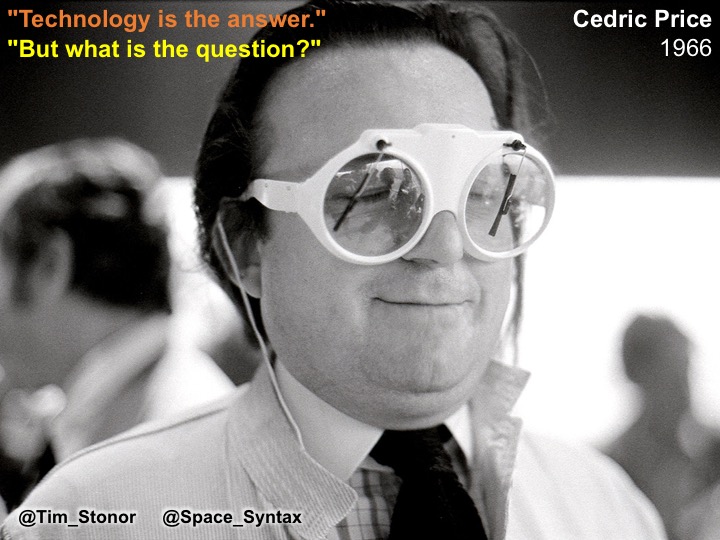
    1966年,塞德里克·普莱斯说,我喜欢一开始就对新技术进行一点质疑。当然,“技术就是答案”。他也强调:“不过问题是什么?”。
    I’d like to begin with a little scepticism about new technology. Of course “Technology is the answer“, said Cedric Price in 1966. He also said, “But what is the question?”

    这些问题就是我们试图去获得无人驾驶技术。
    What are the questions that we are trying to answer in the pursuit of autonomous vehicle technologies?

    我认为仅仅从驾驶员的角度去谈论智慧出行,并不充分。 我喜欢从整个城市的角度去考虑收益。如果我们过度关注车辆而不是城市,那么风险也是需要考虑的。
    I don’t think it’s enough to talk about intelligent mobility from the perspective of the driver alone. I’d like us to think about its benefits for cities as a whole. And the risks too, if we focus too much on the vehicle and not enough on what’s around it: the city. (more…)

  • Notes from first ULI UK Tech Forum

    1. We need to have a clear definition of technology. Physical as well as digital technology. Users and uses as well as creators and providers. Pre-construction, construction, post-construction. 

    2. Because we’ve always had technology:

    a. Writing (wooden stylus & wax tablet) movement

    b. Air conditioning – occupancy

    c. Underfloor heating – occupancy

    d. The shower – personal

    e. Bicycle – movement

    f. Revolving door – occupancy

    g. The elevator – occupancy

    h. The car – movement

    i. Solar panels – occupancy

    j. The Internet – movement & occupancy

    k. Autonomous vehicles – movement

    l. Drones – movement

    m. Photofungal trees – place
    We’ve always had technology. It’s always changed. Perhaps the pace is accelerating globally (but we shouldn’t forget the industrial revolution). 

    3. What hasn’t changed is the fundamental purpose of cities: social and economic trade. 

    4. In the future, autonomous vehicles will change the nature of movement. They will permit people to be far more productive while they drive. 
    5. Another key, and consequential, change will be in the nature of physical connections, transformed from highways to streets. Connectivity (as Chris Choa suggested) as an asset. 

    6. Therefore the street as an asset. The piazza as an asset. Not just the buildings that line them. The suburban business park will go the way of the dinosaurs. 

    7. The nature of online interaction is a further area of significant new change. 

  • A velvet revolution for the Blue House roundabout – Newcastle City Council to think again

    A velvet revolution for the Blue House roundabout – Newcastle City Council to think again

    Massive popular opposition to plans for a disfiguring roundabout leads to the City Council announcing this evening that it will go back to the drawing board. This is a positive development. A working group will now be established to look at alternative plans.

    Jesmond Local press article

    YouTube clip of Cllr Bell’s statement


  • Growth. Are you old school or new school?

    Growth. Are you old school or new school?

    There are two different schools of thought about how to accommodate urban growth. The first says that cities should build more road capacity to handle private vehicle traffic. The second says that less space should be provided for private vehicles and more investment should be made in public transport and “active travel” i.e. walking and cycling. The first approach is generally more costly than the second.

    The old school of thought has prevailed for around a century. The new school is relatively more recent, responding to the frequent failure of the former, where more road space has created more road traffic, which has created more congestion.

    Cities all over the world are now removing expensive car-oriented infrastructure and introducing space for walking, cycling and public transport. Ring roads and bypasses are being unpicked and cities are thriving as a result. Look at Copenhagen, Paris, London, Birmingham, Boston, Poynton or any number of places that have employed the new school approach.

    On Poynton…”This was the busiest junction in Cheshire, with 25,000 vehicle movements per day and the fourth worst performing retail centre in Cheshire East. It now accommodates a similar volume of traffic, but since average speeds have fallen to below 20mph, drive times through the centre are significantly reduced. Anecdotally people feel safer crossing the carriageway and cars will stop for them, make eye-contact and usually elicit a wave of thanks from the pedestrian.” The Academy of Urbanism

    Road speeds are being reduced, from 40 or 50mph to 20 or 30mph. Not only on residential streets but at the intersections of major roads too. Why? Because when you slow traffic down it flows more freely. Why? Because at lower speeds, more vehicles can fit into the same space. This isn’t rocket science. It’s simply a different school of thought.

    When a city pursues “old school thinking” of road capacity increases and banned turns then not only is this going to generate more road traffic it is also going to make it ever harder for people to do anything other than drive. In these circumstances, walking and cycling become harder. “Walking and cycling facilities” might be put in but these are often token gestures because they are fitted in around the needs of traffic. Desire lines – the paths that people prefer to take – are severed and people are encouraged to walk or cycle on unnaturally twisted journeys. What happens as a result? They don’t use these “facilities” and they take risky alternatives, dashing across road lanes or cycling among fast-moving traffic.

    Old school thinking is voracious – once started it is hard to stop. Nevertheless, evidence, analysis and creative thinking can help. If there is a willingness to listen.

    I speak from the perspective of practice – of having observed the behaviour of people on foot, on bikes and in vehicles in a scientific manner for over 25 years. Of having presented evidence of fact to local authorities and of overturning poorly thought-through, old school proposals. Of having designed alternatives that don’t put anyone in particular first but instead balance the needs of all. This isn’t about being pro-bike and anti-car. It’s about being pro-place and pro-cities.

    And let’s be clear, new school thinking is fundamentally about being pro-growth. But pro a form of growth that is smart and sustainable: growth that doesn’t sacrifice the profound benefits of local places for the expedience of cross-city commuting, but growth that promotes alternative ways of traveling and enhances the attractiveness of cities as places to live in and invest in.

  • Backwards plans for Newcastle’s Blue House Roundabout

    Backwards plans for Newcastle’s Blue House Roundabout

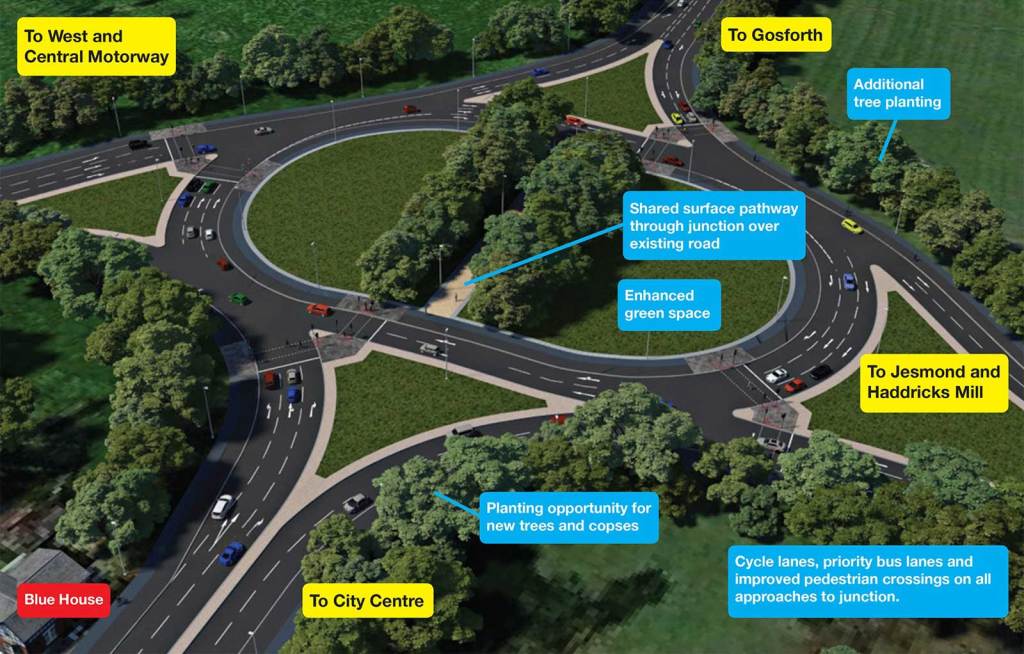
    Newcastle City Council’s plans for the Blue House Roundabout are appalling and unnecessary.

    I know the junction and have walked and driven across it more times than I can remember. The last thing it needs is what is proposed and I intend to do what I can to help stop the scheme.

    There is already a significant body of local opposition to the proposals, for example:

    Self-Loathing on a City Scale

    “At present, it’s a busy, but functioning, junction occupying a particularly striking location – the intersection of two broad avenues of lime trees, some 130 years old, which cross the historic open spaces known as Duke’s Moor, Little Moor and the Town Moor. These spaces belong to the hereditary Freemen of Newcastle upon Tyne, who have been exercising their right to graze cattle here for a thousand years or so. They form a green belt around the city centre and make its inner suburbs surprisingly pastoral.”

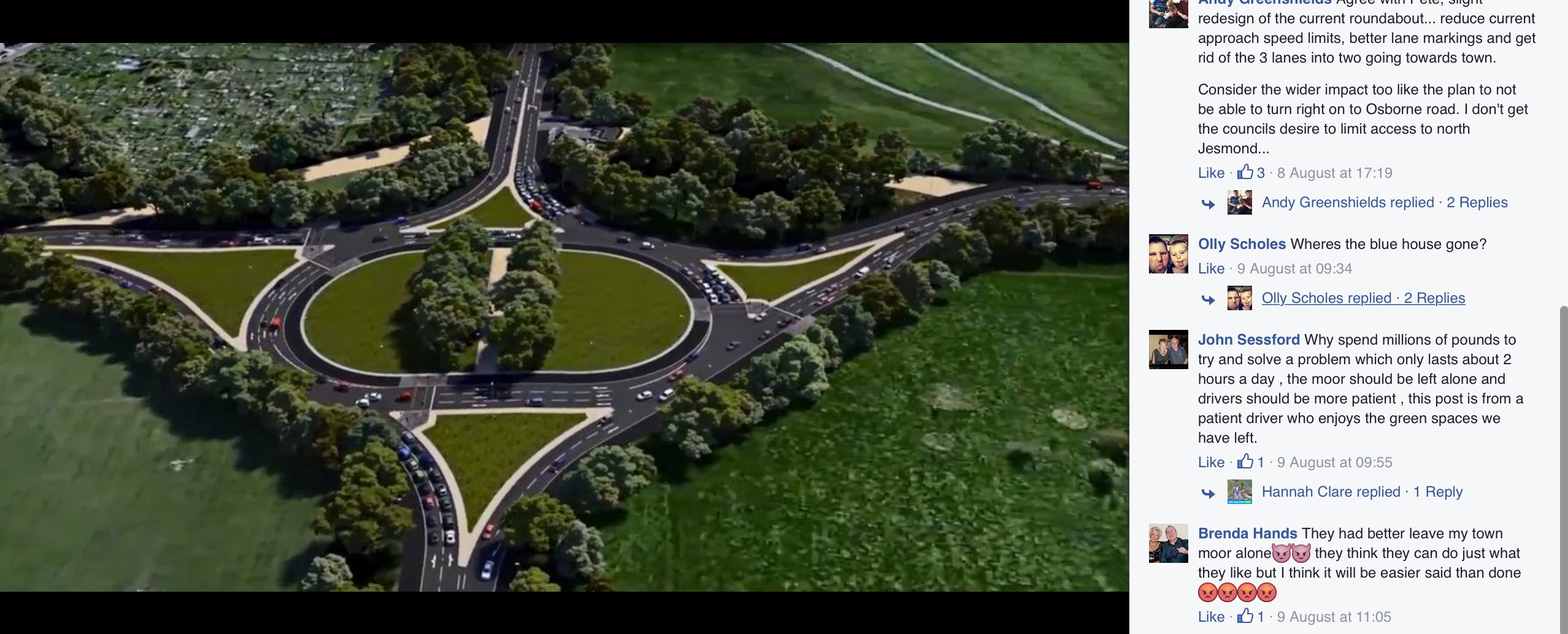
    Facebook and Twitter are both active:

    image

    Yet the more weight that can be brought against these unnecessary, expensive and car-centric proposals, the better.

    Don’t let this nonsense be foisted any further. Take Newcastle forwards not backwards.

  • We are what we street. The elements of successful #urban placemaking

    PART ONE – THE ELEMENTS OF SUCCESSFUL URBAN PLACEMAKING
    Location
    How the site fits into its context, including complementary and competitive attractions; in other words, what else is nearby to which the design should respond? The success of any development, no matter how large, is a function of the wider setting.

    Linkage
    The specific points at which connections can be made into this context, including public transport connections; in other words the “gateways” into the design.

    Layout
    The spatial layout design of the project itself in terms of its streets and spaces, whether public/private or open/covered, and the importance of:

    – first, encouraging through movement connections between gateways

    – second, providing a simple, intelligible internal circulation network through a grid of streets and other connections.

    This is the most important of the five elements since the spatial layout, once created, tends to be the most permanent part of the development. It is the most expensive to alter once constructed since it sets out the footprints of buildings and, importantly, since it carries the bulk of major services such as energy, water and data supply as well as waste handling.

    Land use
    The quantum of different land use attractions and the disposition of these within the spatial layout both in two and three dimensions; in other words where uses are and how they stack up, especially the land uses that occur at street level and any other principal pedestrian levels.

    The location of land uses should follow the hierarchy of spatial connections created by the spatial layout design, with the most movement-sensitive land uses located on the most spatially important connections and so on. This alignment of land use attraction with spatial layout attraction is a fundamental property of both historic cities and successful modern places.

    Landscape
    How the spatial layout is “dressed” both in terms of the “green/blue” landscape of planting and water and the “architectural” landscape of building frontages at the principal pedestrian levels.

    Here what matters is that the spatial layout is not overly fragmented or dispersed by planting and that the principal pedestrian levels are lined with open, active frontages.

    PART TWO – THE DESIGN
    The five elements of successful placemaking establish a framework for design practice. What matters next is the way in which these generic principles are translated into a specific design proposal. This is a creative step, which relies on a blend of imagination and craft, honed by experience.

    The challenge for future urban practice is that the five elements are not commonly appreciated in the field of retail development, which has instead adopted principles of gravitational attraction that tend to create anchored, inward-facing, covered malls rather than open, street-based shopping streets, whether we call such streets “high streets” or “souqs”.

    PART THREE – THE WAY FORWARD
    It has been, and will continue to be, down to pioneering organisations to point out what is increasingly obvious to all but those who are too immersed in it: that anchored malls create sterile places; and then for these pioneers to deliver new places that work because they employ the timeless elements of successful placemaking.

    Fortunately, this challenge is facilitated by the continued emergence of technology-based tools for analysing location, identifying points of linkage, testing different layout concepts and modelling the interaction of these with different land use and landscape treatments.

  • We don’t guess the structural performance of individual buildings so why do we guess the human performance of entire cities?

    We don’t guess the structural performance of individual buildings so why do we guess the human performance of entire cities?

    The structural steelwork of a large and complex building would not be designed without running engineering calculations. Even the smallest of buildings is subject to objective structural analysis. No client and professional team would rely on guesswork, no matter how famous or experienced the architect or engineer.

    So why do we leave the human performance of places to the whim of architects who run no calculations and rely only on their instinct and ego? Why is the science of human behaviour so poorly developed? Why is chronic failure still tolerated?

    In the early sixteenth century, William Harvey challenged the medical profession to take a more objective, more observation-driven approach to the understanding of the circulation of blood. At the time, medical thinking was largely based on the beliefs of Galen of Pergamon, who had set these out in the second century. Harvey challenged a medical mindset that hadn’t changed in one and a half millennia. And he encouraged his peers to embrace advances in science that allowed new forms of investigation.

    We can see a similar state of affairs in the prevalence of, and institutional inertia around, twentieth century planning. Based on belief, not observation-based science, a doctrinal approach to urban planning and design pervades the professions. This is the case, whether the specific approach is Modernism, the Garden City movement or (and especially) Landscape Urbanism. Each is to some degree unscientific.

    These approaches propose different kinds of urban outcomes but what unites them is a belief that the future should look fundamentally different to the form of continuously connected, dense and mixed-use urbanism found in cities for as long as there have been cities – the kind of urbanism that architects and town planners visit on their holidays.

    The kind of urbanism – and here’s the irony – that Galen would have recognised. If only architecture and town planning were stuck in a fifteen hundred-year-old mindset. We would still have vehicles on the road but we wouldn’t have vehicle dominance. We wouldn’t have land use zoning that generates long-distance commuting, traffic congestion and negative health impacts. We wouldn’t be encroaching on the rural landscape with semi-detached, density-fearing dwellings.

    Fundamental change in our professions is needed and science has an important part to play. In the spirit of Harvey’s observation-based approach, we need to embrace the new capabilities offered by sensing, analytics and modelling. We need to understand how cities truly work before we then form ideas about how to change them. We must move beyond the beliefs of twentieth century practice. The evidence is there to demonstrate that practice based on belief hasn’t delivered great places with the consistency required either by the investors in them or the users of them.

    We can learn from Harvey, even if our end goal is the urbanism of Galen.

  • How cities connect people across space & time

    How cities connect people across space & time

    The subject of “connectivity” is much mentioned in urban planning practice, not least by the Space Syntax community. 

    But what do we mean by connectivity? 

    1. Urban practice should connect across different scales of activity:

    Urban Planning (macro scale)

    Urban Design (meso scale)

    Building Design (micro scale)

    ie 3 scales of space.

    2. Urban practice should also connect across different phases of activity:

    Design (before construction)

    Construction (during construction)

    Operations (after construction)

    ie 3 phases of time

    This gives urban practice a clear space/time organisational framework. 

    3. This framework can then be used to discuss the subject of connectivity according to several key dimensions:

    Physical connections – connecting buildings, streets and spaces.

    Human connections – connecting people with each other.

    Environmental connections – connecting human interventions to the natural environment: climate, topography. 

    Digital connections – using data to support physical connections and enhance human connections. 

    Professional connections – connecting across practice boundaries. 

    Connectivity is key. But how we connect is complex and multi-dimensional.