Blog
-
Weekly update
13th-19th June 2011
Monday
Fly to Chicago.Meeting with SOM Chicago, BlackBox Studio.
Tuesday
Fly to Washington DC.Meetings at British Embassy with UK Trade & Industry and Science & Innovation teams.
Wednesday
Presentation at the National Capital Planning Commission.Train to Philadelphia.
Thursday
Meeting at OLIN landscape architects.Train to New York.
Friday
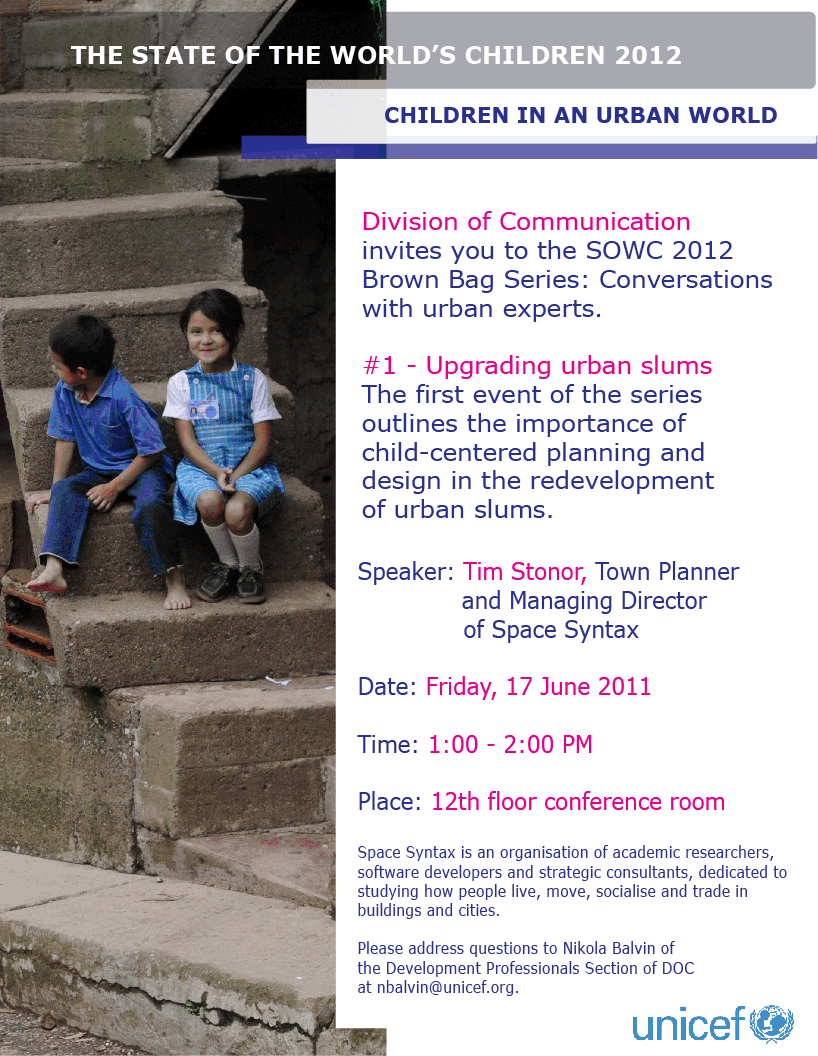
Presentation at UNICEF on “Upgrading urban slums“.Train to Boston.
-
Weekly update
6th-12th April 2011
Tuesday
Meeting with Richard Burck Associates, landscape architects.Meeting with Ronee Saroff, Content Manager at Harvard Graduate School of Design to discuss Loeb Fellowship digital communications.
Wednesday
Meeting with Ken Kruckemeyer and Barbara Knecht, Program Directors at IHP Cities in the 21st Century.Thursday
Skype meeting with Space Syntax London management team.Friday
Meeting with Jim Stockard, Loeb Fellowship Curator. -
Weekly update
30th May-5th June 2011
Monday
Memorial Day in Jamestown, Rhode Island.Wednesdy
Lunch with Jim Stockard & Sally Young re Loeb Fellowship digital media strategy.Thursday
Travel to Maine. -
Weekly update
23rd-29th May 2011
Monday
Dinner with Loeb Fellows hosted by Simeon Bruner of the Bruner Foundation re the Rudy Bruner Awards and the Bruner Loeb Forum.Tuesday
Meeting with Nader Ardalan and research team at the Harvard Graduate School of Design re the Gulf Encyclopedia of Sustainable Urbanism.Dinner with Loeb Fellows hosted by Jim Stockard, Loeb Fellowship Curator.
Wednesday
Harvard Graduate School of Design Commencement talk by Chris Anderson, Curator of the TED Conference.Talk at Boston Livable Streets on “The role of technology in placemaking“.
Thursday
Commencement ceremonies at Harvard University. -
Weekly update
16th-22nd May 2011
Monday
Meeting with Peter Gori of the Boston Redevelopment Authority regarding the redesign of City Hall Plaza.Thursday
Skype meeting with Space Syntax London management team.Lunch with Bryan Bell, Loeb Fellow to discuss the SEED Network and Space Syntax business plans.
Friday
Lunch with David Rubin & Chris Hanlin of OLIN landscape architects. -
Weekly update
9th-15th May 2011
Monday
Conference call to prepare for the “Modelling & measuring cities” session at the Urban Systems Symposium, NYU Shack Institute of Real Estate.Dinner with Paul Cote, Tilly Hatcher and Nick Hornig, the Space Syntax group at the Harvard Graduate School of Design.
Tuesday
Train to New York.Wednesday
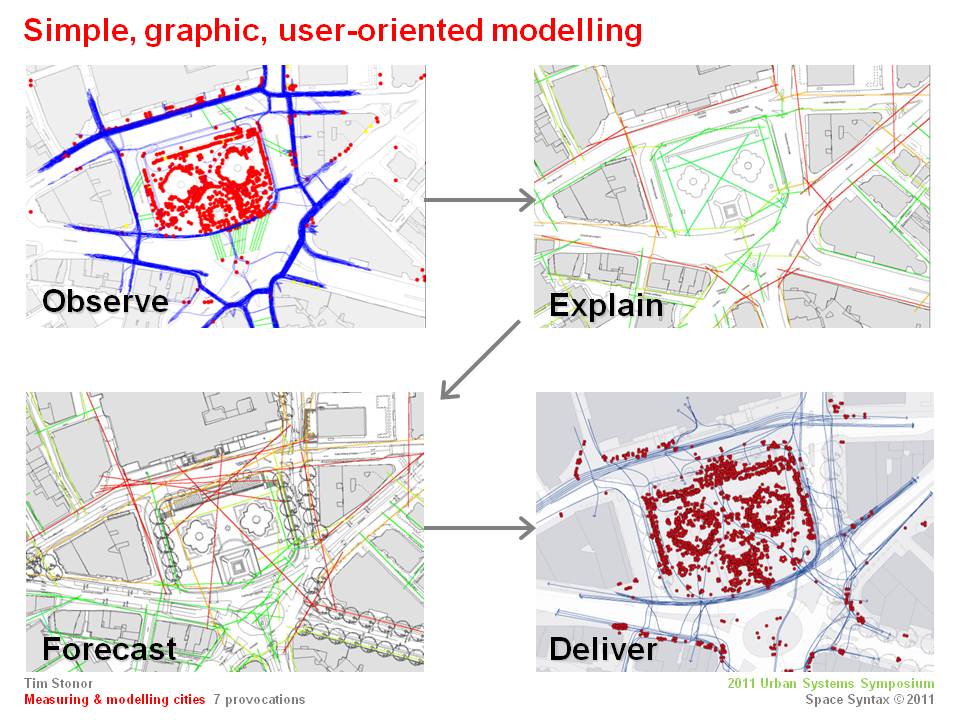
Presentation titled “7 provocations” in the “Modelling & measuring cities” session at the Urban Systems Symposium, NYU Shack Institute of Real Estate.Train to Boston.
-
Measuring & modelling cities
11th May 2011
2011 Urban Systems Symposium
NYU Shack Institute of Real Estate, New York -
Weekly update
2nd-8th May 2011
Tuesday
Meeting with Sir Stuart Lipton to discuss the Space Syntax business plan.Wednesday
Travel to Boston.Party with African-American students at the Harvard Graduate School of Design, hosted by the Loeb Fellows.
Thursday
Lunch with Randy Gragg, Loeb Fellow to discuss Space Syntax analysis of Portland, Oregon.Final dinner with Loeb Fellows.
Friday
Annual Loeb Lecture, presented by Marcel Acosta , Executive Director of the National Capital Planning Commission and Harriet Tregoning, Director of the Washington DC Office of Planning.Saturday
Meeting with the new Loeb Fellowship Class of 2012. -
The aesthetics of performance
“…Thanks for thinking of me re the architecture event. I’m actually in London next week but am flying out on the 4th.
Discussions of architectural aesthetics are often dull in my opinion, because they only deal with how things look rather than how they work; the aesthetics of performance are more my thing – and the automotive industry knows a thing or two here of course. So, if you go and they mince on about the merits of symmetry or some such nonsense, perhaps you can ask them if it’s enough to talk about buildings and shouldn’t they also be talking about the aesthetics of people movement, social interaction and economic transaction. There’s beauty in performance. Ask a dancer or an engineer!…”
-
Spatial layout, urban movement & human transaction
“Designing mobility for democracy: the role of cities”
#demobility
Thursday, 14th April 2011 from 1pm to 5pm
NYU, Kimmel Center, Eisner & Lubin Auditorium
60 Washington Square South, New York Summary
Given the title of this event: “Designing mobility”, I want to turn to the subject of design and the role of architects. The key message of this presentation is that cities need architects, not only to design the buildings that fit into them but also for the networks of space that connect them together. Why? Because architects have a special skill: to resolve complex problems into elegant solutions. And the spatial network of the city is a complex design problem.However, before they can really help, architects need to “get” cities. The problem for cities is that architects are not sufficiently familiar with the way cities work and therefore the design principles they need to work with to make cities more effective as places of human transaction.
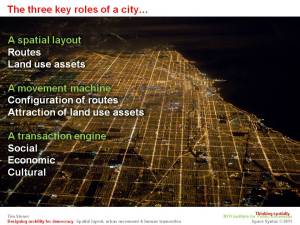 So what is the role of a city?
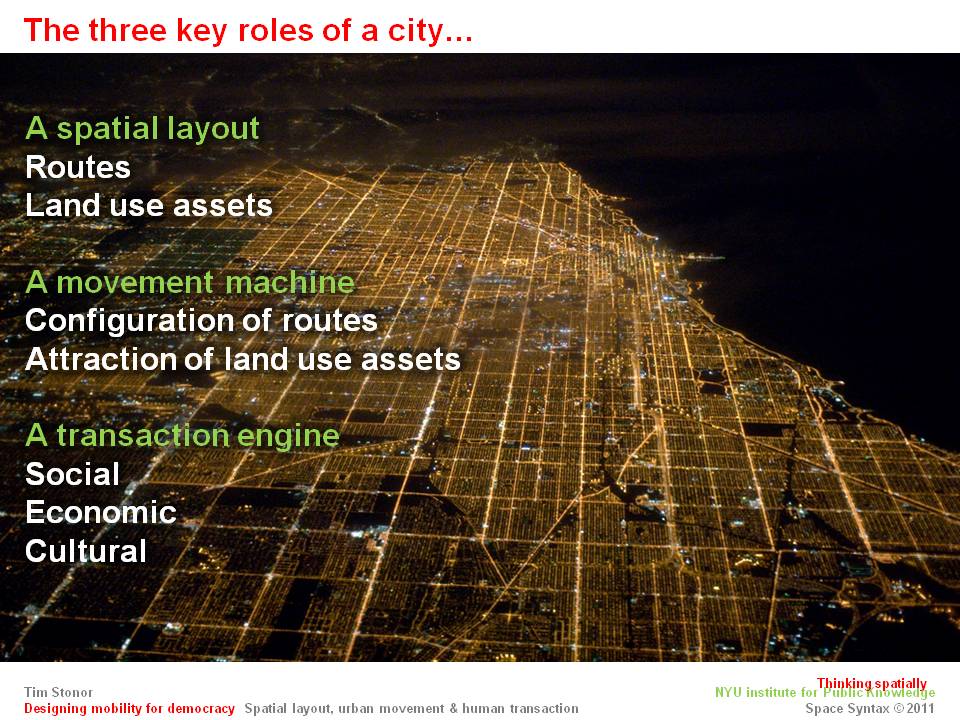
A city should act in three key ways:
1. as a spatial layout – of routes (streets and paths) and of land use assets
2. as a movement machine, organised by the configuration of the route network and the attraction of the land uses assets
3. as a transaction engine, generating and accommodating social, economic and cultural exchange.
A city is therefore a place of production and reproduction.
When cities don’t work a whole series of assumptions are typically loosed into the policy framework. Perhaps the greatest and most damaging of these is that that they lack transport infrastructure. Witness Sydney’s aerial people mover or the radical and crude plumbing of highway arteries into the capillary network of historic cities, especially here in the US.
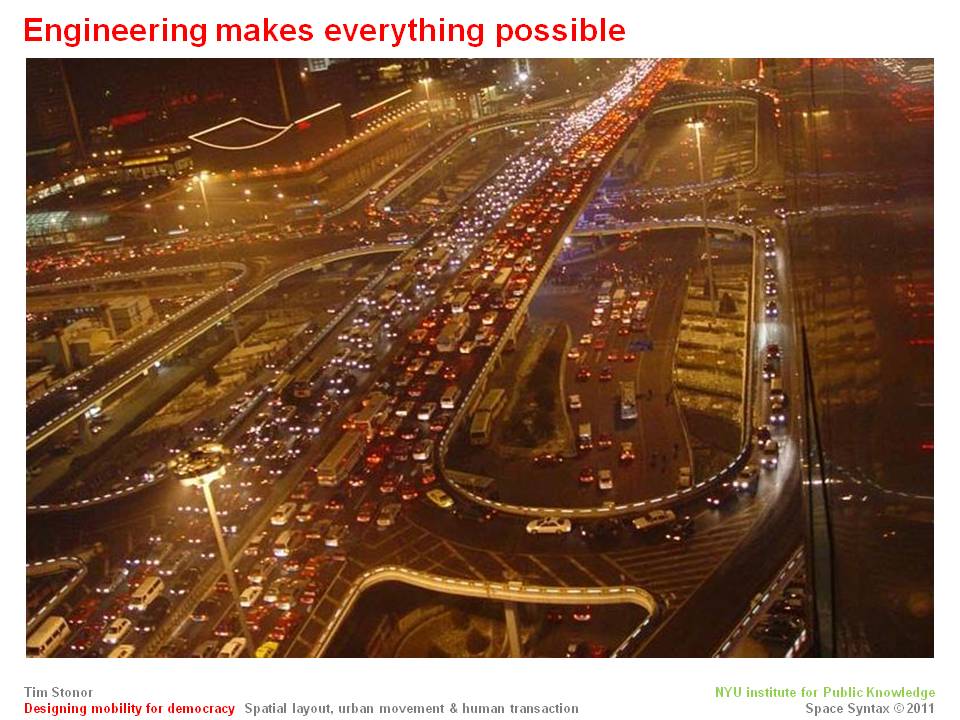
 Often the last thing that troubled places need is more transport infrastructure, especially when it is about moving people large distances. Engineering shows us that we can move human beings in pretty much any way we please, whether it’s to the moon or into the hearts of historic places, like here in Beijing.
 As Sartre remarked, “Everything has been figured out, except how to live.”
Heroically engineered mobility in the form of great road intersections such as that in Beijing is – with notable exceptions – the default response of the global transportation community and therefore of the political system. Witness the federal response to the current economic recession and the bent towards building and fixing highways.
In this talk I want to argue that, if cities are to fulfill those three roles I set out they need to provide a new kind of mobility. And this is not, as Enrique Peñalosa said, only a problem of government. it is also a problem of design. And a problem of design theory at that.
-
Ed Glaeser at the American Planning Association
Notes from Prof Ed Glaeser’s keynote at the 2011 American Planning Association Conference in Boston, 12th April 2011
A city’s “innovative density” is provided by its urban connections.
Historical urban growth and decline
Historically, cities grew by water.
As transport costs lowered (now 10% of a century ago) people and production did not need to be near water hubs – leading to suburbs and low density living.Warmer cities grow faster.
Transportation
The car is a product of a city (Detroit) but not the kindest of progeny.Average US car commute 24min
Average US pub transport commute 48minThe hallmark of declining cities is that they have an abundance of infrastructure. Governments need to invest in people not in infrastructure. This was the mistake of the Detroit people mover, passing over empty houses on empty streets.
Cities that come back eg NY through the influence of financial markets – a fact that is not discussed enough.
Wealthy people live in and work in cities because, in terms of making money, intimate knowledge is more important than having lots of space eg the Bloomberg bullpen, modelled on wall-less financial market settings.
By being around smart people we become smarter.
More skilled areas have grown more quickly.
Cities are places of promise and poverty. Urban poverty is not sign of failure but of success. Dharavi attracts people with a promise of a better life; better than the enforced sterility of the suburbs.
If, when a subway stop is built, poverty levels rise in the vicinity of that stop, is that a bad thing? No, it shows that subways attract people who can’t afford to drive – this fact should be celebrated.
Roads and driving
The answer is not to build new roads.
Turner showed that “If you build it they will drive”.
Congestion charging is the solution. There is no right to drive in the Constitution.Conclusions – Policy changes needed
1. change the US obsession with home ownership, especially large houses. Typically, even lower income homes in the US are 2x those in the UK and Germany – by making urban housing expensive, the federal government is socially engineering poor people into suburbs2. change the US federal obsession with building highways, especially in low density cities
3. reform the schools system that is forcing people to suburbs in search of good schools.
Thank you for coming and thank you for what you do. Planning matters because space matters.
-
Eduardo Rojas
Notes of a talk by Eduardo Rojas given to MIT Humphrey SPURS Fellows and Harvard Loeb Fellows at Stella Conference Room 7-338 MIT, 11th April 2011.
Housing in Latin America
1900
25% urban1985
4.7 family size2000
75% urban
4.1 family size2015
80% urban
3.5 family sizeInformal sector
1990s 60% new jobs
48% in informal sector
24% self employedHigher, more persistent and increasing inequalities in Latin America than in the rest of the world. (more…)
-
Everyone in LA should have an equal opportunity of being eaten by a mountain lion
MIT Media Lab, 8th April 2011
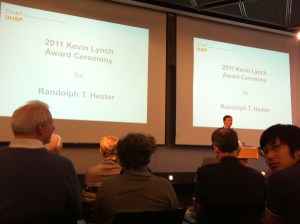
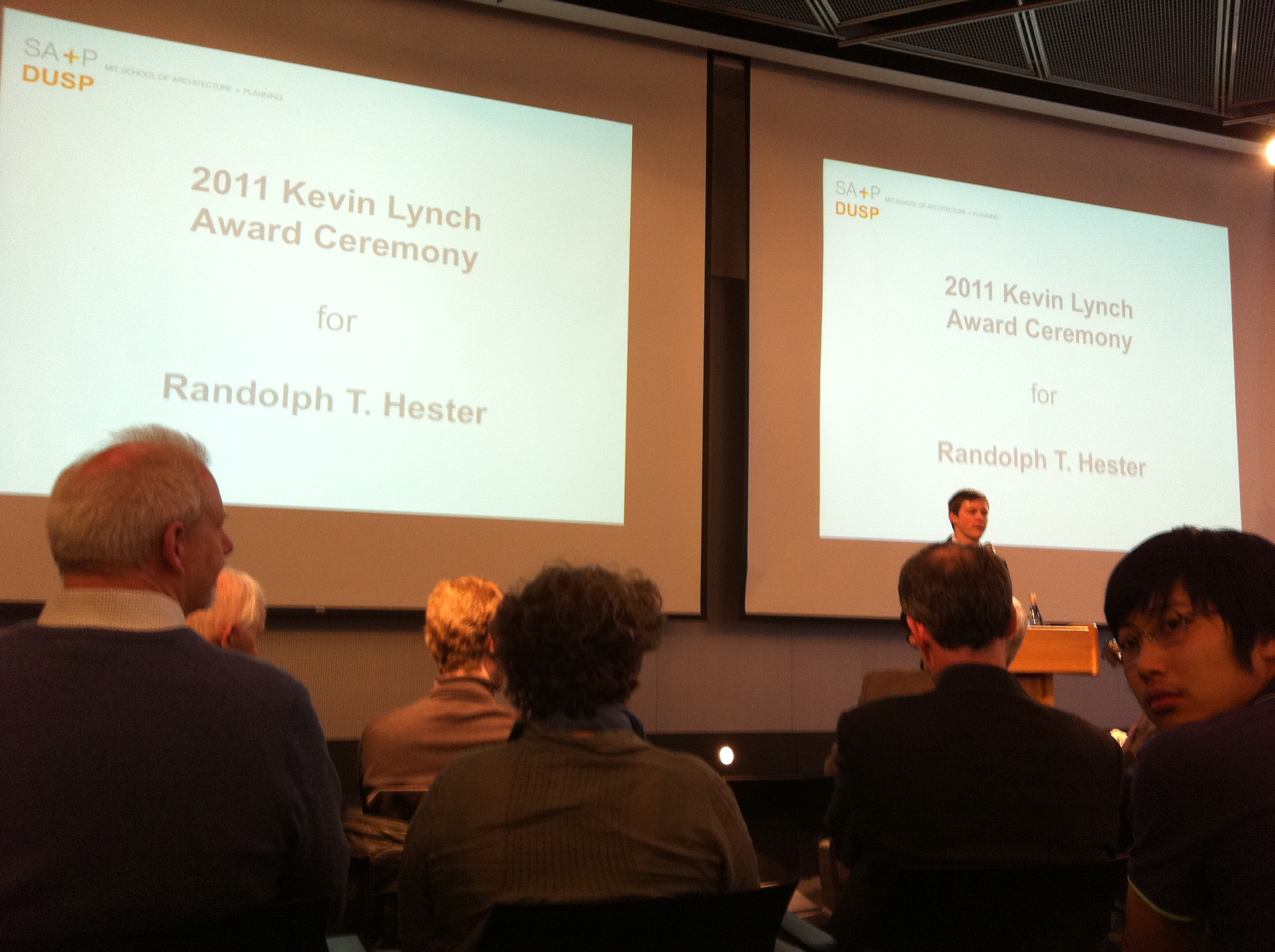
In accepting the 2011 Kevin Lynch Award at MIT, Randy Hester gave a provocative speech about the enduring importance of urban design. Here is my tweetroll from the event.
18:06
At the 2011 Kevin Lynch Award Ceremony @MIT Media Lab, intro by Andres Sevtsuk.18:30
Randolph T. Hester wins Kevin Lynch Award @MIT – giving powerful talk abt risks of virtual capital that doesn’t care for “place”. #urbanism18:34
RH – everyone may not care about greenhouse gases but everyone cares about #nature – concern for nature is the gateway to ecologicalism.18:38
RH – there is a paradox btwn ecology & democracy and a need to harness the paradox, leading to new, recombinant urban/ecological aesthetics.18:40
RH – it’s not about designing urban or landscape but both. Everyone in LA should have an equal opportunity of being eaten by a mountain lion. (more…) -
Weekly update
4th-10th April 2011
Tuesday
Meeting with Joshua Kauffman, partner at beyondMEASURE.Attend “CityScans” talk by Anna Rose at Harvard Graduate School of Design.
Loeb Fellows invite… public seminar of “Sparking Social Change“.
Wednesday
Skype meeting with Christian Beros, Space Syntax Romania.Tutorial with Harvard Graduate School of Design student.
Meeting with Joshua Kauffman, partner at beyondMEASURE.
Loeb Fellows invite… public seminar of “Food Systems“.
Thursday
Business Plan meeting with Anna Rose.Space Syntax Q+A session with Harvard Graduate School of Design students.
Workshop with Utile Inc Architecture + Planning.
Pinup crits with Rahul Mehrotra’s Mumbai Studio at the Harvard Graduate School of Design.
Dinner with Anna Rose and Loeb Fellows: Bryan Bell and Ana Gelabert Sanchez.
Friday
Attend PlanningTech@DUSP conference at MIT.Attend the 2011 Kevin Lynch Award Ceremony for Randolph Hester at MIT.
-
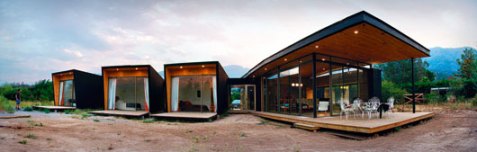
Exhibition – “Chile. Beyond landscape”
 14th April-17th May 2011
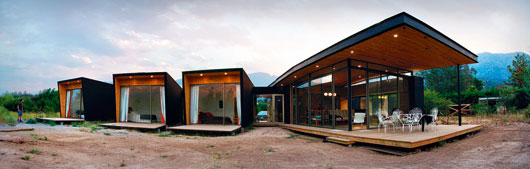
National Museum of Contemporary Art, Bucharest, RomaniaSpace Syntax Romania director Christian Beros has curated an exhibition of Chilean architecture.
“In the past 20 years, Chilean architecture has earned a place on the covers of some of the most prestigious journals, books and sites recognized by contemporary architecture. The projects presented are most often linked with the dramatic scenery on the shores of the Pacific rocky cliffs, deserts, ice fields of Patagonia, the extreme conditions of living and production “architectural” in such environments…
By contrast, we were interested in generational experiences and projects that create a new direction in Chile, going further than their predecessors, exploring new areas and interfaces between the architecture, arts and technology.”






 Tim Stonor
