There is so much interest, from so many different interests, in the future of urban living. This suggests that, whatever else, people suspect that things will change. I’m sure this is right – technology, resource scarcity, population growth, energy shortage and climate change: all are factors that will provoke change. The question is, will these changing “inputs” affect the shape and form of the “output” ie the look and feel of the city?
Again, the short answer is “yes”. But not in a sci-fi, megalopolis, flying cars kind of way. Nor in a “let’s all abandon the city and live in rural bliss, connected to each other by the Internet”.
The reality, if done well, will look and feel strikingly familiar. We will in the main, by necessity, live at density and travel on foot and by bike, making lots of small journeys and a few larger ones. Likewise we will, by necessity eat local, reduce, recycle, reuse. Cities will be incredibly green because we will, by necessity need to harvest rainwater, prevent runoff, shade streets.
The effects on social and economic productivity will be enormous. The quality of human interaction will be enhanced.
Having been through an era of evermore globally connected urbanism, with the consequently divisive effects of major traffic arteries on local communities and the throttling or urban centres by that 60s badge of honour, the ring road, we will move to an age of continuously connected, convivial, landscaped urbanism.
For me, this can be summed up as a change from “transport planning” to “transaction planning”. This will necessitate an end of ages for the traffic engineer and the birth of an era of sophisticated, humane urbanism.
11th May 2011
2011 Urban Systems Symposium
NYU Shack Institute of Real Estate, New York
Notes from Prof Ed Glaeser’s keynote at the 2011 American Planning Association Conference in Boston, 12th April 2011
A city’s “innovative density” is provided by its urban connections.
Historical urban growth and decline
Historically, cities grew by water.
As transport costs lowered (now 10% of a century ago) people and production did not need to be near water hubs – leading to suburbs and low density living.
Warmer cities grow faster.
Transportation
The car is a product of a city (Detroit) but not the kindest of progeny.
Average US car commute 24min
Average US pub transport commute 48min
The hallmark of declining cities is that they have an abundance of infrastructure. Governments need to invest in people not in infrastructure. This was the mistake of the Detroit people mover, passing over empty houses on empty streets.
Cities that come back eg NY through the influence of financial markets – a fact that is not discussed enough.
Wealthy people live in and work in cities because, in terms of making money, intimate knowledge is more important than having lots of space eg the Bloomberg bullpen, modelled on wall-less financial market settings.
By being around smart people we become smarter.
More skilled areas have grown more quickly.
Cities are places of promise and poverty. Urban poverty is not sign of failure but of success. Dharavi attracts people with a promise of a better life; better than the enforced sterility of the suburbs.
If, when a subway stop is built, poverty levels rise in the vicinity of that stop, is that a bad thing? No, it shows that subways attract people who can’t afford to drive – this fact should be celebrated.
Roads and driving
The answer is not to build new roads.
Turner showed that “If you build it they will drive”.
Congestion charging is the solution. There is no right to drive in the Constitution.
Conclusions – Policy changes needed
1. change the US obsession with home ownership, especially large houses. Typically, even lower income homes in the US are 2x those in the UK and Germany – by making urban housing expensive, the federal government is socially engineering poor people into suburbs
2. change the US federal obsession with building highways, especially in low density cities
3. reform the schools system that is forcing people to suburbs in search of good schools.
Thank you for coming and thank you for what you do. Planning matters because space matters.
View and download Anna Rose’s presentation
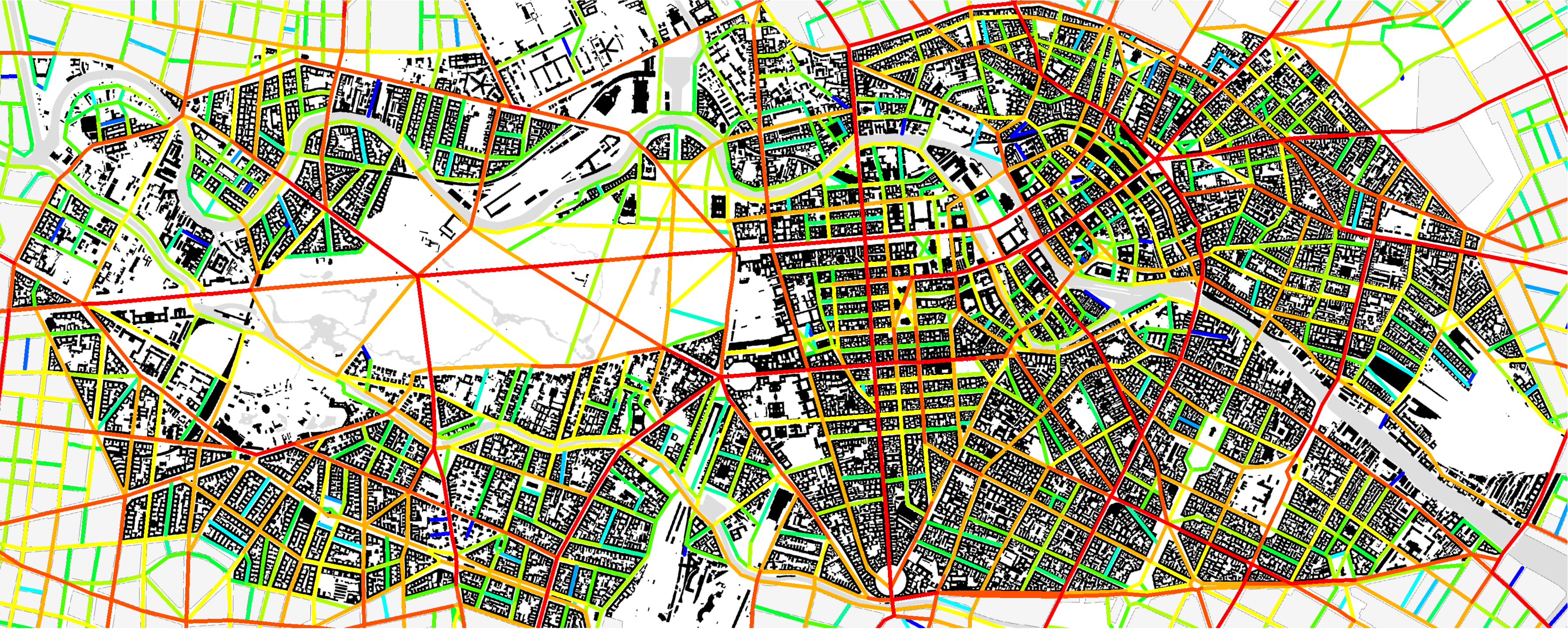
On Tuesday, 5th April, Space Syntax director Anna Rose gave a talk at the Harvard GSD on the use of Space Syntax in planning and urban design. She began by describing Berlin’s spatial transformation during the 20th century, showing graphically how the connected heart of pre-war Berlin was then divided by the Wall and later reconnected with Reunification.
Anna then offered some thoughts on how the Potsdamerplatz development, including the Kulturforum, could be spatially replanned to better connect these important cultural and economic assets into the movement network of the wider city.
Finally, she showed how Space Syntax techniques work at the smaller scale of urban design, with the case of Old Market Square in Nottingham, where the design concept emerged from a spatial analysis of the site and its urban setting.
_____________
Tuesday, 5th April 2011 at 1pm
Harvard Graduate School of Design, Portico Room 121
48 Quincy Street, Cambridge, MA 02138
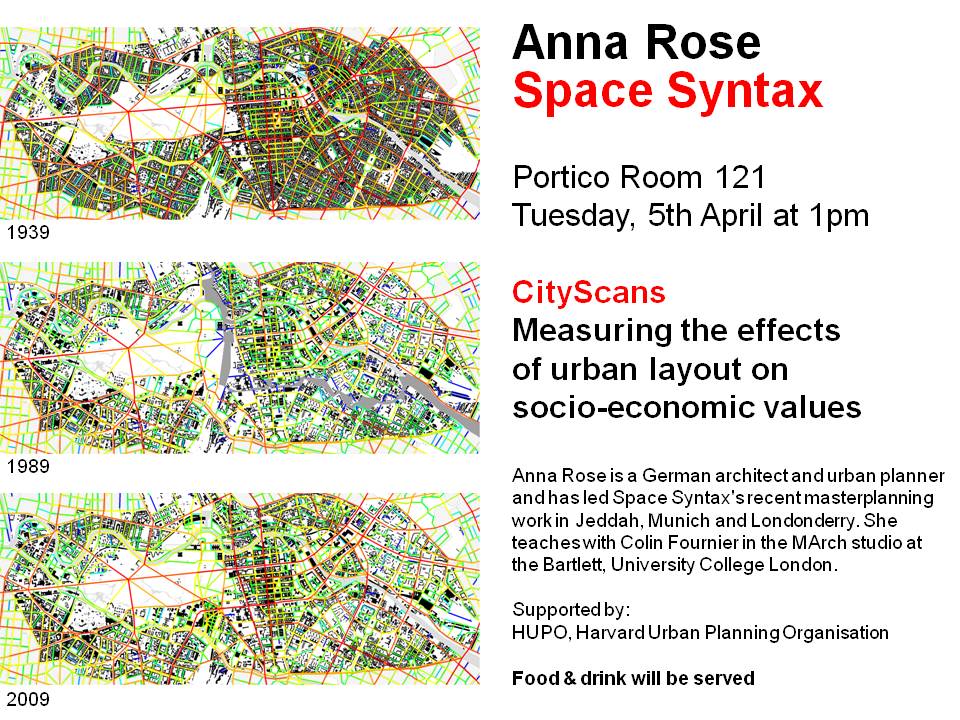
Anna Rose is a German architect and urban planner and has led Space Syntax’s recent masterplanning work in Jeddah, Munich and Londonderry. She teaches with Colin Fournier in the MArch studio at the Bartlett, University College London.
Anna’s work is featured in the recent issue of Arch+.
She recently gave a presentation of the Berlin CityScans project at the Berlin Kulturforum.
Notes from a lecture given at the Lincoln Institute of Land Policy
23rd March 2011
View a summary of the presentation on YouTube
Opening comments
Good afternoon. I am delighted to have this opportunity to report on my progress as this year’s Lincoln Loeb Fellow. My brief today is in two parts: first, to describe my work as an architect and urban planner at the strategic consulting company, Space Syntax Limited; second, to say something about where I think my practice, and the field generally, is heading.
In doing so, I want to make special reference to new technologies and new methods of communication that have emerged in recent years.
A plan to transform an established business
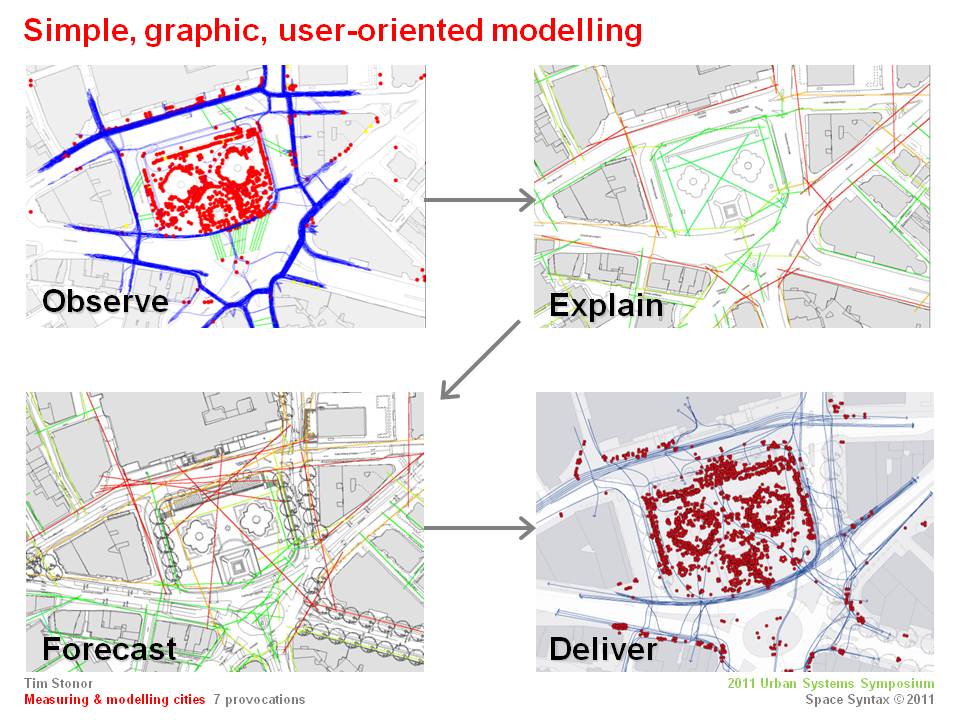
“Space Syntax” is an evidence-based approach to planning and design, with a focus on the role of spatial networks in shaping patterns of social and economic transaction. First developed at University College London, it explains, scientifically, why the continuously connected city is a good thing and it exposes the risks that come from sprawl and disconnection. It has much to say about the benefits of density and the hazards of urban fragmentation. It gets us away from simplistic banners like “New Urbanism” or “Landscape Urbanism” by providing a detailed, forensic description of the city.
Space Syntax is best known in the UK but, over the last fifteen years, we have established a network of Space Syntax consulting companies to take the approach into a growing number of countries. Although not immune to the ebbs and flows of the market, we have a commercially successful operation.
Yet, in collaboration with UCL, we now plan to make it available at low or no cost, to as many people as are willing to take it up. More than that, we are about to open up the “source code” of the software to anyone who wants to get their hands on it. We are, in other words, about to publish the recipe for our secret sauce.
In my talk today I will argue that this can only be a good thing. (more…)
 An article in the New Zealand Dominion Post, titled “On your feet, Wellington” reports on Space Syntax’s proposals to reconnect the pedestrian infrastructure of the capital.
 I spoke today to Dr Joyce Rosenthal’s “Environmental Planning & Sustainable Development” class at the Harvard University Graduate School of Design.
My presentation “Carbon emissions & spatial connections” can be viewed on Slideboom.
 For digital users
2010 was the year to get connected; 2011 will be the year to become networked.
It is one thing to buy an iPhone, join Facebook and Twitter, get a blog, friend and follow. It is another to keep it all going.
Already, people are being encouraged to unplug. But why unplug when it is possible to network? How? The solution is to link Twitter and Facebook to a blog; to connect the blog to LinkedIn, taking advantage of the interconnections so that things are only done once.
In other words, connectivity is only the beginning – networking is the goal. And not just for tech geeks but for all users of urban places…
 For urbanists
The 20th century was about cities getting connected; the 21st will be about cities becoming networked. (more…)
One of the challenges in achieving an integration of thinking between hackers and urbanists is the rate of change online. Will the massive experimentation currently underway on the internet continue at a pace, or settle down as norms are established and protocols emerge? Perhaps the same protocols that make it possible for people to live in cities. We sometimes call them “manners” or “cultural norms” and we know when they are being broken. Equally so, we call them street networks and we generally understand now to navigate them. We don’t all have to follow manners and streets but they offer a guide to behaviour and they make the difference between structured living and chaos.
How social networking protocols are established online will, in return, influence the social dynamic of future city living, perhaps as much as the efforts of planners and architects to structure social encounter by virtue of where we place things (buildings) and how we connect them together (streets, utilities and transport networks). This is because the people using online space and the people using urban space are the same people. (more…)
Notes from a talk by Leo Saldanha and Bharghavi Rao on “Contested Terrains: Environmental and Spatial Justice in Urban India” at Harvard University Graduate School of Design, organised by HUPO, the Harvard Urban Planning Organisation.
Themes
A right to life includes a right to livelihood.
This challenged by:
– privatisation
– gating
– surveillance
– separation and marginalisation
– cleansing of the urban poor
– harassment of sexual minorities
– encroachment of the car.
This creates a fragmentation of communities. The problems are well understood by elected representatives – the problem is in municipal bureaucracies.
The future needs to be the “cheap city”. The small/medium-sized city is the future. (more…)


 Tim Stonor
