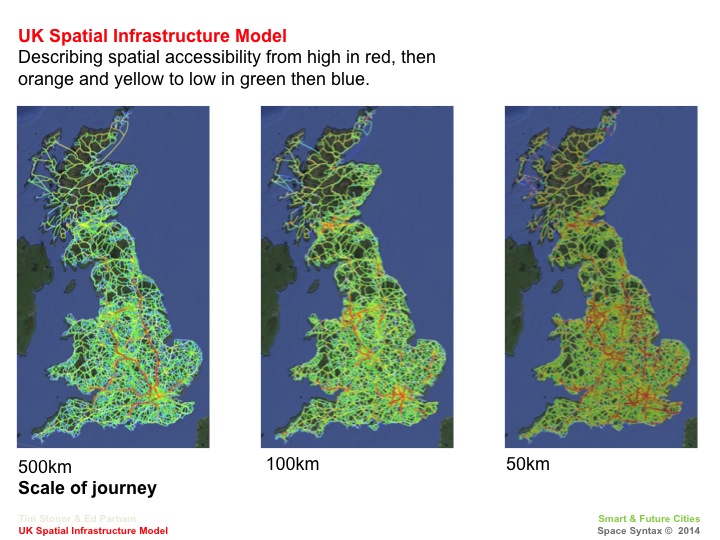
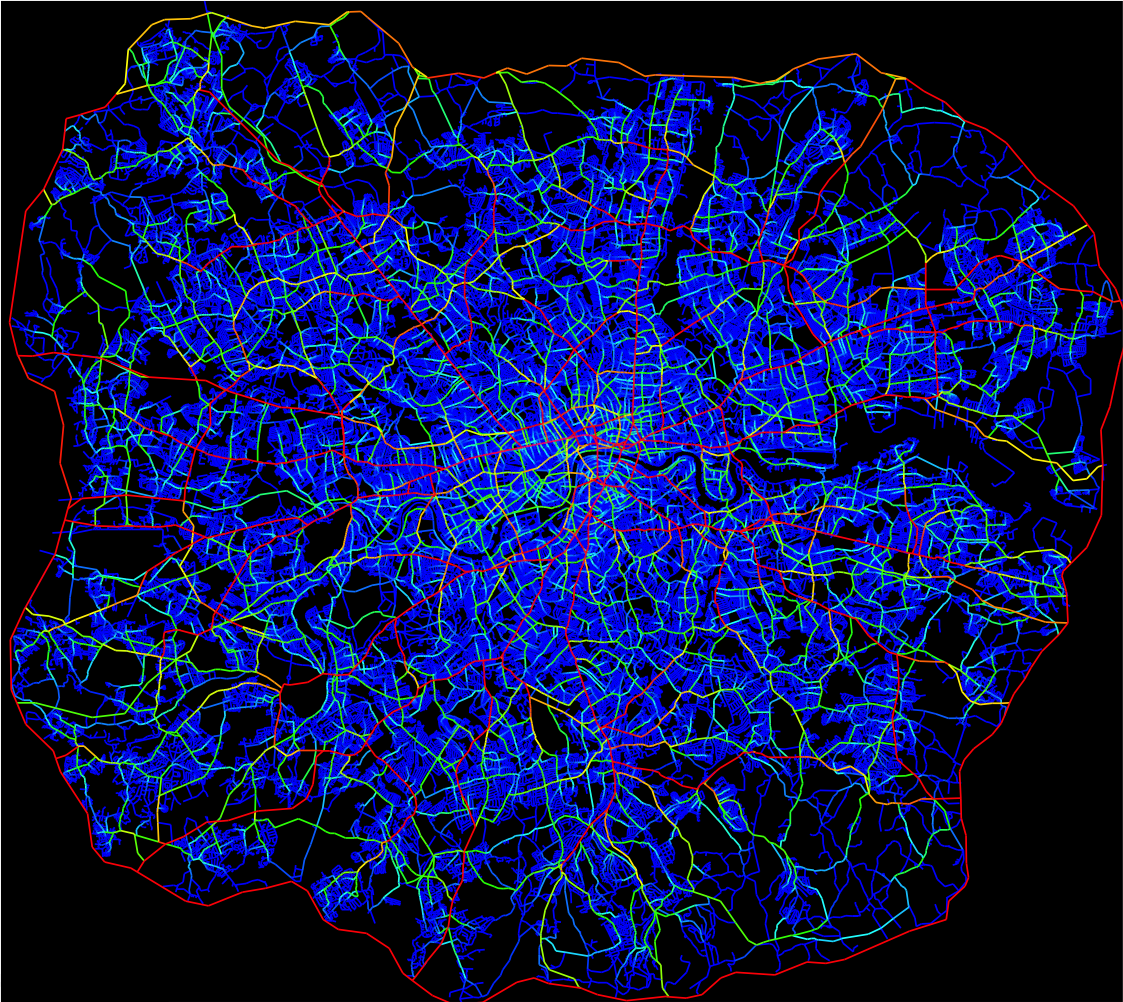
This is a model of the spatial infrastructure of Great Britain (and will soon include Northern Ireland to become a model of the United Kingdom). It allows us to zoom in and out on cities, towns and villages as well as the connections between them. It also lets us understand the hierarchy of connections at different scales – which routes are more important at a local, pedestrian scale and which are more important at a cross-country, car scale. More important routes are coloured red, then orange and green to less well connected routes in blue. (more…)
Category: Spatial modelling
-
Spatial Layout as Critical Infrastructure
Stub…notes for an upcoming conference talk
Key issue to be addressed:
– Urban-Rural development
– Urban Regeneration
– Smart Cities.
When a network of streets is laid out, planners and designers build in an enormous amount of “embedded potential”:
- the pattern of movement
- land use potential
- safety
- land value
- social interaction
- public health
- carbon emissions.
The design of the street network has a fundamental and measurable influence on each of the above.
Later changes – to land use pattern or to the local design of streets (eg road widening or narrowing, adding cycle lanes or public transport) – can enhance or even diminish these potentials, but such later changes always occur around a benchmark that is set by spatial configuration decisions.
Buildings come and go – are built and demolished – but the spatial network, once laid out, is harder to adjust.
Exceptional new connections – such as bridges – can be built to connect disconnected networks but grids are resilient to change. Therefore, putting the wrong grid into an urban development can be a pathological move, setting the socio-economic potential of places for generations to come.
How do we know this?
The evidence-base: post-war housing estates; UK New Towns. Places that go wrong within a generation, if that – sometimes within a few years. Car-dominant transport planning. Land use zoning.
Risk of failed UK models.
In finding a balance between the tension of urban and rural development, Chinese towns and cities should learn from China first:
– mixed use planning: marginal separation by linear integration.
– mixed mode planning: roads, streets, lanes, canals: Jiading.
– mixed character planning.
What are the Spatial Layout requirements?
The historic Chinese grid: rectilinear hierarchy.
Pervasive centrality.
To be developed…
-
SkyCycle – elevated but not remote
The comparison between SkyCycle – a proposal to create a network of strategic cycling routes above London’s radial railway lines – and the City of London’s much maligned network of (unbuilt or demolished) upper level walkways is one worthy of attention.
1. The City of London “Pedways” often paralleled routes at street level. When they did so they effectively split the pedestrian flow between upper level and street level – thus typically making neither level particularly/sufficiently vibrant. This is why most of them did not work or were resisted from being built in the first place.
However, as all good students of spatial networks understand, not all links are equal. When upper level walkways genuinely create routes that are not available at ground level then the evidence of observation surveys shows that they can be very well used. Some of the upper level routes through the Barbican are as well used as ground level residential streets elsewhere in London. Reality is, as always, more subtle than simplistic classification.
2. In contrast, SkyCycle follows railway lines that have historically created morphological “fissures” in the street network either side of them. In this way SkyCycle does not recreate routes that are already available. Instead, it create new routes.
3. Spatially, these SkyCycle routes have two important characteristics:
a) because they connect directly from the edge of London to the centre, linking to the ground level at accessible points in the street network (identified by Space Syntax through spatial accessibility analysis) SkyCycle routes add to London’s “foreground network” of important arterials (the red and orange links in a Space Syntax map of London).
-
Spatial Planning and the Future of Cities
How might cities be planned in the future?
This is not only a question of how they might look but also, and more importantly, about how they might be laid out as patterns of buildings and spatial connections.
Laying out a city means answering two key questions: “what goes where?” and the “how does it all connect together?” The answers to these questions have fundamental implications for the social, economic and environmental performance of urban places. And the jury is out as to which is the best way to do so: to use spatial planning to create place.
The global urban risk is that architects and planners have created, and continue to create, highly unsustainable city layouts – car dependent, socially divisive, congested and life-suppressing. And, it would seem, the more technologically advanced cities have become, the less efficiently they have worked.
By contrast, the street-based, continuously connected grid – the kind of layout that the slow, incremental evolution of cities produced before the intervention of modernism – has largely fallen out of fashion.
My argument in this piece is that the continuously connected grid is the only form of urban layout that can deliver sufficient social, economic and environmental value. The only kind of grid that is truly sustainable. (more…)
-
UrbanRural: one system, many tensions
Notes from a meeting with the Beijing Institute of Agriculture and Forestry at Space Syntax London, 18th September 2013.
http://www.youtube.com/watch?v=dxz9msSBlzA
Common themes
Production
The rural landscape is a place of production. So is the city: production of goods and production of ideas.Protection
Protection of natural assets in the rural landscape. Protection of historic buildings in the city. Avoidance of pollution in both. Protection of water courses – natural and artificial in both.Waste
Avoidance of waste in both urban and rural settings. The rural landscape as the wastebasket of the urban landscape. Tension.Movement
Conflicts in the rural landscape between local movement (agricultural productivity) and urban-rural movement (commuting). Tension. (more…) -
Urban data: some risks – unnecessary complexity and shallow artistry
As a user of urban data I know the benefits that can be gained from visualising information on city form and city performance. But… and this is the but… these benefits only flow if the visualisation is followed up with analysis of that data – analysis that seeks out patterns, correlations and associations in order to make sense of the data. Then, on the basis of this analysis, it is possible to inform urban planning and design decisions – indeed I find that good analysis inspires design thinking, pointing the user in certain directions.
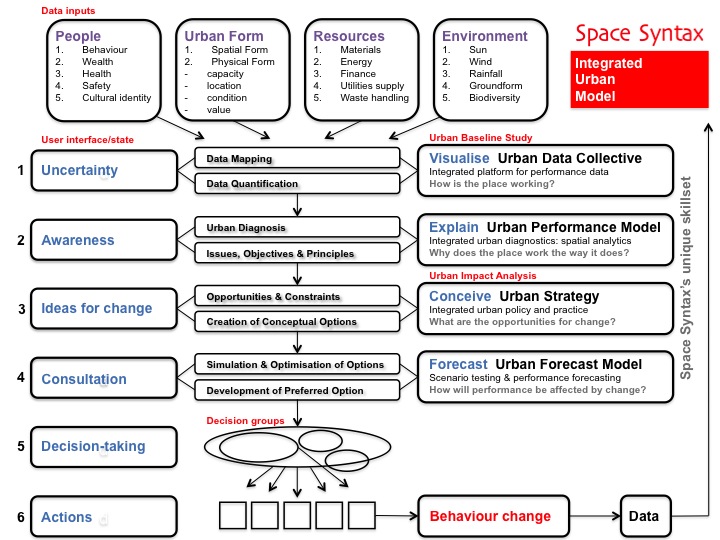
The approach we have developed at Space Syntax is to be simultaneously a) “data-light”, b) analysis intensive and c) outcomes oriented. I appreciate that we are using our Integrated Urban Models in specific contexts – usually in the crafting of public space designs, urban masterplans and, increasingly, regional strategies – but I believe these principles apply to whatever kind of modelling is being undertaken.
One of the weaknesses of urban transport modelling, for example, has been its “data intensity” – its use of multiple variables, coupled with a degree of data “manipulation” – at least this is what I’m told. The result is expensive, time-consuming modelling.
Another trend I detect is “data-as-art” – making visualisations, usually animated, of data flows. These create seductive imagery but I do question their purpose – because the analysis is often missing.
And therefore, for both of these reasons (data intensity and data-as-art) I worry that cities pursuing urban data initiatives may find that these become extremely complicated, expensive and unwieldy – if aesthetically charming – and I wonder what such data strategies would do to further the cause of cities. They will, no doubt though, reward their creators.
-
The importance of grids
The natural shape of the network is a grid, not a tree. Trees focus on singular points – grids share the burden.
The natural shape of the city is a grid, not a tree. The evidence of history tells us as much. Rectilinear grids pervade the historic record – in the Middle East, Latin America, East Asia. The gridiron is not then a modern creation – it would seem we have always built grids.
Why should grids be as important – indeed fundamental – as they are? (more…)
-
Unbuilt Britain: 3. A Revolution in the City
Broadcast 26th August 2013 on BBC4, featuring Space Syntax analysis of Wren, Hook & Evelyn’s plans for rebuilding the City of London after the Great Fire of 1666.

Tim Stonor with presenter Olivia Horsfall Turner along with Kathryn Ross and the crew from Timeline Films Link to the programme on the BBC website
Link to the programme on YouTube
Download a presentation of Space Syntax’s analysis
“Using her skills to uncover long-forgotten and abandoned plans, architectural investigator Dr Olivia Horsfall Turner explores the fascinating and dramatic stories behind some of the grandest designs that were never built.
Destruction, whether intentional or circumstantial, often creates a clean slate and demands a fresh outlook in which we come to think the unthinkable. This programme looks at bold, and in some cases shocking, plans to make revolutionary changes to Britain’s biggest cities. (more…)
-
Darwin CBD – Workshop 1 – Transcript of Tim Stonor’s presentation
Given by audio link to Darwin CBD Masterplan Workshop 1 on 21st August 2013.
Download the presentation, including voiceover“Good afternoon, everybody.
My name is Tim Stonor. I’m the Managing Director of Space Syntax and unfortunately I’m not able to join you for the workshop today. But my colleague Eime Tobari is with you and will be able to address any questions you may have at the end of this presentation. I did though have the pleasure of being in Darwin a couple of months ago and had the chance then to meet colleagues and discuss some of the issues facing the future of the city.
Today, I want to give you a presentation about the Spatial System of the city – it’s route network, its streets, its pedestrian pathways – and how these can work to improve the movement of people across the city; the bringing together of people in space to trade socially and economically. And I want to show you the work that Space Syntax has done to date in analysing the strength currently of spatial connections in the city and then analysing some opportunities for future growth.
But I want to start by looking at some issues that face all cities worldwide, and especially the issue of the private car and its place alongside other modes of transport, namely public transport and walking. Many cities worldwide have got the balance wrong and they have over-provided for private transport and under-provided for those other modes to their cost. (more…)
-
Teaching urban design – a sketch for a new approach
Sketch…
Space Syntax is keen to play a role in initiatives that embed the Space Syntax approach in everyday urban practice. The watchword is “dissemination”. Our aim is to create a professional landscape that uses Space Syntax as an everyday approach to the planning, designing and general governance of places.Here are some of my thoughts about the potential structure of an urban design course, which are largely about using this as an opportunity to break down many of the barriers that conventionally get in the way of good urban design:
1. combine art and science: especially the importance of a science-informed approach to urban design, which is often missing
2. combine creative and analytic/disciplines: bring together designers and analysts in an intellectual cocktail
3. combine design, planning, infrastructure engineering, finance, governance, legals
4. put the human being at the heart of it all (more…)
-
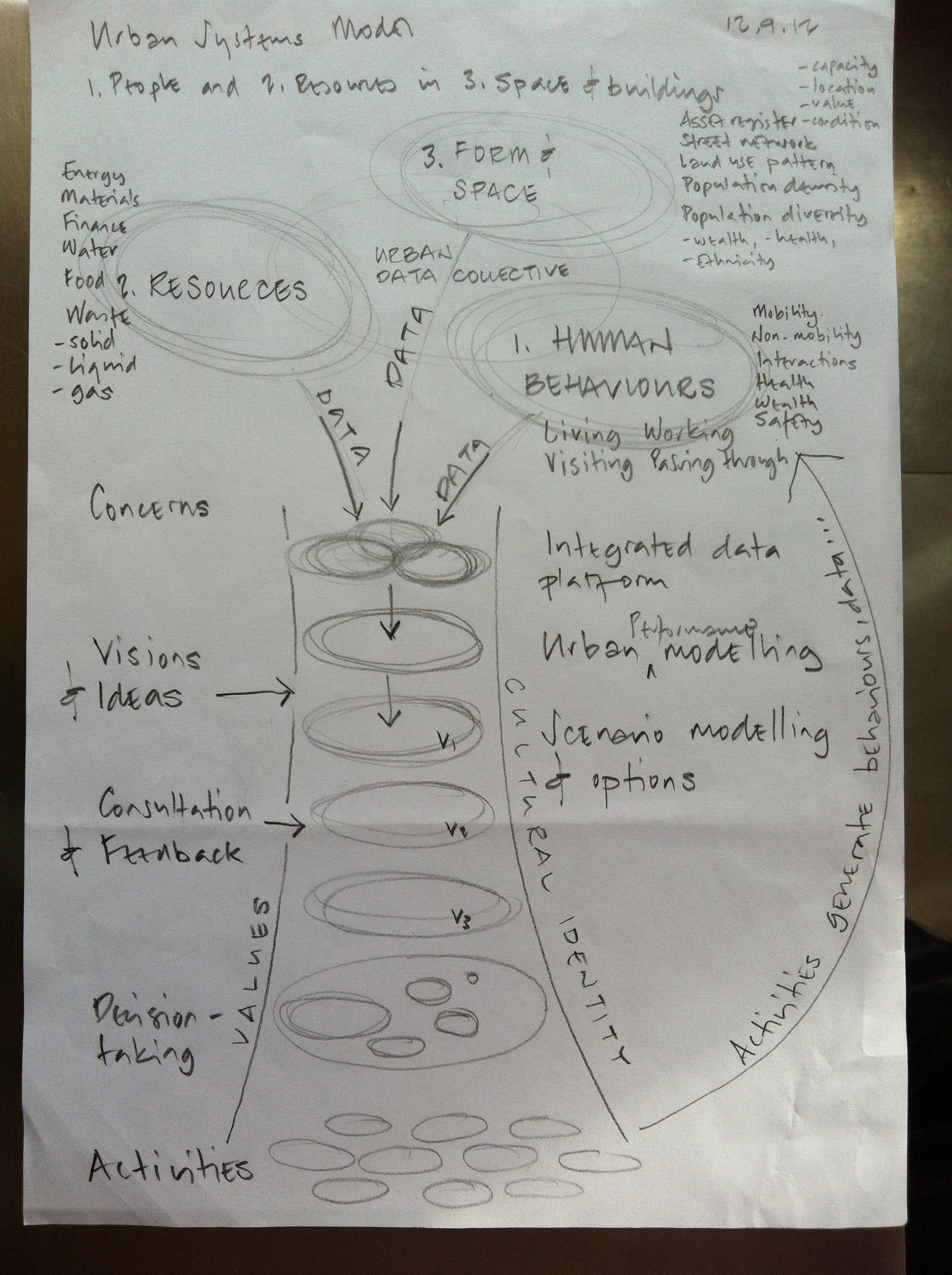
Smart cities – why, what, how, how?
Some advice for people promoting a Smart City approach. Prepare your answers to the following questions:
1. Why do we need “smart” and do we even need cities any more?
First, provide a clear and simple explanation of why cities are important ie what they do that is special: they arrange physical buildings within spatial networks to create intensifications of opportunities for people to interact and transact, socially and economically. Acknowledge the interdependencies between cities, towns and villages but emphasise the primacy of cities.
Second, explain how this process is facilitated by the propinquity and connectivity that cities offer – traditionally physical connectivity and, increasingly, digital.
Third, describe the threats to the efficiency of cities: gradual, sprawling growth; over-reliance on private cars.
Fourth, describe the consequences of inefficiency: economic inefficiency, social isolation, unhealthy living, short-term investment, environmental degradation.
Fifth, speculate on the further risks associated with a “same as usual” approach. (more…)
-
A short film about Space Syntax
Tim Stonor, Managing Director, Space Syntax
“The population of the world is increasing and, as it increases, more and more of us are living in cities. As cities have grown in the 20th century they have often grown to disconnect people.Space Syntax has discovered that many of these problems in cities – disconnection, lack of contact between people, lack of access to jobs – come down to the way in which the city is planned as a layout of space.”
Ronan Faherty, Commercial Director, Land Securities
“As a developer, the most important thing for us is understanding the consumer and anything that assesses the consumer and helps us understand them provides real value. When you’re putting down a new property into an existing space we want to understand where consumers are coming from and then how they should engage with the property: where we should put escalation and movement and flows. (more…) -
Quality Streetscapes Conference notes
This first part of this presentation introduces a new approach to valuing urban design – one which allows design decisions to be embedded in real estate valuation calculations. The approach connects design to the rateable value of retail, commercial and residential property offerings. It allows investment decisions to be related directly to design proposals, showing how Proposal A will generate more long term value than Proposal B. The tool is already being used in practice.
Part Two describes Space Syntax Limited’s plans to disseminate its science-based, human-focused approach to urban planning and design. Key to this is the creation of an Academy to provide training to professional and non-professional stakeholders. (more…)
-
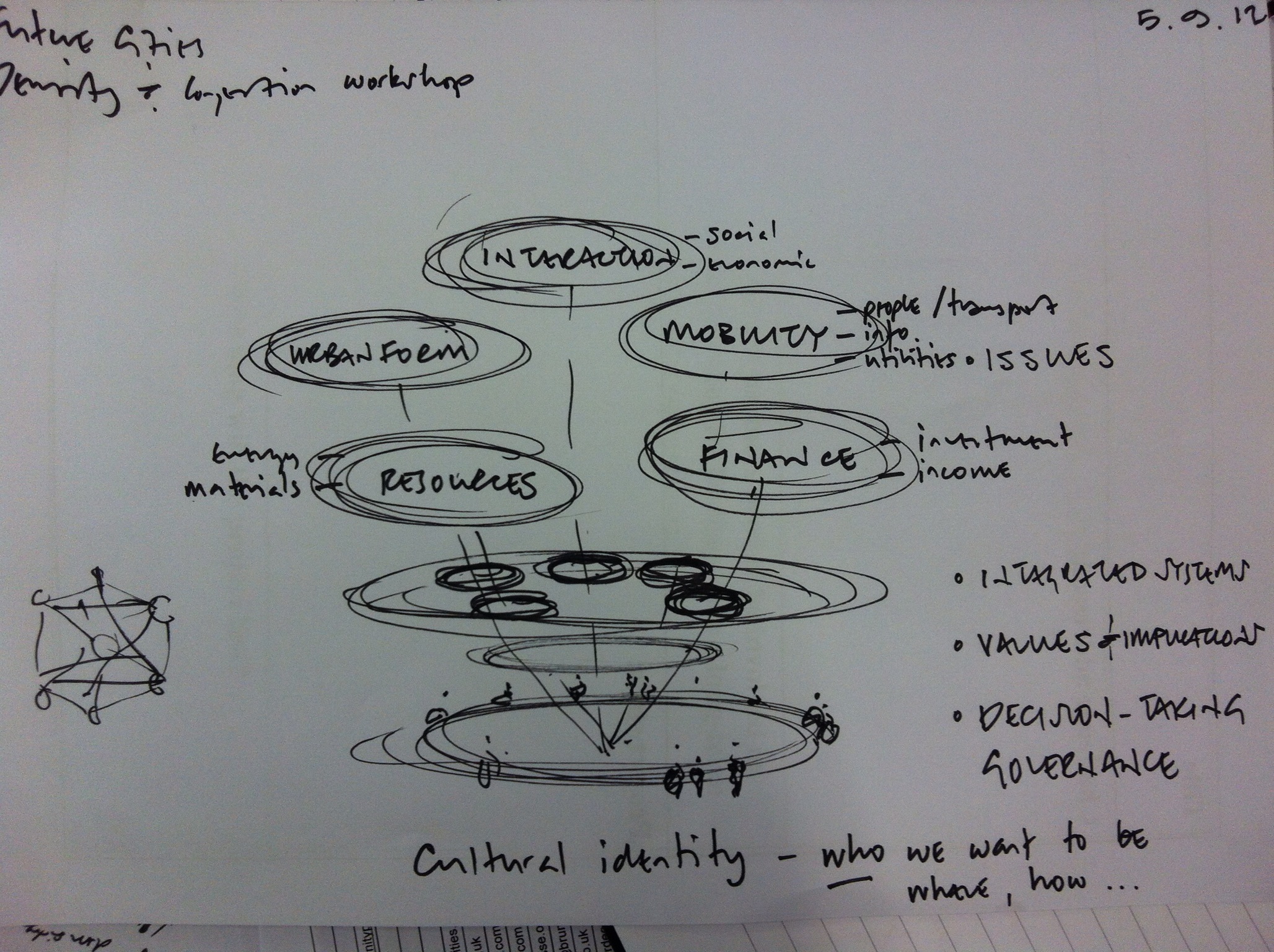
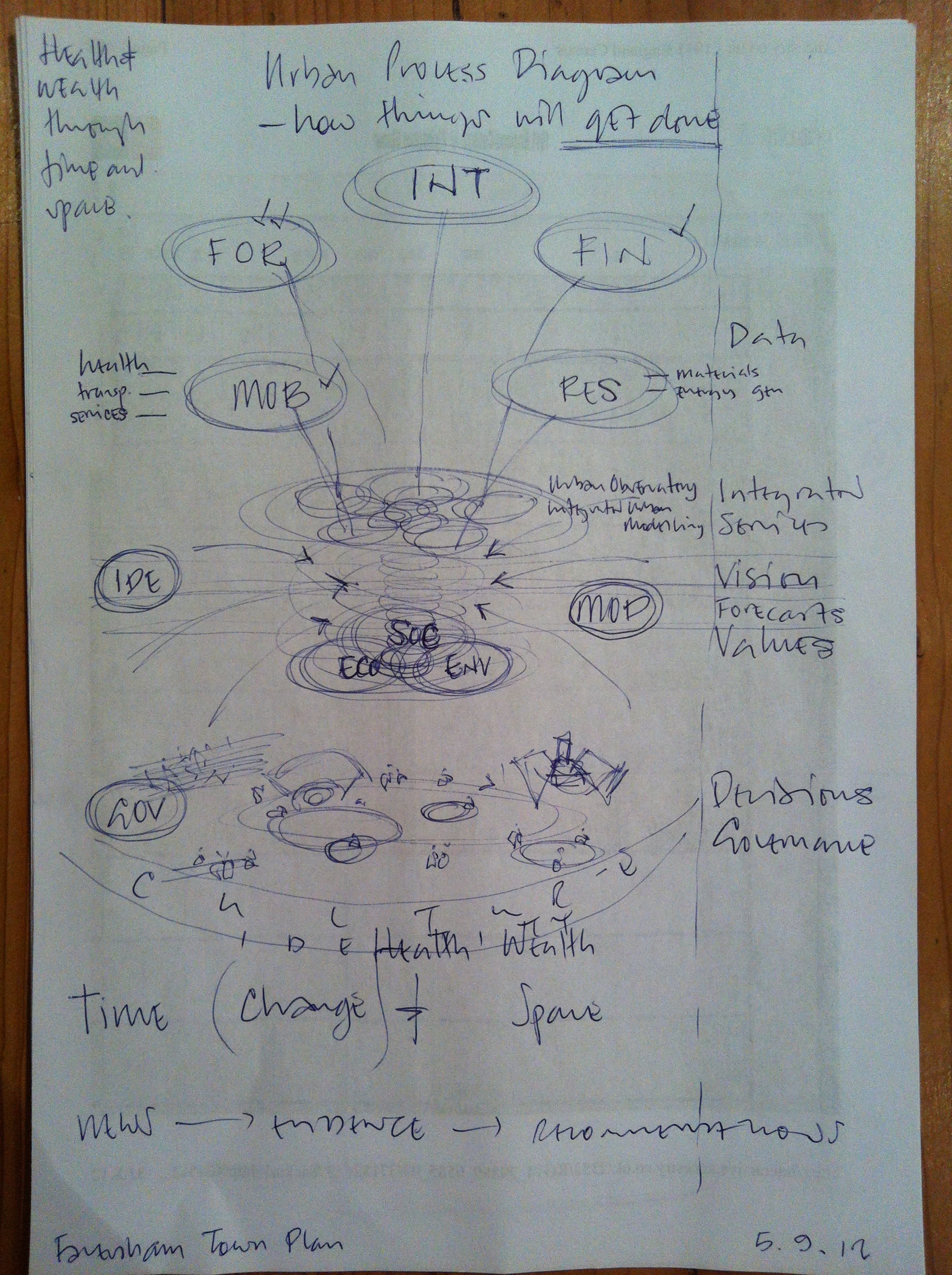
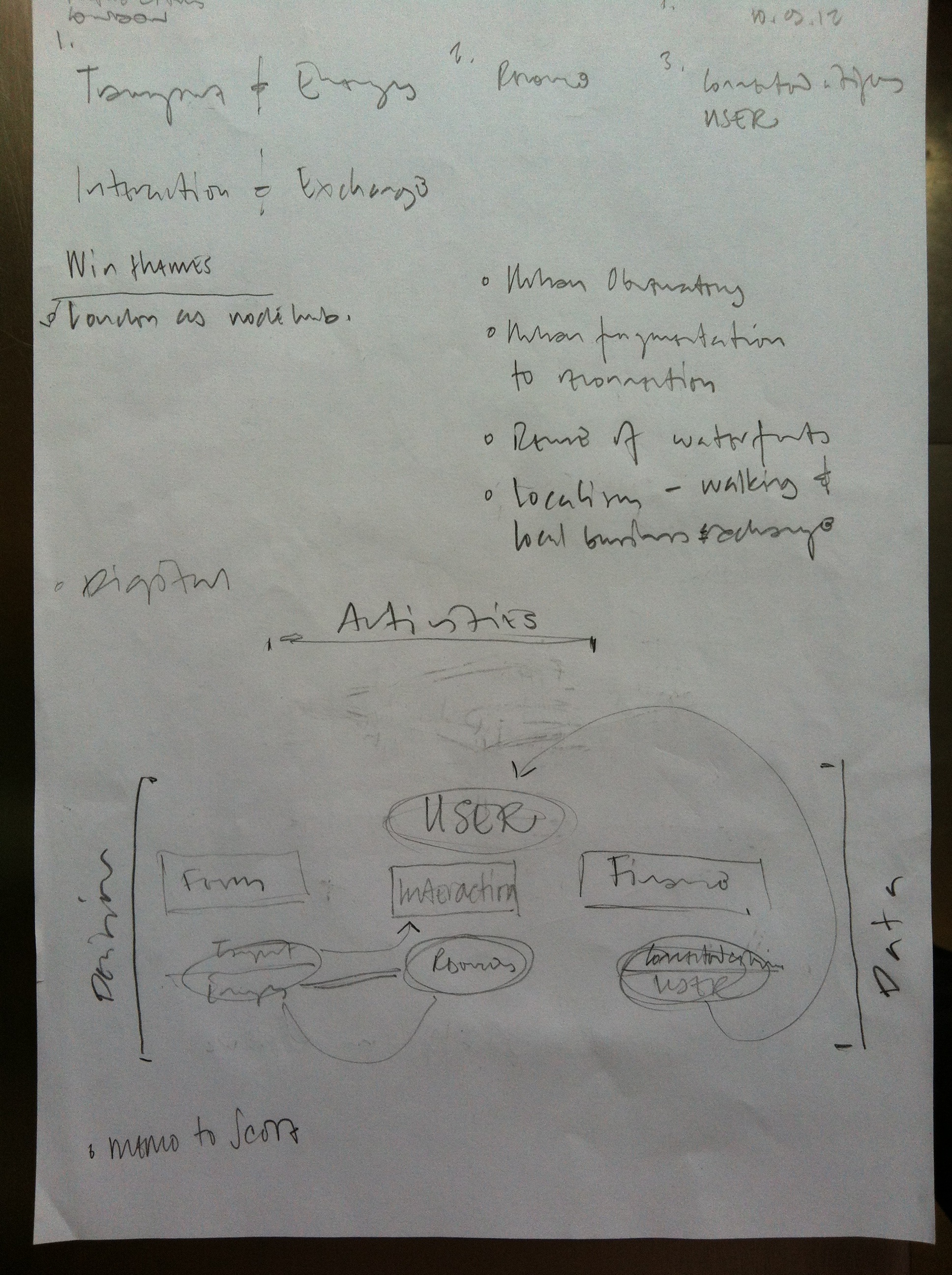
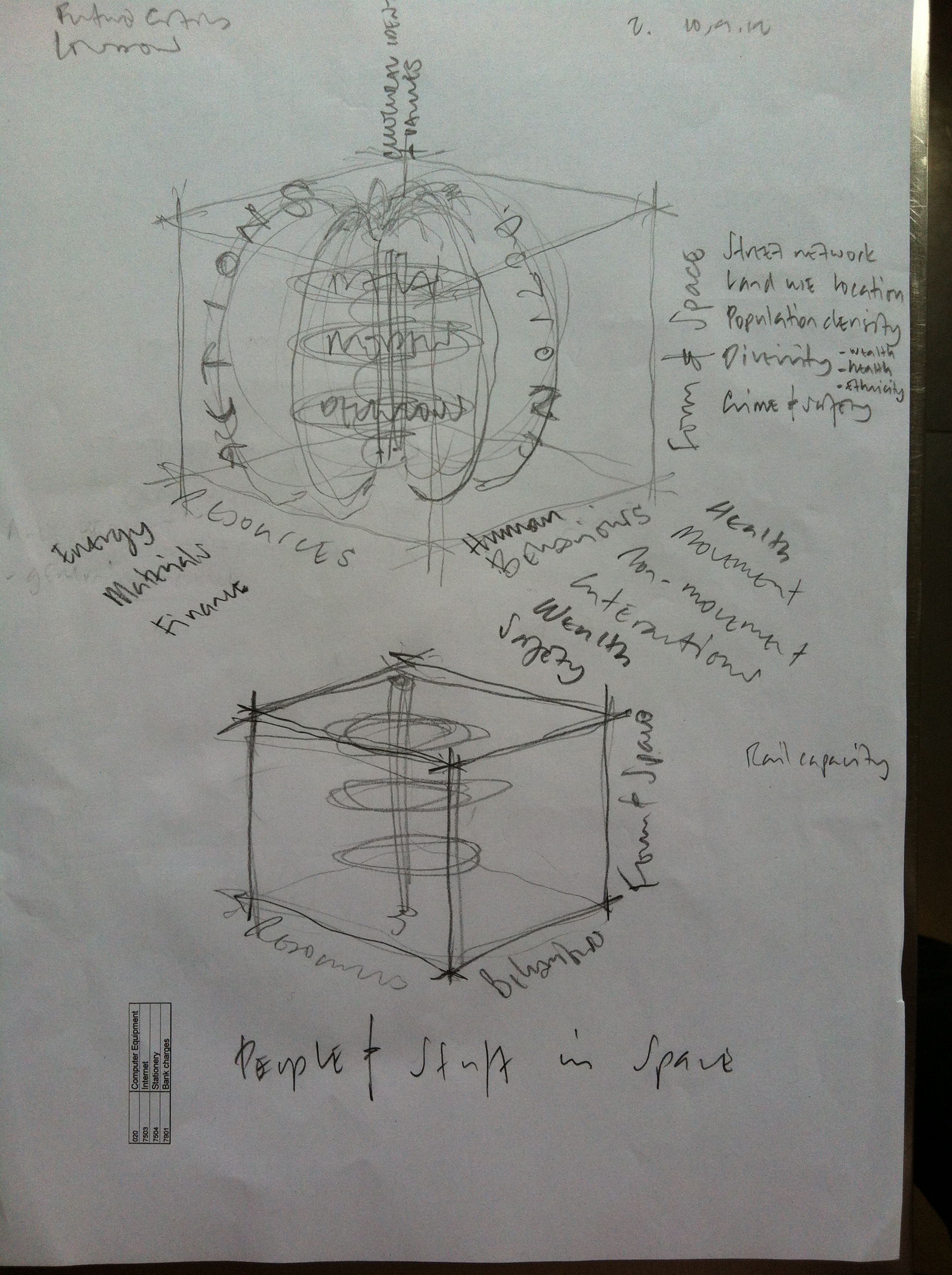
Future Cities_Cities of Transaction
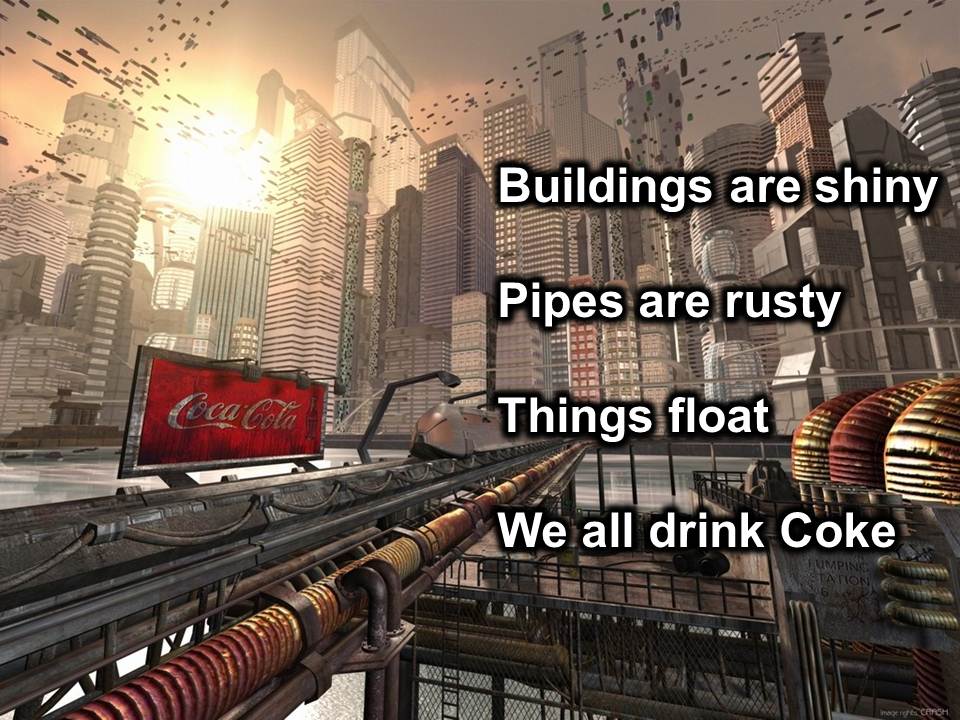
Thinking about the future of cities is not a new challenge. From Christopher Wren’s plan for the post-fire rebuilding of London in 1666 to Ebenezer Howards’s Garden City concept, to Le Corbusier, to Bladerunner, human ingenuity has been tasked with anticipating the future.
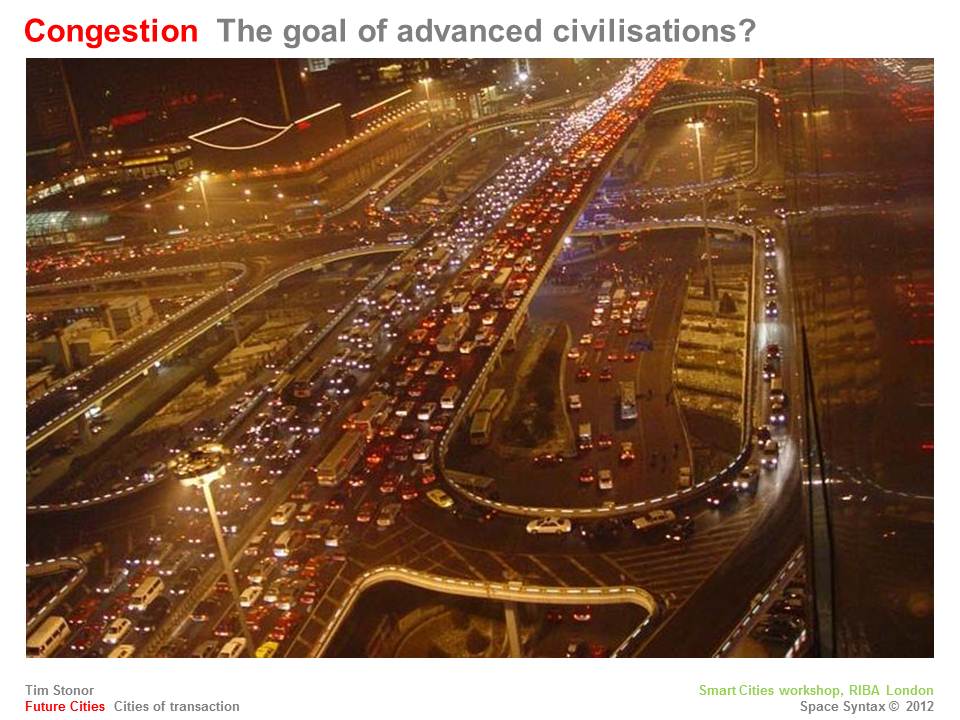
A problem, if we care to admit it, is that these plans tend to fail. Look at what replaced Wren’s ideas: more of the same. Or, consider the legacy of post-war housing and the New Towns movement: social and spatial isolation. Car dependency. Traffic congestion.
Why should this be? (more…)