Category: Place

  • The urban cortex

    The urban cortex

    A talk given at Lombardini22 architects in Milan on 13th May 2025.

    The idea I’d like to explore this evening is that cities serve a higher purpose than we typically credit them with, and this idea is that cities are natural extensions of the human brain. Far from being artificial, alien objects, cities work with us, their users, to help us solve the problems of our times. Cities are extensions of our brains and, just like our brains, cities are sophisticated computers.

    At least they are, if we design them well. 

    Great cities are not just beautiful to look at and stimulating to be in. They are also highly efficient human transactions machines: bringing people together to form relationships and generate outcomes. Cities are the outermost layer of our common existence. Hence the title of this talk: the ‘urban cortex’.  

    One challenge when discussing cities is that urban commentators often begin by describing cities as chaotic, that their street networks are ‘labyrinthine’. This is a lazy approach to urbanism – and not one that we share at Space Syntax. Instead, we’ve spent the last 50 years studying the apparent chaos of cities and discovering regularities within them – of spatial layout, of land use distribution, of density, mobility and the distribution of inequalities. 

    These discoveries help us both to understand cities and to better design them. 

    Cities are not chaotic. We don’t build them by chance. Within their apparently labyrinthine randomness there are structures that organise the ways we move through cities – and interact with each other within them.

    There are regularities that allow us to understand cities – not just as urban scientists might pick them apart but as every day users make sense of the places they’re in:

    • how they feel comfortable in them
    • feel like they want to visit and explore them
    • meet people in them
    • go to work in them
    • invest their time and their money 
    • have fun
    • feel excitement. 

    This is the ‘urban buzz’ that draws people to cities.  

    (more…)
  • “7Ls” of urban planning & design

    “7Ls” of urban planning & design

    Location – where is the site and what’s around it

    Linkage – where are the principal ways into the site (can any new ones be established?)

    Layout – the pattern & hierarchy of streets

    Land use – more than housing?

    Landscape – the look and feel of the place (covers a lot eg materials, blue/green)

    Lining – how the buildings meet the street (active or blank frontages)

    Longevity – quality construction & operational expectations

  • Ten top tips for community campaigning

    Ten top tips for community campaigning

    1) expect it to be a long run

    2) celebrate small victories

    3) gather the opinions of local people (local people are local experts)

    4) gather the opinions of non-local experts

    5) don’t accept “no” as an answer (“no” is an excuse, not an answer)

    6) keep a record of everything (because people will come and go and they won’t otherwise know what has gone before)

    7) expect setbacks (because nothing is linear and you’ll go in circles from time to time)

    8) be patient with the naysayers since they can sometimes become your firmest advocates

    9) be active online to promote and rebut

    and…finally

    10) hang on to the fact that, however unlikely it may sometimes seem, common sense will prevail!

  • Office or home – where’s the best place to work from in the New Normal?

    Office or home – where’s the best place to work from in the New Normal?

    Screenshot 2020-05-04 at 16.53.58

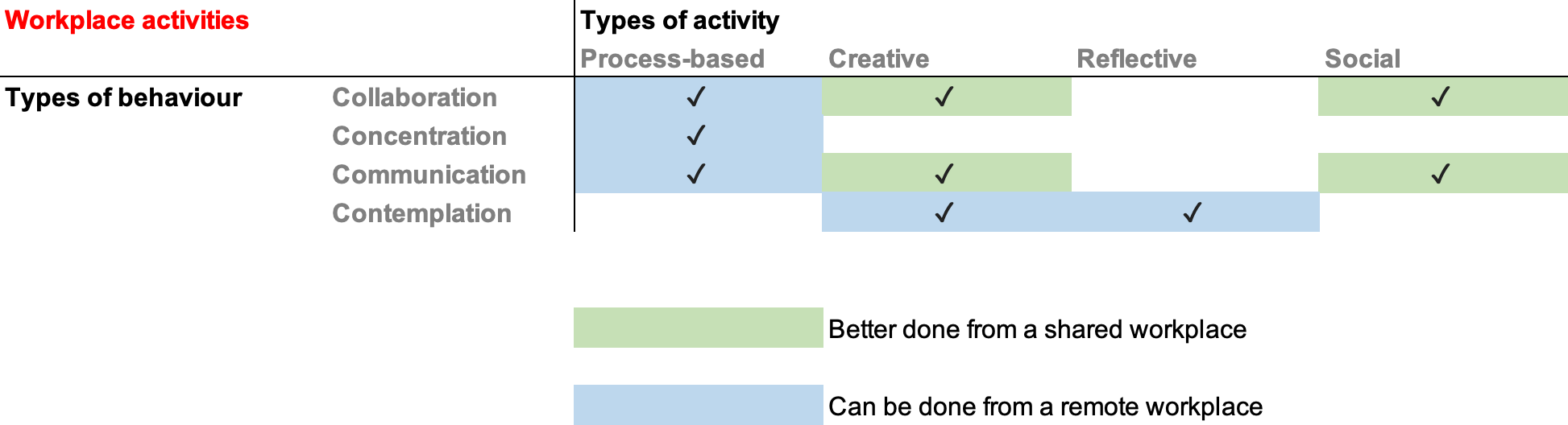
    The question about when we return to work is also a question about how we return to work. For many, remote working has been a revelation. Perhaps not ideal in every respect but certainly helpful in many: the convenience of not commuting, the realisation that Zoom, Teams, Miro, Skype, Whatsapp and other platforms mean it’s possible to stay in touch in ways we hadn’t realised.

    So there’s a fair amount of “unlock inertia” going around and a good set of very reasonable questions being asked:

    • will anyone want to work 9-5 anymore?
    • and on every day of the week?
    • can we carry on having those online meetings because they seem, at least for some purposes, to be more efficient than round-table events?
    • and how do we stop ourselves drifting back to the Old Normal?

    We’ve been discussing the future of work at Space Syntax, both for ourselves and for our clients who we help create workplaces that foster interaction, encourage serendipitous encounters and nurture creativity. I wrote recently about what the office of the future might look like, with no desks and board rooms – a little provocatively for some as it turned out, but deliberately done to stimulate our thinking about why we need offices. (more…)

  • Is physical distancing possible on city streets?

    Is physical distancing possible on city streets?

    Until a vaccine is found for COVID-19, and perhaps beyond, it will be important to practise physical distancing in towns and cities.

    Whether this is possible will come down to the “carrying capacity” of the urban infrastructure: in particular, the relationship between Pedestrian Supply in the form of sufficiently wide footways and Pedestrian Demand in terms of the need for people to walk, whether that is to work, home, school, the shops or for leisure and pleasure.

    Both supply and demand are calculable using tools from tape measures to multi-variable modelling algorithms.

    Screenshot 2020-04-28 at 17.40.49

    Much well-deserved attention has been paid to the Sidewalk Widths NYC project, a digital map that “is intended to give an impression of how sidewalk widths impact the ability of pedestrians to practice social distancing.” By measuring the available width of footways, the map indicates which footways may or may not be suitable for physical distancing.

    Sidewalk width provides an important piece of the “Pedestrian Supply” equation. However, it is not on its own capable of answering the central question: is physical distancing possible?

    First because it is a one-dimensional measure and physical distancing is at least two-dimensional: it may be possible to keep 6 feet to the side of someone else, but is it possible to keep 6 feet in front and 6 feet behind? Given the length of many streets in New York City it may seem apparent that there is plenty of space to go around but the generously wide sidewalks of Times Square demonstrate that, under normal circumstances it is possible for these to be swamped with human activity and, as a result unsuitable for physical distancing under the new normal. Furthermore, it may be possible to observe distancing while walking mid-block but what happens at street intersections? Is there space to queue? Are the street lights synchronised to let one “platoon” of users cross before the next arrives behind them? Is flow predominantly one-directional (which it may often, but not always, be in the rush hour) or two-directional (as it can be at lunchtime)? One-way flows may have less of the “ordered chaos”, the urban ballet of two-way flows and so one-way flows may be more efficient.  (more…)

  • Silver linings: how design can exploit the virus

    Silver linings: how design can exploit the virus

    A “to do” list for urban planners, architects & interior designers, in response to the coronavirus.

    In towns & cities:

    • reduce traffic speeds to 20mph/30kph to discourage speeding on empty streets during lockdown & to keep the air clean, the sound low & the accidents down after the “return”.

    On wide streets:

    • broaden footways to improve physical distancing in the short term & encourage pedestrian flow in the long
    • then narrow roadways further with cycle lanes to support physical activity during lockdown & active commuting on the return.

    In public spaces:

    • provide more shade, more seats, more WiFi
    • place more seats on broadened footways so calls can be answered & people can convert from moving to sitting down…
    • …and so “I’ll call you back” becomes “Just give me a second to sit down.”

    (more…)

  • Beyond placemaking: 7 dimensions of “Place Performance”

    Beyond placemaking: 7 dimensions of “Place Performance”

    Notes from a talk at the Bartlett Real Estate Institute, University College London, 24th April 2019.


    Placemaking is the art and science of planning and designing spaces for human activity, however that is done: ‬

    – by a single hand (usually not a good approach) or by multiple hands (usually a good approach)

    – by academics, professionals and non-professionals. ‬‬

    ‪But beyond placemaking is “place working”, or “place functioning”, or “place performance”: when the planning, design and construction work is finished and the place becomes operational. When it fills with the mysterious liquid called human behaviour. ‬‬‬

    And key to which is human transaction: the everyday social and economic exchanges that take place between people – these transactions not only sustain lives but bring about inventions that shape cultures.

    Place Performance has many dimensions. Here are seven that I have seen work in practice: (more…)

  • Intense relationships: measuring urban intensity

    Enriching design practice by the mapping of human behaviour patterns could transform urban space

    An article published in the Architectural Review on 30th April 2018.

    There’s much debate about how to measure density – dwellings per hectare, bedrooms per hectare or people per hectare; including or excluding major highways, parks and open spaces; the permanent population only or the transient one too? 

    While this gives urban planners something to disagree about, it risks missing the point: great urban places are not created by density; they’re created by intensity. The difference matters. When people describe the buzz of a market they don’t say, ‘Wow – it was so dense’. They’re much more likely to say how intense it was. Density is a word used by planners. Intensity is a word that real people use, and perhaps because it describes the outcomes that people experience rather than the inputs that have gone into creating them. It’s the outcomes that are ultimately more important.

    But planning professionals like density. Even though density doesn’t capture the essence of what it feels like to be somewhere, the term appeals to professional instincts. It describes the raw ingredients that planners have to handle and, once you choose which version of the formula to use, density is easy to measure. It involves a simple calculation of straightforward urban quantities such as the number of people, of houses or of bedrooms, all divided by the geographic area over which those ingredients occur. Easy.

    By contrast, intensity seems more difficult to pin down, not least because it appears to have a subjectively emotional dimension; it speaks of feelings, responses, stimuli; raising problems about how it can be measured. But intensity is also a response to context, to place and above all to people – and here we find clues to its measurement.

    (more…)
  • This town is big enough for the both of us

    This town is big enough for the both of us

    Independent newspaper, UK

    I am standing at the junction of two of the busiest streets in central London – High Holborn and Shaftesbury Avenue. In one direction is Centre Point and the start of Oxford Street; in another Leicester Square; to the south-east is Covent Garden; behind me is Bloomsbury and the giant hulk of the British Museum. It’s quite a vista. But my view only lasts for eight seconds before the little green man turns red and a herd of black cabs rev their engines.

    Pointing down the streets and cursing the crossing barriers that pen in tourists and office workers is Tim Stonor, managing director of Space Syntax, a UCL-affiliated consultancy whose job it is to understand how humans move within spaces like these. They have analysed people flow within the British Museum and helped Norman Foster redesign Trafalgar Square.

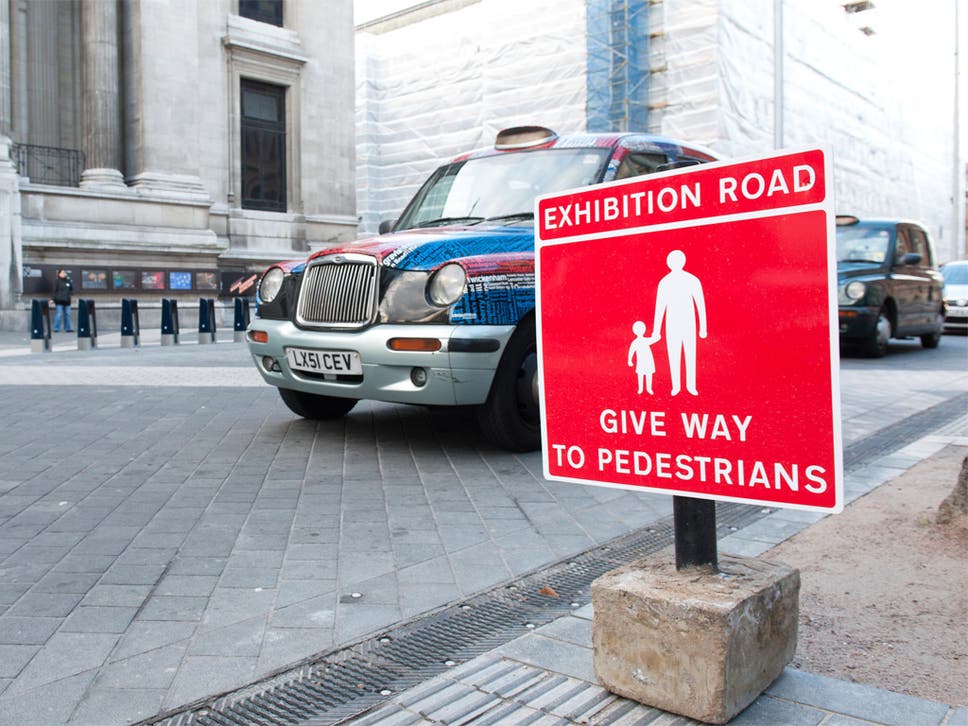
    London is – when compared to car-heavy cities such as Los Angeles – quite easy to navigate on foot. But all too often roads are designed for cars – pedestrians are plodding afterthoughts.

    Read the article