Category: Coronavirus

  • Choosing the office of the future: a time for quality, not quantity

    Choosing the office of the future: a time for quality, not quantity

    Released today, Deloitte Real Estate’s London Office Crane Survey reports a 50% reduction in the construction of new office space in central London in six months. Yet even such a significant reduction in supply may not be enough to offset a greater reduction in demand. As a result, there is likely to be an oversupply of office space in central London. 

    Mike Cracknell, director at Deloitte Real Estate, said, “By transforming outdated buildings into COVID-safe, high-quality workspaces, developers are looking to upgrade and futureproof their offices in a market where occupational demand is increasingly discerning.”

    Indeed, in a buyers’ market, what matters is quality not quantity. And not only the functional specification of office space in terms of health and safety – such as air quality, general environmental cleanliness and the presence or not of touchless interfaces – but also in terms of organisational performance: is this an office in which my organisation can thrive?

    When evaluating their needs, organisations must consider the fundamental purpose of an office. 

    It is no longer enough – if ever it were – to think of an office as a place that’s big enough to get most people together to give them a place to work from where they can occasionally gather in large rooms for group meetings. That can all be done, to some degree of success, on Zoom. Nor is it about having a desk where everyone can work from. For most, a kitchen table or home office may still be good enough. 

    No, what matters is everything that doesn’t get programmed into the working day: the incidental, the serendipitous. Sometimes thought only of in terms of ‘the social side of things’, the informal interactions that occur in offices are actually the hard currency of operational effectiveness. Offices that ‘buzz’ are places where ideas are born and shared. Where people not only want to work but want to stay working. And where outsiders want to visit, bringing with them their own ideas, their own colleagues and, in so doing, enhancing the melting pot of creativity.

    (more…)

  • Office or home – where’s the best place to work from in the New Normal?

    Office or home – where’s the best place to work from in the New Normal?

    Screenshot 2020-05-04 at 16.53.58

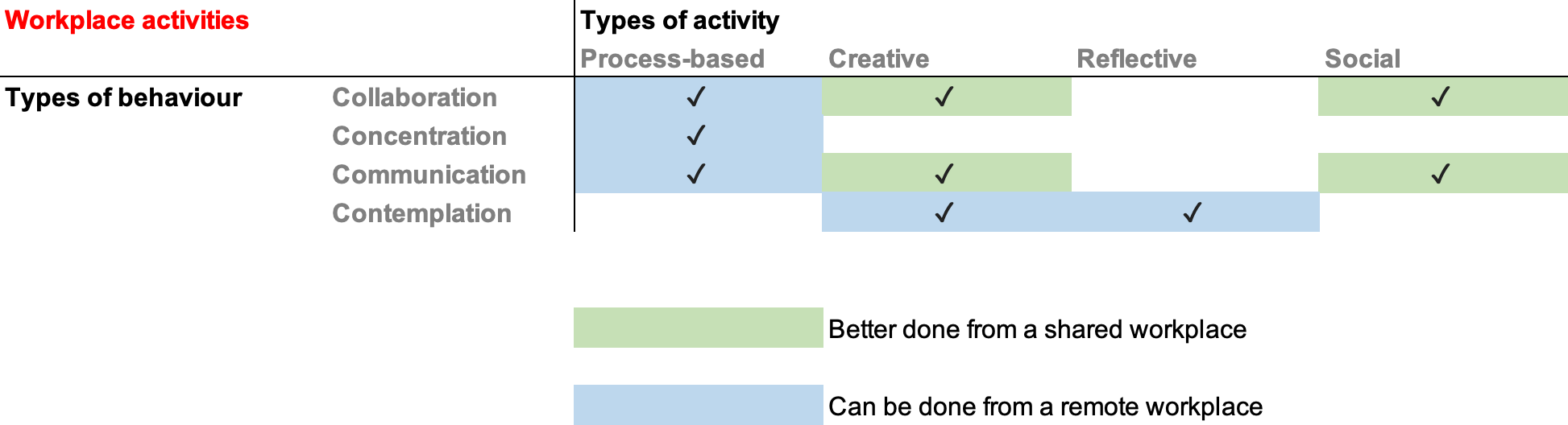
    The question about when we return to work is also a question about how we return to work. For many, remote working has been a revelation. Perhaps not ideal in every respect but certainly helpful in many: the convenience of not commuting, the realisation that Zoom, Teams, Miro, Skype, Whatsapp and other platforms mean it’s possible to stay in touch in ways we hadn’t realised.

    So there’s a fair amount of “unlock inertia” going around and a good set of very reasonable questions being asked:

    • will anyone want to work 9-5 anymore?
    • and on every day of the week?
    • can we carry on having those online meetings because they seem, at least for some purposes, to be more efficient than round-table events?
    • and how do we stop ourselves drifting back to the Old Normal?

    We’ve been discussing the future of work at Space Syntax, both for ourselves and for our clients who we help create workplaces that foster interaction, encourage serendipitous encounters and nurture creativity. I wrote recently about what the office of the future might look like, with no desks and board rooms – a little provocatively for some as it turned out, but deliberately done to stimulate our thinking about why we need offices. (more…)

  • Is physical distancing possible on city streets?

    Is physical distancing possible on city streets?

    Until a vaccine is found for COVID-19, and perhaps beyond, it will be important to practise physical distancing in towns and cities.

    Whether this is possible will come down to the “carrying capacity” of the urban infrastructure: in particular, the relationship between Pedestrian Supply in the form of sufficiently wide footways and Pedestrian Demand in terms of the need for people to walk, whether that is to work, home, school, the shops or for leisure and pleasure.

    Both supply and demand are calculable using tools from tape measures to multi-variable modelling algorithms.

    Screenshot 2020-04-28 at 17.40.49

    Much well-deserved attention has been paid to the Sidewalk Widths NYC project, a digital map that “is intended to give an impression of how sidewalk widths impact the ability of pedestrians to practice social distancing.” By measuring the available width of footways, the map indicates which footways may or may not be suitable for physical distancing.

    Sidewalk width provides an important piece of the “Pedestrian Supply” equation. However, it is not on its own capable of answering the central question: is physical distancing possible?

    First because it is a one-dimensional measure and physical distancing is at least two-dimensional: it may be possible to keep 6 feet to the side of someone else, but is it possible to keep 6 feet in front and 6 feet behind? Given the length of many streets in New York City it may seem apparent that there is plenty of space to go around but the generously wide sidewalks of Times Square demonstrate that, under normal circumstances it is possible for these to be swamped with human activity and, as a result unsuitable for physical distancing under the new normal. Furthermore, it may be possible to observe distancing while walking mid-block but what happens at street intersections? Is there space to queue? Are the street lights synchronised to let one “platoon” of users cross before the next arrives behind them? Is flow predominantly one-directional (which it may often, but not always, be in the rush hour) or two-directional (as it can be at lunchtime)? One-way flows may have less of the “ordered chaos”, the urban ballet of two-way flows and so one-way flows may be more efficient.  (more…)

  • No board rooms, no desks. The office of the future…

    No board rooms, no desks. The office of the future…

    Images of future offices, with physically distanced workstations to separate desk-bound workers, seem to miss the point. Offices aren’t for staying apart – they’re for coming together. But how can that be organised in a post-COVID world?

    Offices have desks because we’ve long thought that people couldn’t or shouldn’t work from home. Attitudes were changing slowly, with progressively greater levels of home working in recent years. Now, enforced lockdown has shown, in a short space of time, that for many of us it’s entirely possible to do much of our work from the place we live.

    This is especially so when we’ve got the right kit and the right applications, and when we’ve moved sufficiently well along the learning curve to use our tech properly. And home working is likely to be even easier when, for many, the kids are back at school and home is an emptier, quieter and less disruptive place to be.

    To continue to be relevant, to be attractive to people who are used to the comforts of home working, offices should no longer be boxes where people sit further apart from each other. Instead, they need to be places for doing what can’t be as easily done at home:

    ⁃ serendipitous encounter outside of planned meetings

    ⁃ overheard conversations that prompt interruptions, discussions and, as a result, new ideas

    ⁃ introductions between the person you’re with and the person you bump into. (more…)

  • Silver linings: how design can exploit the virus

    Silver linings: how design can exploit the virus

    A “to do” list for urban planners, architects & interior designers, in response to the coronavirus.

    In towns & cities:

    • reduce traffic speeds to 20mph/30kph to discourage speeding on empty streets during lockdown & to keep the air clean, the sound low & the accidents down after the “return”.

    On wide streets:

    • broaden footways to improve physical distancing in the short term & encourage pedestrian flow in the long
    • then narrow roadways further with cycle lanes to support physical activity during lockdown & active commuting on the return.

    In public spaces:

    • provide more shade, more seats, more WiFi
    • place more seats on broadened footways so calls can be answered & people can convert from moving to sitting down…
    • …and so “I’ll call you back” becomes “Just give me a second to sit down.”

    (more…)