Category: Business

  • Office or home – where’s the best place to work from in the New Normal?

    Office or home – where’s the best place to work from in the New Normal?

    Screenshot 2020-05-04 at 16.53.58

    The question about when we return to work is also a question about how we return to work. For many, remote working has been a revelation. Perhaps not ideal in every respect but certainly helpful in many: the convenience of not commuting, the realisation that Zoom, Teams, Miro, Skype, Whatsapp and other platforms mean it’s possible to stay in touch in ways we hadn’t realised.

    So there’s a fair amount of “unlock inertia” going around and a good set of very reasonable questions being asked:

    • will anyone want to work 9-5 anymore?
    • and on every day of the week?
    • can we carry on having those online meetings because they seem, at least for some purposes, to be more efficient than round-table events?
    • and how do we stop ourselves drifting back to the Old Normal?

    We’ve been discussing the future of work at Space Syntax, both for ourselves and for our clients who we help create workplaces that foster interaction, encourage serendipitous encounters and nurture creativity. I wrote recently about what the office of the future might look like, with no desks and board rooms – a little provocatively for some as it turned out, but deliberately done to stimulate our thinking about why we need offices. (more…)

  • Is physical distancing possible on city streets?

    Is physical distancing possible on city streets?

    Until a vaccine is found for COVID-19, and perhaps beyond, it will be important to practise physical distancing in towns and cities.

    Whether this is possible will come down to the “carrying capacity” of the urban infrastructure: in particular, the relationship between Pedestrian Supply in the form of sufficiently wide footways and Pedestrian Demand in terms of the need for people to walk, whether that is to work, home, school, the shops or for leisure and pleasure.

    Both supply and demand are calculable using tools from tape measures to multi-variable modelling algorithms.

    Screenshot 2020-04-28 at 17.40.49

    Much well-deserved attention has been paid to the Sidewalk Widths NYC project, a digital map that “is intended to give an impression of how sidewalk widths impact the ability of pedestrians to practice social distancing.” By measuring the available width of footways, the map indicates which footways may or may not be suitable for physical distancing.

    Sidewalk width provides an important piece of the “Pedestrian Supply” equation. However, it is not on its own capable of answering the central question: is physical distancing possible?

    First because it is a one-dimensional measure and physical distancing is at least two-dimensional: it may be possible to keep 6 feet to the side of someone else, but is it possible to keep 6 feet in front and 6 feet behind? Given the length of many streets in New York City it may seem apparent that there is plenty of space to go around but the generously wide sidewalks of Times Square demonstrate that, under normal circumstances it is possible for these to be swamped with human activity and, as a result unsuitable for physical distancing under the new normal. Furthermore, it may be possible to observe distancing while walking mid-block but what happens at street intersections? Is there space to queue? Are the street lights synchronised to let one “platoon” of users cross before the next arrives behind them? Is flow predominantly one-directional (which it may often, but not always, be in the rush hour) or two-directional (as it can be at lunchtime)? One-way flows may have less of the “ordered chaos”, the urban ballet of two-way flows and so one-way flows may be more efficient.  (more…)

  • SMEs and large businesses

    We heard it said this afternoon (UK-China Sustainable Urbanisation Conference) that SMEs need large businesses to help them find work. I have a different perspective, born of twenty years’ experience in creating and running an SME, Space Syntax.

    First, not all small companies want to become large companies. Bigger is not always better, yet this is the conventional wisdom. Small companies are agile. Large companies are often slow and conservative.

    Second, small companies help large companies find work. It doesn’t only work the other way round. My company regularly introduces large companies – some of the largest in our industry – to new opportunities.

    Of course small companies benefit from the strength of large companies. But don’t let’s think the large companies are doing us a favour. Far from it.

  • Designing Resilient Cities – creating a future Avalon

    Designing Resilient Cities – notes from Day 1
    A note from the Vice-Mayor for Infrastructure to the Mayor

    cc
    Vice-Mayor for Sustainability
    Vice-Mayor for Engagement
    Vice-Mayor for Disruption
    The Public

    Avalon faces the risk of functional failure. The only way forward is to change.

    Our infrastructure is inefficient. It needs to become efficient. This is not just a question of maintenance. There won’t be enough money to run the transport network, supply water, remove waste, provide broadband. Unless the city either shrinks to a size its current economic structures can afford; or grows to create a larger tax base – so long as the city can retain control over how that tax is spent.

    The view of the infrastructure team is that Avalon should grow. But not off the back of its existing industries. These are running out of steam. The industrial infrastructure of the city needs to expand and to reinvigorate. Creative industries will be central to this.

    A new population will come to Avalon. A younger population, joining the older, wiser and more experienced population that built the city’s wealth in the 20th century. Joining young people who, having grown up in Avalon have chosen to stay there rather than take the increasingly well-trodden path elsewhere. The city has seen too much of this. Its infrastructure of talent must be rebuilt.

    And these people will need somewhere to live. Houses that are affordable. We need to build.

    But this does not mean ever further sprawl into our precious countryside – which is too beautiful and too productive to become a building site. No, it means building on our existing urban footprint. We need to find space within the city, not outside. Some of our redundant industrial sites will provide excellent places for new housing: close to transport infrastructure, with excellent, ready-made supplies of water and power. We need to look hard at the vast city parks that were built many years ago and have simply not worked as they were intended – they have harboured crime rather than nurtured culture.

    And culture is central to what we must do. Avalon needs to recapture the spirit in which it was first built: a pioneering spirit where anything was possible. Music, art, sculpture, performance: song and dance – we were good at it when we tried. The future memories of Avalon will be built on the strength of the cultural infrastructure that we put in place in the next few years.

    And to achieve all of this we need to change the way that we make decisions in the city. No more top down dictats. We need a governance infrastructure that involves everyone: participatory planning, budgeting and decision-taking. An elected mayor for a start.
    _____________

    Components of infrastructure
    Demographics
    Life satisfaction.

    Transportation
    – on ground
    – above ground
    – below ground.

    Health
    Not just
    – physical buildings

    but also
    – insurance.

    Security
    – police
    – building protection
    – wellbeing.

    Equality

    Utilities
    – water
    – gas
    – waste
    – digital.

    Green environment

    Culture
    – facilities.

    Place
    – connections.

    Diagnosis
    Avalon is…

    Set in its ways.

    Boring.

    No desire to change.

    Reliant on the public sector.

    Declining core industry.

    Few common places.

    Weak cultural identity.

    Car-reliant.

    Running out of time.

    Risks
    Functional failure
    – not enough revenue to run the city.

    Fragmentation
    – in governance, leading to rivalry and underperformance.

    Disenchantment
    – no sense of belonging.

    Disconnection
    – of people from planning
    – reinforced by physical remoteness of outlying centres.

    Civic unrest
    – class distinctions, unintegrated, breeding distrust.

    Poverty
    – when older population retire.

    Complacency

    Cultural sterility
    – no fun
    – no stimulation
    – no sense of belonging.

    Industrial stagnation
    – no innovation.

    Objectives
    Governance
    – committees to reflect areas
    – directly elected mayor
    – participatory planning
    – devolved management of infrastructure.

    Identity
    – common vision
    – campaign
    – slogan.

    Industry
    – built around the creative industries
    – attracting people from outside, not only serving existing population
    – business development area
    – enhance links to surrounding agriculture.

    Public realm
    – enhanced

    Consumption
    – reduce
    – reuse
    – recycle
    – multiple uses of each infrastructure asset e.g. reservoir is boating lake.

    Housing
    – more affordable.

    Density
    – intensify existing urban footprint rather than further sprawl.

    Connectivity
    – revitalise the centre.

    Transport
    – integrate existing modes.
    _____________

    Designing City Resilience is a two-day summit at the RIBA, 17-18th June 2015. Avalon is one of four imaginary cities being looked at during the event in a creative approach that breaks the mould of typical, presentation-only conference agendas. By engaging in a rapid prototyping exercise, delegates immediately test the ideas they have heard in the keynote presentations and on-stage discussions. They also bring to the event their own international experiences.

    The result is a two-way, creative conversation that produces a richer outcome: a set of designs for the transformation of the physical, spatial, environmental, industrial, educational, healthcare and governmental structures of the four cities.

  • Integrated Urbanism – Massachusetts & the United Kingdom Partnership Forum

    Introduction
    Good afternoon Governor Patrick, visiting delegates and colleagues from the UK. As a recent resident of Massachusetts myself, it is a special pleasure to speak alongside the Governor on the subject of data and cities: and to share some remarks on the common interest in this room: the science of cities.

    Massachusetts and the United Kingdom Partnership Forum

    A few words about me: I am an architect and an urban planner in private practice. My company, Space Syntax is a consulting company that specialises in predictive analytics – using data science to forecast the impact of urban planning decisions – the “what goes where and how does it all connect together” – on urban impacts such as mobility, interaction, wealth, health and personal safety. (more…)

  • Building a Smart City modelling team

    Integrated Urban Model

    .

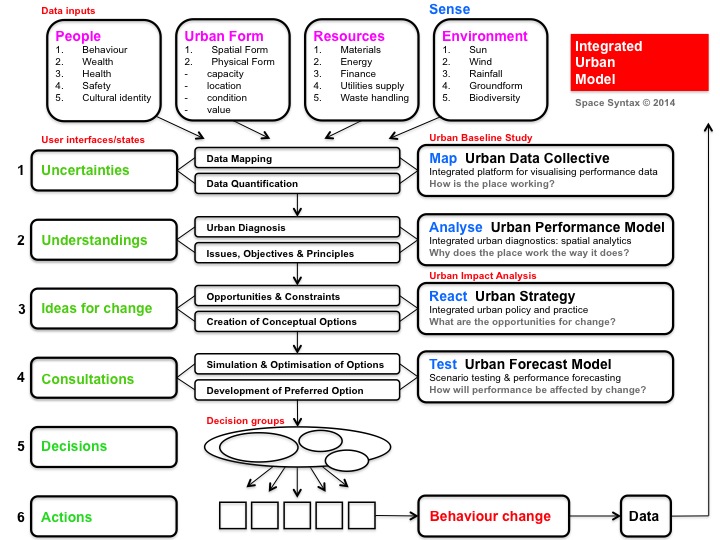
    Cities planning their future are increasingly turning to the production of Integrated Urban Models. These are tools that bring together various datasets on different asoects of urban performance, from the behaviour of people to the flows of energy, water and other utilities. The aim is to better predict the future of cities by better understanding how they are currently working.

    This is a nascent but rapidly developing field in which knowledge is emerging and evolving at a pace. Given the complexity of cities it is a good idea to involve many specialists in different subjects, led by an Urban Modelling Advisory Panel (UrbanMAP).   (more…)

  • Space Syntax: the push of intent, the pull of need and the resistance of the “pre-digital”

    I was asked an interesting question yesterday about the barriers to growth and acceptance of Space Syntax and Integrated Urban Models.

    I believe there are three important components to the answer.

    First, the growth of Space Syntax Limited‘s business was robust for 19 years, following its startup as a UCL spinoff company in 1989 – until 2008, when the bottom dropped out of the global real estate market. In that initial period, the company’s turnover grew at an annual rate of over 20%. This allowed continuous staff growth and market penetration. During this time the company devoted profits to the production of new software and new research findings as well as a modest return to shareholders and staff bonuses. It invested this way because it was determined that its growth should be about long term success and sustainability, not short-term reward.

    2008 saw the global financial crisis hit the urban planning and design industry at home and abroad. This disrupted the growth curve at Space Syntax for two years. The company is today back on an accelerated growth track having seen consistent turnover growth at over 40% in each of the past two years, the steepest rate in its history. (more…)

  • Going to “work” is actually going to “interact”

    Why is people movement important in buildings?
    In a knowledge economy, the key role of buildings is the production and dissemination of new knowledge to drive innovation.

    Awareness leads to interaction leads to transaction.

    Spatial layout works with management style to create a “spatial culture”.

    Corner offices v corridors
    People should sit based on need not based on status. Needs change during the day and during the week so people should move. Offices should provide different kinds of work environment. Open plan and busy when you need more interaction. Corner office/cellular when you need less. Management should permit workers to choose where they want to sit – this is part of trusting workers to perform and businesses will perform better as a result of having great space and great people.

    Effects of technology
    Technology will not replace the office because what matters is making “first contact” and this is harder online – much easier face to face.

    Going to work is about going to interact.

  • A short film about Space Syntax

    Tim Stonor, Managing Director, Space Syntax
    “The population of the world is increasing and, as it increases, more and more of us are living in cities. As cities have grown in the 20th century they have often grown to disconnect people.

    Space Syntax has discovered that many of these problems in cities – disconnection, lack of contact between people, lack of access to jobs – come down to the way in which the city is planned as a layout of space.”

    Ronan Faherty, Commercial Director, Land Securities
    “As a developer, the most important thing for us is understanding the consumer and anything that assesses the consumer and helps us understand them provides real value. When you’re putting down a new property into an existing space we want to understand where consumers are coming from and then how they should engage with the property: where we should put escalation and movement and flows. (more…)