Category: Big Data

  • The urban cortex

    The urban cortex

    A talk given at Lombardini22 architects in Milan on 13th May 2025.

    The idea I’d like to explore this evening is that cities serve a higher purpose than we typically credit them with, and this idea is that cities are natural extensions of the human brain. Far from being artificial, alien objects, cities work with us, their users, to help us solve the problems of our times. Cities are extensions of our brains and, just like our brains, cities are sophisticated computers.

    At least they are, if we design them well. 

    Great cities are not just beautiful to look at and stimulating to be in. They are also highly efficient human transactions machines: bringing people together to form relationships and generate outcomes. Cities are the outermost layer of our common existence. Hence the title of this talk: the ‘urban cortex’.  

    One challenge when discussing cities is that urban commentators often begin by describing cities as chaotic, that their street networks are ‘labyrinthine’. This is a lazy approach to urbanism – and not one that we share at Space Syntax. Instead, we’ve spent the last 50 years studying the apparent chaos of cities and discovering regularities within them – of spatial layout, of land use distribution, of density, mobility and the distribution of inequalities. 

    These discoveries help us both to understand cities and to better design them. 

    Cities are not chaotic. We don’t build them by chance. Within their apparently labyrinthine randomness there are structures that organise the ways we move through cities – and interact with each other within them.

    There are regularities that allow us to understand cities – not just as urban scientists might pick them apart but as every day users make sense of the places they’re in:

    • how they feel comfortable in them
    • feel like they want to visit and explore them
    • meet people in them
    • go to work in them
    • invest their time and their money 
    • have fun
    • feel excitement. 

    This is the ‘urban buzz’ that draws people to cities.  

    (more…)
  • What will cities look like 30 years from now?

    What will cities look like 30 years from now?

    I joined a carbon reduction event yesterday where, by way of introducing ourselves, we were each asked to predict the future: what did we think we would see more of in 2050 – in terms of objects, experiences and services. A neat little ice-breaker if ever there was one.

    Here are my top-of-the-head responses:

    1. Object

    Green, shaded main streets

    ⁃ fronted by shops at ground level with people living above them

    ⁃ lined by trees that provide shade, lower air temperatures, disperse strong winds and encourage walking

    ⁃ forming the centres of local neighbourhoods that are built relatively densely but that are also intensely green (green walls, green roofs, green verges

    ⁃ connected into a secondary network of slow streets that people can walk, cycle and drive along.

    2. Experience

    Conviviality: the “Urban Buzz”

    – people standing, sitting, talking and generally being present with one another, forming local communities.

    3. Service

    Data-driven urban planning & design

    – harnessing machine learning and AI-driven algorithms to create future plans and predict their impacts.

    The first two will help address the Climate Emergency by reducing transport emissions. The third will threaten the established authority of the architectural and urban planning professions, which will need to adapt to survive by accelerating their uptake of digital tools.

  • Is physical distancing possible on city streets?

    Is physical distancing possible on city streets?

    Until a vaccine is found for COVID-19, and perhaps beyond, it will be important to practise physical distancing in towns and cities.

    Whether this is possible will come down to the “carrying capacity” of the urban infrastructure: in particular, the relationship between Pedestrian Supply in the form of sufficiently wide footways and Pedestrian Demand in terms of the need for people to walk, whether that is to work, home, school, the shops or for leisure and pleasure.

    Both supply and demand are calculable using tools from tape measures to multi-variable modelling algorithms.

    Screenshot 2020-04-28 at 17.40.49

    Much well-deserved attention has been paid to the Sidewalk Widths NYC project, a digital map that “is intended to give an impression of how sidewalk widths impact the ability of pedestrians to practice social distancing.” By measuring the available width of footways, the map indicates which footways may or may not be suitable for physical distancing.

    Sidewalk width provides an important piece of the “Pedestrian Supply” equation. However, it is not on its own capable of answering the central question: is physical distancing possible?

    First because it is a one-dimensional measure and physical distancing is at least two-dimensional: it may be possible to keep 6 feet to the side of someone else, but is it possible to keep 6 feet in front and 6 feet behind? Given the length of many streets in New York City it may seem apparent that there is plenty of space to go around but the generously wide sidewalks of Times Square demonstrate that, under normal circumstances it is possible for these to be swamped with human activity and, as a result unsuitable for physical distancing under the new normal. Furthermore, it may be possible to observe distancing while walking mid-block but what happens at street intersections? Is there space to queue? Are the street lights synchronised to let one “platoon” of users cross before the next arrives behind them? Is flow predominantly one-directional (which it may often, but not always, be in the rush hour) or two-directional (as it can be at lunchtime)? One-way flows may have less of the “ordered chaos”, the urban ballet of two-way flows and so one-way flows may be more efficient.  (more…)

  • Cities from scratch – Astana Economic Forum

    Cities from scratch – Astana Economic Forum

    Good afternoon. I’m delighted to be a member of this panel today.

    Let me start by describing my organisation’s approach to the creation of cities from scratch.

    Space Syntax is an international urban planning and design studio and has been involved in plans for new cities and new city extensions throughout the world, including here in Kazakhstan.

    Our approach is built on three key ingredients: (more…)

  • Intense relationships: measuring urban intensity

    Enriching design practice by the mapping of human behaviour patterns could transform urban space

    An article published in the Architectural Review on 30th April 2018.

    There’s much debate about how to measure density – dwellings per hectare, bedrooms per hectare or people per hectare; including or excluding major highways, parks and open spaces; the permanent population only or the transient one too? 

    While this gives urban planners something to disagree about, it risks missing the point: great urban places are not created by density; they’re created by intensity. The difference matters. When people describe the buzz of a market they don’t say, ‘Wow – it was so dense’. They’re much more likely to say how intense it was. Density is a word used by planners. Intensity is a word that real people use, and perhaps because it describes the outcomes that people experience rather than the inputs that have gone into creating them. It’s the outcomes that are ultimately more important.

    But planning professionals like density. Even though density doesn’t capture the essence of what it feels like to be somewhere, the term appeals to professional instincts. It describes the raw ingredients that planners have to handle and, once you choose which version of the formula to use, density is easy to measure. It involves a simple calculation of straightforward urban quantities such as the number of people, of houses or of bedrooms, all divided by the geographic area over which those ingredients occur. Easy.

    By contrast, intensity seems more difficult to pin down, not least because it appears to have a subjectively emotional dimension; it speaks of feelings, responses, stimuli; raising problems about how it can be measured. But intensity is also a response to context, to place and above all to people – and here we find clues to its measurement.

    (more…)
  • Intelligent mobility: risks & rewards

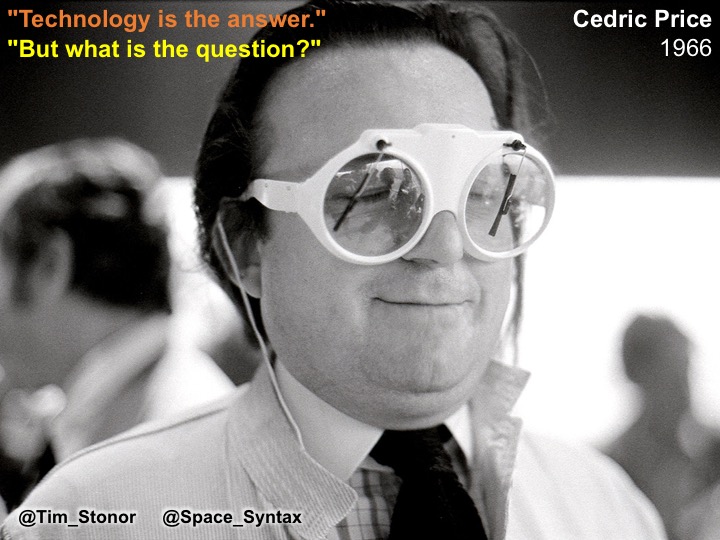
    第一页   技术就是答案
    Slide 1       Technology is the answer

    Slide01

    1966年,塞德里克·普莱斯说,我喜欢一开始就对新技术进行一点质疑。当然,“技术就是答案”。他也强调:“不过问题是什么?”。
    I’d like to begin with a little scepticism about new technology. Of course “Technology is the answer“, said Cedric Price in 1966. He also said, “But what is the question?”

    这些问题就是我们试图去获得无人驾驶技术。
    What are the questions that we are trying to answer in the pursuit of autonomous vehicle technologies?

    我认为仅仅从驾驶员的角度去谈论智慧出行,并不充分。 我喜欢从整个城市的角度去考虑收益。如果我们过度关注车辆而不是城市,那么风险也是需要考虑的。
    I don’t think it’s enough to talk about intelligent mobility from the perspective of the driver alone. I’d like us to think about its benefits for cities as a whole. And the risks too, if we focus too much on the vehicle and not enough on what’s around it: the city. (more…)

  • Notes from first ULI UK Tech Forum

    1. We need to have a clear definition of technology. Physical as well as digital technology. Users and uses as well as creators and providers. Pre-construction, construction, post-construction. 

    2. Because we’ve always had technology:

    a. Writing (wooden stylus & wax tablet) movement

    b. Air conditioning – occupancy

    c. Underfloor heating – occupancy

    d. The shower – personal

    e. Bicycle – movement

    f. Revolving door – occupancy

    g. The elevator – occupancy

    h. The car – movement

    i. Solar panels – occupancy

    j. The Internet – movement & occupancy

    k. Autonomous vehicles – movement

    l. Drones – movement

    m. Photofungal trees – place
    We’ve always had technology. It’s always changed. Perhaps the pace is accelerating globally (but we shouldn’t forget the industrial revolution). 

    3. What hasn’t changed is the fundamental purpose of cities: social and economic trade. 

    4. In the future, autonomous vehicles will change the nature of movement. They will permit people to be far more productive while they drive. 
    5. Another key, and consequential, change will be in the nature of physical connections, transformed from highways to streets. Connectivity (as Chris Choa suggested) as an asset. 

    6. Therefore the street as an asset. The piazza as an asset. Not just the buildings that line them. The suburban business park will go the way of the dinosaurs. 

    7. The nature of online interaction is a further area of significant new change. 

  • We are what we street. The elements of successful #urban placemaking

    PART ONE – THE ELEMENTS OF SUCCESSFUL URBAN PLACEMAKING
    Location
    How the site fits into its context, including complementary and competitive attractions; in other words, what else is nearby to which the design should respond? The success of any development, no matter how large, is a function of the wider setting.

    Linkage
    The specific points at which connections can be made into this context, including public transport connections; in other words the “gateways” into the design.

    Layout
    The spatial layout design of the project itself in terms of its streets and spaces, whether public/private or open/covered, and the importance of:

    – first, encouraging through movement connections between gateways

    – second, providing a simple, intelligible internal circulation network through a grid of streets and other connections.

    This is the most important of the five elements since the spatial layout, once created, tends to be the most permanent part of the development. It is the most expensive to alter once constructed since it sets out the footprints of buildings and, importantly, since it carries the bulk of major services such as energy, water and data supply as well as waste handling.

    Land use
    The quantum of different land use attractions and the disposition of these within the spatial layout both in two and three dimensions; in other words where uses are and how they stack up, especially the land uses that occur at street level and any other principal pedestrian levels.

    The location of land uses should follow the hierarchy of spatial connections created by the spatial layout design, with the most movement-sensitive land uses located on the most spatially important connections and so on. This alignment of land use attraction with spatial layout attraction is a fundamental property of both historic cities and successful modern places.

    Landscape
    How the spatial layout is “dressed” both in terms of the “green/blue” landscape of planting and water and the “architectural” landscape of building frontages at the principal pedestrian levels.

    Here what matters is that the spatial layout is not overly fragmented or dispersed by planting and that the principal pedestrian levels are lined with open, active frontages.

    PART TWO – THE DESIGN
    The five elements of successful placemaking establish a framework for design practice. What matters next is the way in which these generic principles are translated into a specific design proposal. This is a creative step, which relies on a blend of imagination and craft, honed by experience.

    The challenge for future urban practice is that the five elements are not commonly appreciated in the field of retail development, which has instead adopted principles of gravitational attraction that tend to create anchored, inward-facing, covered malls rather than open, street-based shopping streets, whether we call such streets “high streets” or “souqs”.

    PART THREE – THE WAY FORWARD
    It has been, and will continue to be, down to pioneering organisations to point out what is increasingly obvious to all but those who are too immersed in it: that anchored malls create sterile places; and then for these pioneers to deliver new places that work because they employ the timeless elements of successful placemaking.

    Fortunately, this challenge is facilitated by the continued emergence of technology-based tools for analysing location, identifying points of linkage, testing different layout concepts and modelling the interaction of these with different land use and landscape treatments.

  • We don’t guess the structural performance of individual buildings so why do we guess the human performance of entire cities?

    We don’t guess the structural performance of individual buildings so why do we guess the human performance of entire cities?

    The structural steelwork of a large and complex building would not be designed without running engineering calculations. Even the smallest of buildings is subject to objective structural analysis. No client and professional team would rely on guesswork, no matter how famous or experienced the architect or engineer.

    So why do we leave the human performance of places to the whim of architects who run no calculations and rely only on their instinct and ego? Why is the science of human behaviour so poorly developed? Why is chronic failure still tolerated?

    In the early sixteenth century, William Harvey challenged the medical profession to take a more objective, more observation-driven approach to the understanding of the circulation of blood. At the time, medical thinking was largely based on the beliefs of Galen of Pergamon, who had set these out in the second century. Harvey challenged a medical mindset that hadn’t changed in one and a half millennia. And he encouraged his peers to embrace advances in science that allowed new forms of investigation.

    We can see a similar state of affairs in the prevalence of, and institutional inertia around, twentieth century planning. Based on belief, not observation-based science, a doctrinal approach to urban planning and design pervades the professions. This is the case, whether the specific approach is Modernism, the Garden City movement or (and especially) Landscape Urbanism. Each is to some degree unscientific.

    These approaches propose different kinds of urban outcomes but what unites them is a belief that the future should look fundamentally different to the form of continuously connected, dense and mixed-use urbanism found in cities for as long as there have been cities – the kind of urbanism that architects and town planners visit on their holidays.

    The kind of urbanism – and here’s the irony – that Galen would have recognised. If only architecture and town planning were stuck in a fifteen hundred-year-old mindset. We would still have vehicles on the road but we wouldn’t have vehicle dominance. We wouldn’t have land use zoning that generates long-distance commuting, traffic congestion and negative health impacts. We wouldn’t be encroaching on the rural landscape with semi-detached, density-fearing dwellings.

    Fundamental change in our professions is needed and science has an important part to play. In the spirit of Harvey’s observation-based approach, we need to embrace the new capabilities offered by sensing, analytics and modelling. We need to understand how cities truly work before we then form ideas about how to change them. We must move beyond the beliefs of twentieth century practice. The evidence is there to demonstrate that practice based on belief hasn’t delivered great places with the consistency required either by the investors in them or the users of them.

    We can learn from Harvey, even if our end goal is the urbanism of Galen.

  • How cities connect people across space & time

    How cities connect people across space & time

    The subject of “connectivity” is much mentioned in urban planning practice, not least by the Space Syntax community. 

    But what do we mean by connectivity? 

    1. Urban practice should connect across different scales of activity:

    Urban Planning (macro scale)

    Urban Design (meso scale)

    Building Design (micro scale)

    ie 3 scales of space.

    2. Urban practice should also connect across different phases of activity:

    Design (before construction)

    Construction (during construction)

    Operations (after construction)

    ie 3 phases of time

    This gives urban practice a clear space/time organisational framework. 

    3. This framework can then be used to discuss the subject of connectivity according to several key dimensions:

    Physical connections – connecting buildings, streets and spaces.

    Human connections – connecting people with each other.

    Environmental connections – connecting human interventions to the natural environment: climate, topography. 

    Digital connections – using data to support physical connections and enhance human connections. 

    Professional connections – connecting across practice boundaries. 

    Connectivity is key. But how we connect is complex and multi-dimensional.

  • Sustainability & resilience – a SMART approach

    Sustainability & resilience – a SMART approach

    1. Aspects of sustainability/resilience: SMART outcomes
    Social – improvements in formation & retention of social connections

    Environmental – increases in renewable energy production and reductions in energy demand

    Economic – increases in land value creation

    Health – improvements in public health outcomes

    Education – improvements in achievements/qualifications

    Safety – reductions in offending & reoffending.

    Environmental
    Urban carbon footprint is made up of:
    1. Building carbon.
    2. Transport carbon.

    Urban carbon reduction can be achieved by:
    1. Building carbon reduction – intelligent building services: heating/cooling, lighting.
    2. Transport carbon reduction – walking, cycling, public transport & less private vehicle use.

    2. Process specification: SMART inputs
    1. Integrated Urban Modelling of existing building performance and transport performance.
    2. Predictive Urban Modelling of expected development impacts.

    3. Asset requirements for SMART approach
    1. Pervasive data sensing
    2. Data mapping – centrally coordinated & then distributed eg open platform distribution
    3. Data analysis – undertaken by city, academia & industry then shared
    4. Planning & design response – use of data to create development proposals
    5. Development proposal testing – using the Integrated Urban Model.

  • Sustainable cities of the future – sketch

    Notes for keynote at UK Green Building Council Annual City Summit, Birmingham.

    1. Spatial planning & human behaviour implications of sustainability – reduction of transport carbon through shift towards walking, cycling & public transport

    2. A massive shift needed in transport + land use planning, urban + landscape design, architecture. Professional inertia. Turning the supertanker.

    3. A massive opportunity. Reason to turn.

    4. Lessons from the past eg Pompeii, Brindley Place.

    5. Examples from the present eg Darwin, London SkyCycle, Birmingham Charette.

    6. UK government: Smart & Future cities agenda is a sustainability agenda.

    7. Social inequalities dimension of sustainability.

    8. Need to act at all scales simultaneously ie there’s work for all of us to do.

    9. Challenge for modelling.

    10. Challenge for research.

    11. Challenge for practice: design, development & real estate investment.

    12. Already being acted on. The supertanker is turning.

  • Past, present & future_Space Syntax in practice

    Past, present & future_Space Syntax in practice

    [Speaking notes for Tim Stonor’s opening presentation at the First Conference on Space Syntax in China, Beijing, 5th December 2015.]

    Good morning. It is an honour to be speaking at this important conference alongside so many distinguished speakers and attendees.

    My talk today will cover the past, present and future of Space Syntax Limited’s experience working on projects in London and around the world, including here in China.

    As you heard from Professor Hillier, the relationship between academic research and practice is fundamental. Practice provides an opportunity to apply Space Syntax techniques – and it also provokes new research questions. (more…)