Category: Spatial planning

  • Building a Smart City modelling team

    Integrated Urban Model

    .

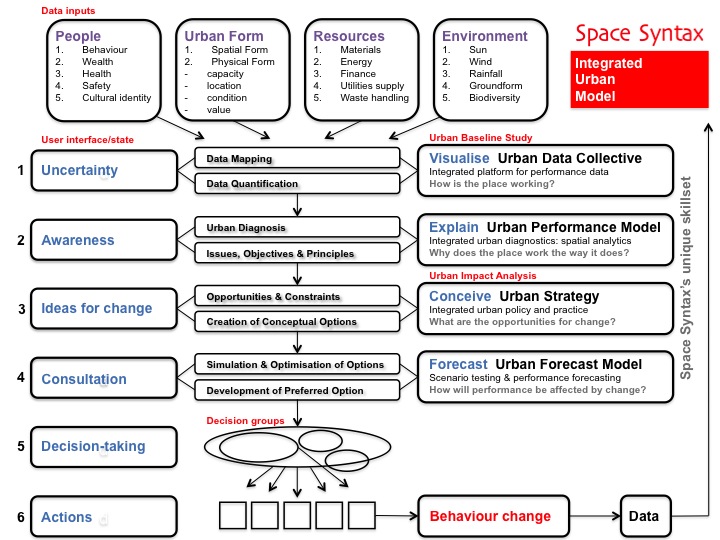
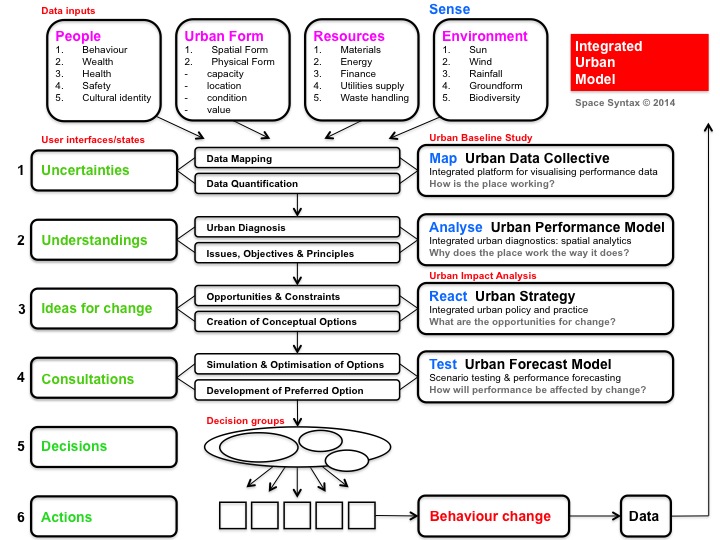
    Cities planning their future are increasingly turning to the production of Integrated Urban Models. These are tools that bring together various datasets on different asoects of urban performance, from the behaviour of people to the flows of energy, water and other utilities. The aim is to better predict the future of cities by better understanding how they are currently working.

    This is a nascent but rapidly developing field in which knowledge is emerging and evolving at a pace. Given the complexity of cities it is a good idea to involve many specialists in different subjects, led by an Urban Modelling Advisory Panel (UrbanMAP).   (more…)

  • From cities of movement to places of transaction

    Summary of Tim Stonor’s talk at the World Cities Summit, Singapore, 3rd June 2014

    From cities of movement to places of transaction – a new mobility focus for city leaders, planners and everyday users

    Key responsibilities for cities
    1. Imagining the future of cities and mobility.

    2. Designing integrated, people-focused planning to sustain cities.

    3. Measuring the social, economic and environmental value created by the movement, interaction and transaction of people.

    The fundamental purpose of cities
    Cities are for transaction: economic and social transaction. People come to cities to trade. It is why we have cities – they are intensifications of opportunities to trade. The public realm of the city – its network of streets and spaces – is where much of this trade occurs: a “transaction machine” which, like any machine, is more or less efficient depending on how it is engineered. (more…)

  • What exactly is human scale?

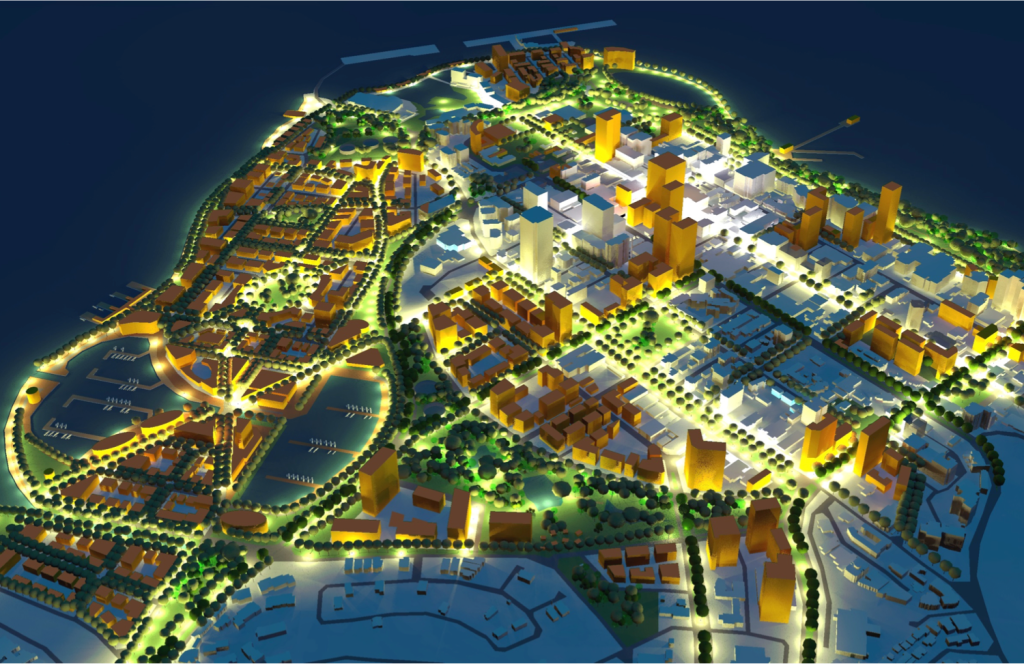
    Darwin masterplanDarwin City Centre Masterplan, Space Syntax

    For too long, architects and urban planners have pursued the myth that human scale means “local” scale. In doing so, they have downscaled space, thinking that by fragmenting and disconnecting towns and cities into small enclaves they would be creating “community”. They were wrong.

    Isolated and disconnected, people on inner -city housing estates, new towns and sprawling housing developments have found it hard to form social networks. To engage with the outside world. To be human.

    And this form of urban planning prevails, being exported to developing cities worldwide.

    In contrast, human scale is a combination of the local and the global, acting simultaneously on the individual. We are, unsurprisingly, more sophisticated than we were given credit for.

    What do I mean? Well, consider having a doorstep conversation with a neighbour while watching the world go by on your street, or a coffee with a friend on the High Street. These are simultaneous local:global experiences.

    Space Syntax analysis identifies the places where shops are most likely to locate in historic towns and cities. Using network models to study patterns of street connectivity, we find that shops are usually in locations that are simultaneously embedded in both local and global movement networks. Where everyday movement criss-crosses, be that local, short-distance movement or larger distance, global movement.

    We call this “multi-scale” analysis and the places it identifies are multi-scale places.

    Human behaviour is no mystery when the right kind of science is directed towards its understanding.

    And the key finding for the creation of future urban settlement is that we need to think more globally. To connect more. To embrace the outside world more. To create more multi-scale places.

    To make places work more effectively at the local scale we need to connect them more effectively at the global.

    We need to see the human scale as a multi-scale phenomenon.

  • Spatial Layout as Critical Infrastructure

    Stub…notes for an upcoming conference talk

    Key issue to be addressed:

    – Urban-Rural development

    – Urban Regeneration

    – Smart Cities.

    When a network of streets is laid out, planners and designers build in an enormous amount of “embedded potential”:

    • the pattern of movement
    • land use potential
    • safety
    • land value
    • social interaction
    • public health
    • carbon emissions.

    The design of the street network has a fundamental and measurable influence on each of the above.

    Later changes – to land use pattern or to the local design of streets (eg road widening or narrowing, adding cycle lanes or public transport) – can enhance or even diminish these potentials, but such later changes always occur around a benchmark that is set by spatial configuration decisions.

    Buildings come and go – are built and demolished – but the spatial network, once laid out, is harder to adjust.

    Exceptional new connections – such as bridges – can be built to connect disconnected networks but grids are resilient to change. Therefore, putting the wrong grid into an urban development can be a pathological move, setting the socio-economic potential of places for generations to come.

    How do we know this?

    The evidence-base: post-war housing estates; UK New Towns. Places that go wrong within a generation, if that – sometimes within a few years. Car-dominant transport planning. Land use zoning.

    Risk of failed UK models.

    In finding a balance between the tension of urban and rural development, Chinese towns and cities should learn from China first:

    – mixed use planning: marginal separation by linear integration.

    – mixed mode planning: roads, streets, lanes, canals: Jiading.

    – mixed character planning.

    What are the Spatial Layout requirements?

    The historic Chinese grid: rectilinear hierarchy.

    Pervasive centrality.

    A smart street-grid.

    To be developed…
  • SkyCycle – elevated but not remote

    The comparison between SkyCycle – a proposal to create a network of strategic cycling routes above London’s radial railway lines – and the City of London’s much maligned network of (unbuilt or demolished) upper level walkways is one worthy of attention.

    1.         The City of London “Pedways” often paralleled routes at street level. When they did so they effectively split the pedestrian flow between upper level and street level – thus typically making neither level particularly/sufficiently vibrant. This is why most of them did not work or were resisted from being built in the first place.

    However, as all good students of spatial networks understand, not all links are equal. When upper level walkways genuinely create routes that are not available at ground level then the evidence of observation surveys shows that they can be very well used. Some of the upper level routes through the Barbican are as well used as ground level residential streets elsewhere in London. Reality is, as always, more subtle than simplistic classification.

    2.         In contrast, SkyCycle follows railway lines that have historically created morphological “fissures” in the street network either side of them. In this way SkyCycle does not recreate routes that are already available. Instead, it create new routes.

    3.         Spatially, these SkyCycle routes have two important characteristics:

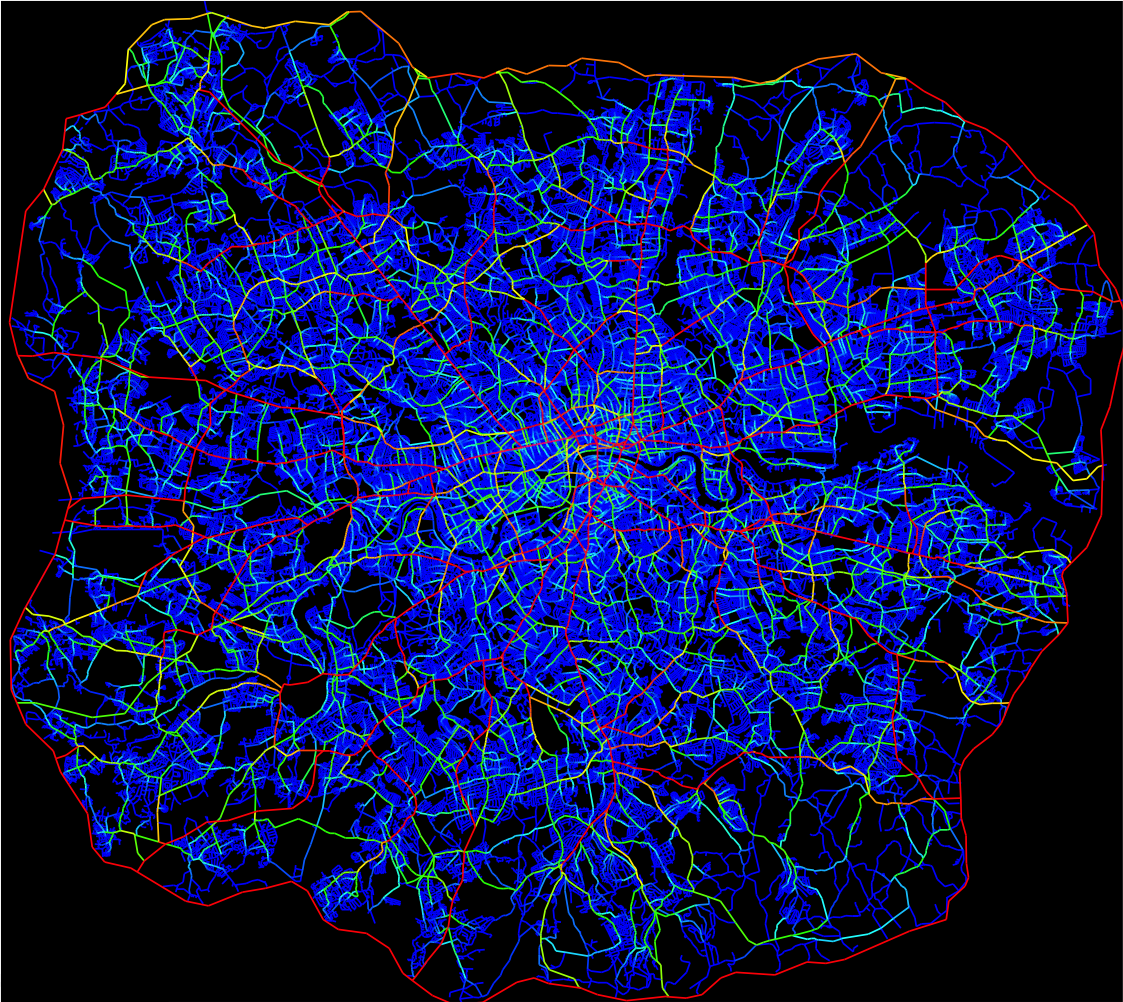
    a)         because they connect directly from the edge of London to the centre, linking to the ground level at accessible points in the street network (identified by Space Syntax through spatial accessibility analysis) SkyCycle routes add to London’s “foreground network” of important arterials (the red and orange links in a Space Syntax map of London).

    London_Global Choice

    (more…)

  • A definition of “Smart” – screens, signs and shop windows

    “Smart” is too often, too narrowly defined in terms of the benefits of digital technology. Of course, digital technology can help cities to be smarter. But being smart means much more than that.

    My own preference is to define “smart” by focusing on three factors:

    1. people
    2. the information that people receive
    3. the behaviours that then follow.

    Smart Cities create behaviour changes that benefit social, economic and environmental outcomes.

    Behaviours rely on information, which can be derived from many sources: certainly, from digital sensing and smartphone displays but also from the physical and spatial world that surrounds city users. From shop windows that reveal the contents of their interiors; from a glimpse down a lane that lands on the sign outside the pub; from the faces of other people – the human display. Each of these sources provides information that influences human behaviour. Each has its place in the definition of a Smart City.

    Smart digital technology – the sensing, the display, and everything in between – helps people to be smart but the sum of digital technology does not create the Smart City. There are other non-digital technologies to consider:

    – the street layout of a city is a technology, guiding the movement patterns of people through the connections it affords, prioritising certain streets by virtue of their greater connectivity and backgrounding others that connect less well

    – a social network of human relations is facilitated by the same technology and becomes a technology in itself: a powerful repository of knowledge and intelligence.

    The spatial and social fabrics of the city are machines in their own ways, with mechanisms that deserve equal attention to digital technologies when it comes to defining the Smart City.

    People – the ultimate consumers of information – should be put at the centre of the Smart City. Their behaviours should be enabled by both digital and non-digital technologies. Because these behaviours rely on information sources, the places in which people move and interact in the city should be created to act as efficient information devices. They should be clearly laid out to optimise information flow as well as comfortably furnished to support effective – call it “smart” – human transaction.

    Smart = human behaviour * technological (Digital * nonDig) behaviour

    Inspired by a conversation with Michael Mulquin

  • Spatial Planning and the Future of Cities

    How might cities be planned in the future?

    This is not only a question of how they might look but also, and more importantly, about how they might be laid out as patterns of buildings and spatial connections.

    Laying out a city means answering two key questions: “what goes where?” and the “how does it all connect together?” The answers to these questions have fundamental implications for the social, economic and environmental performance of urban places. And the jury is out as to which is the best way to do so: to use spatial planning to create place.

    The global urban risk is that architects and planners have created, and continue to create, highly unsustainable city layouts – car dependent, socially divisive, congested and life-suppressing. And, it would seem, the more technologically advanced cities have become, the less efficiently they have worked.

    By contrast, the street-based, continuously connected grid – the kind of layout that the slow, incremental evolution of cities produced before the intervention of modernism – has largely fallen out of fashion.

    My argument in this piece is that the continuously connected grid is the only form of urban layout that can deliver sufficient social, economic and environmental value. The only kind of grid that is truly sustainable. (more…)

  • A short film about Space Syntax

    Tim Stonor, Managing Director, Space Syntax
    “The population of the world is increasing and, as it increases, more and more of us are living in cities. As cities have grown in the 20th century they have often grown to disconnect people.

    Space Syntax has discovered that many of these problems in cities – disconnection, lack of contact between people, lack of access to jobs – come down to the way in which the city is planned as a layout of space.”

    Ronan Faherty, Commercial Director, Land Securities
    “As a developer, the most important thing for us is understanding the consumer and anything that assesses the consumer and helps us understand them provides real value. When you’re putting down a new property into an existing space we want to understand where consumers are coming from and then how they should engage with the property: where we should put escalation and movement and flows. (more…)