Tim Stonor speaks at the Building Research Establishment about his experience using data in the planning and design of buildings and urban settlements.
Tim Stonor speaks at the Building Research Establishment about his experience using data in the planning and design of buildings and urban settlements.
Speaking at the invitation of the organisers of the British Business Summit, Istanbul, Turkey. (more…)
Broadcast 26th August 2013 on BBC4, featuring Space Syntax analysis of Wren, Hook & Evelyn’s plans for rebuilding the City of London after the Great Fire of 1666.
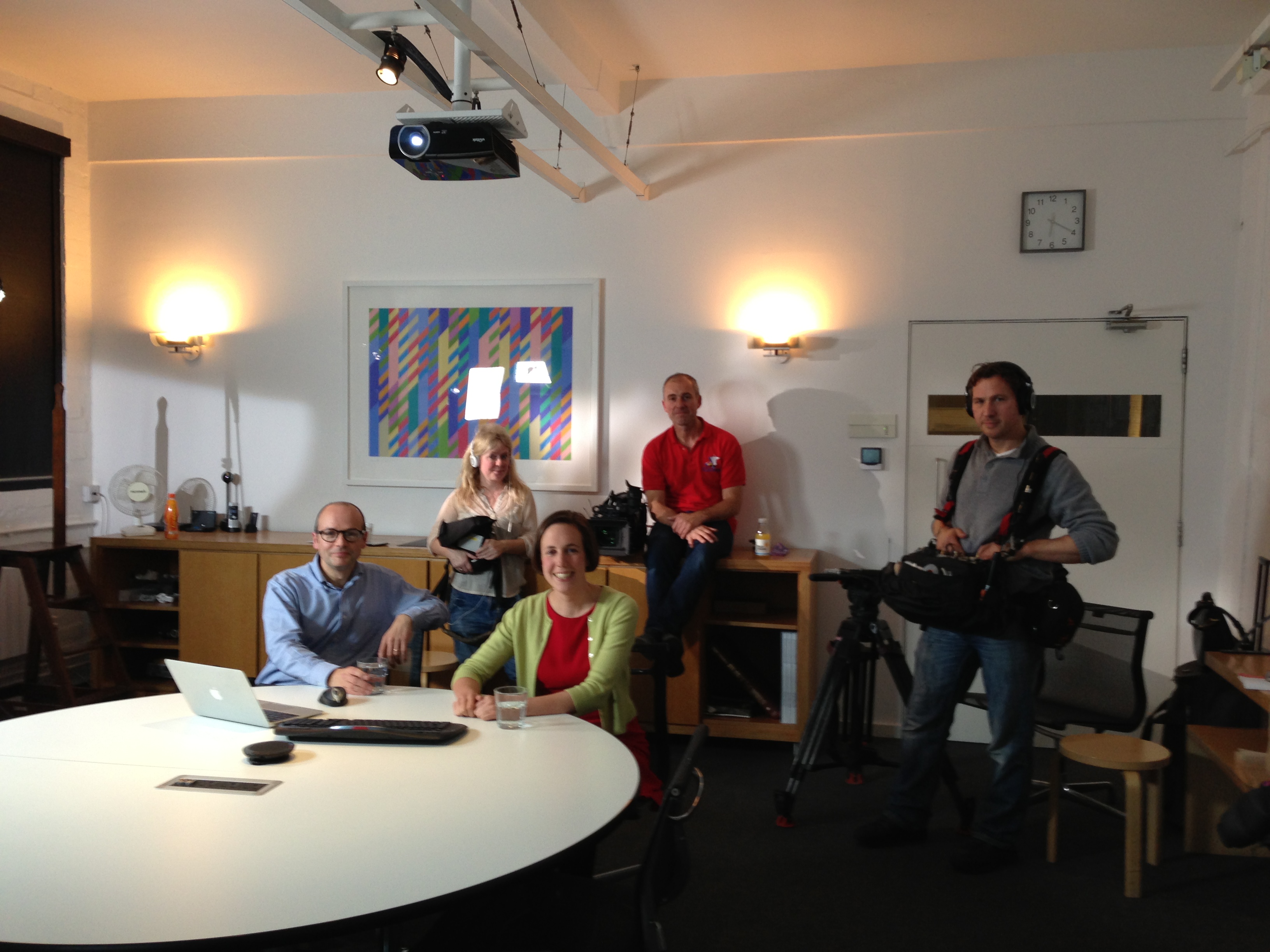
Link to the programme on the BBC website
Link to the programme on YouTube
Download a presentation of Space Syntax’s analysis
“Using her skills to uncover long-forgotten and abandoned plans, architectural investigator Dr Olivia Horsfall Turner explores the fascinating and dramatic stories behind some of the grandest designs that were never built.
Destruction, whether intentional or circumstantial, often creates a clean slate and demands a fresh outlook in which we come to think the unthinkable. This programme looks at bold, and in some cases shocking, plans to make revolutionary changes to Britain’s biggest cities. (more…)
On 15th November 2012, UK Secretary of State for Business, Vince Cable, visited the Space Syntax London studio.
Tim Stonor, Managing Director, Space Syntax
“The population of the world is increasing and, as it increases, more and more of us are living in cities. As cities have grown in the 20th century they have often grown to disconnect people.
Space Syntax has discovered that many of these problems in cities – disconnection, lack of contact between people, lack of access to jobs – come down to the way in which the city is planned as a layout of space.”
Ronan Faherty, Commercial Director, Land Securities
“As a developer, the most important thing for us is understanding the consumer and anything that assesses the consumer and helps us understand them provides real value. When you’re putting down a new property into an existing space we want to understand where consumers are coming from and then how they should engage with the property: where we should put escalation and movement and flows. (more…)
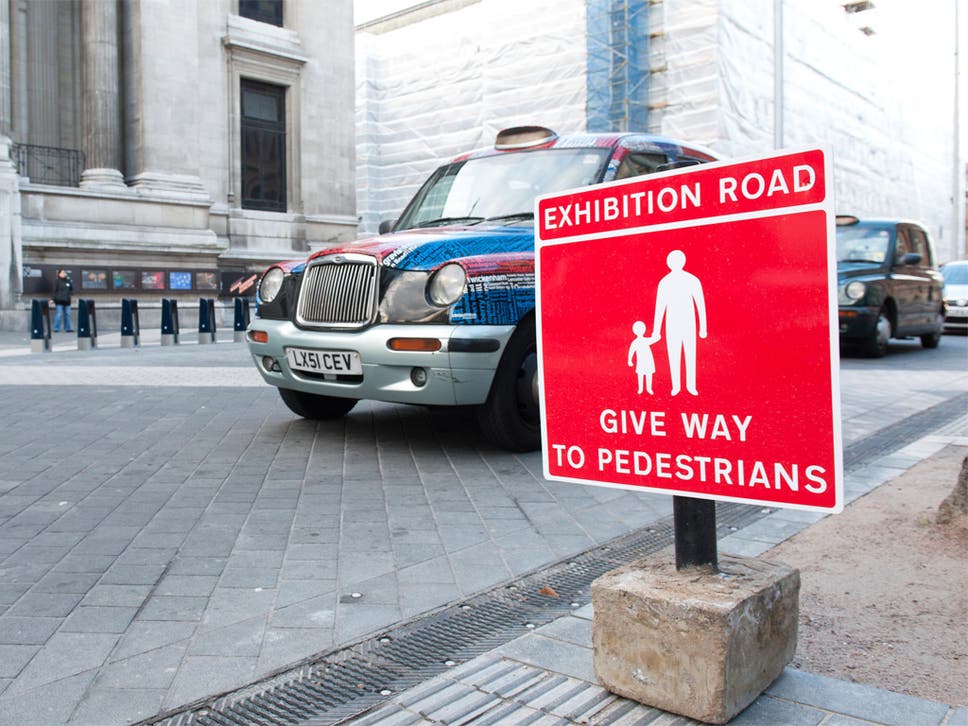
Independent newspaper, UK
I am standing at the junction of two of the busiest streets in central London – High Holborn and Shaftesbury Avenue. In one direction is Centre Point and the start of Oxford Street; in another Leicester Square; to the south-east is Covent Garden; behind me is Bloomsbury and the giant hulk of the British Museum. It’s quite a vista. But my view only lasts for eight seconds before the little green man turns red and a herd of black cabs rev their engines.
Pointing down the streets and cursing the crossing barriers that pen in tourists and office workers is Tim Stonor, managing director of Space Syntax, a UCL-affiliated consultancy whose job it is to understand how humans move within spaces like these. They have analysed people flow within the British Museum and helped Norman Foster redesign Trafalgar Square.
London is – when compared to car-heavy cities such as Los Angeles – quite easy to navigate on foot. But all too often roads are designed for cars – pedestrians are plodding afterthoughts.
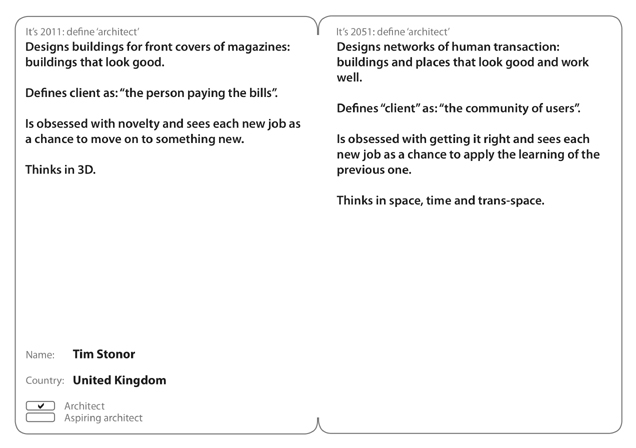 “The Architect: What now?” is an exhibition using debate, inks, film, sound and sculpture to explore the momentous identity change facing the architectural profession. Its aim is to encourage visitors to define / redefine the role of the architect and understand what this means for the construction industry.
I was delighted to be asked to participate.
 An article in the New Zealand Dominion Post, titled “On your feet, Wellington” reports on Space Syntax’s proposals to reconnect the pedestrian infrastructure of the capital.
“Demonising Wikipedia won’t work. It’s massively used and it’s in all our interests to make it massively better.”
Nieman Journalism Fellow and BBC reporter Philippa Thomas comments in her blog on the myth and reality of Wikipedia.
As reported in the Times Higher Education Supplement on 17 April 1998
Julia Hinde reports on UCL’s novel architectural consultancy that aims to make money from the spaces between buildings.
How is it that some company coffee machines become the focus of office life, where deals are struck and ideas take shape, while others are purely functional? Why do some modern shopping centres take off, while others are seen as windswept and heartless and remain deserted?
It is down to “space”, says architect Tim Stonor, the business mind behind University College London’s architecture consultancy, the Space Syntax Laboratory. (more…)
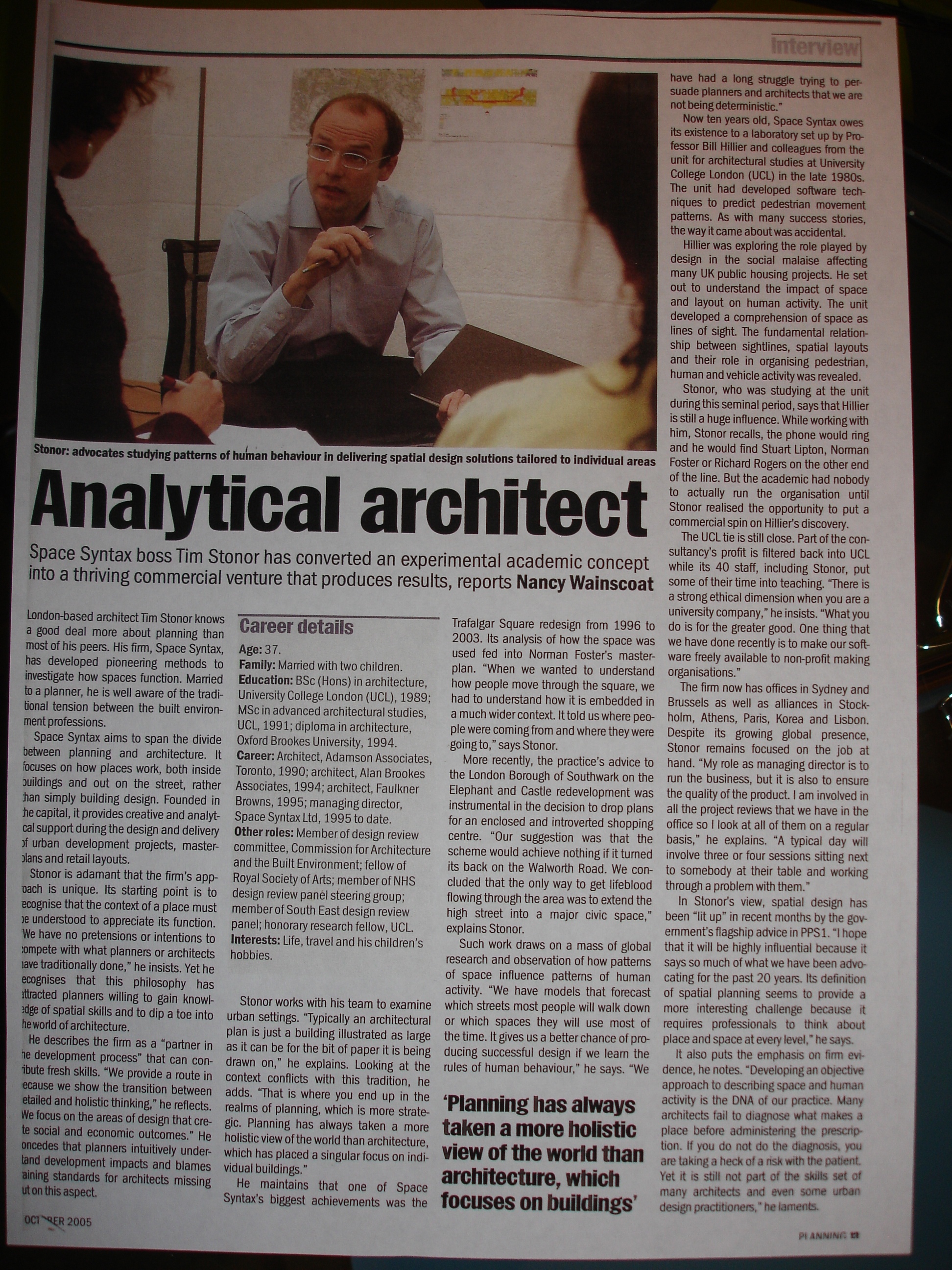
 Tim Stonor