Category: Development
-
Measuring & modelling cities
11th May 2011
2011 Urban Systems Symposium
NYU Shack Institute of Real Estate, New York -
Spatial layout, urban movement & human transaction
“Designing mobility for democracy: the role of cities”
#demobility
Thursday, 14th April 2011 from 1pm to 5pm
NYU, Kimmel Center, Eisner & Lubin Auditorium
60 Washington Square South, New York Summary
Given the title of this event: “Designing mobility”, I want to turn to the subject of design and the role of architects. The key message of this presentation is that cities need architects, not only to design the buildings that fit into them but also for the networks of space that connect them together. Why? Because architects have a special skill: to resolve complex problems into elegant solutions. And the spatial network of the city is a complex design problem.However, before they can really help, architects need to “get” cities. The problem for cities is that architects are not sufficiently familiar with the way cities work and therefore the design principles they need to work with to make cities more effective as places of human transaction.
 So what is the role of a city?
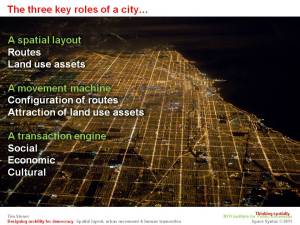
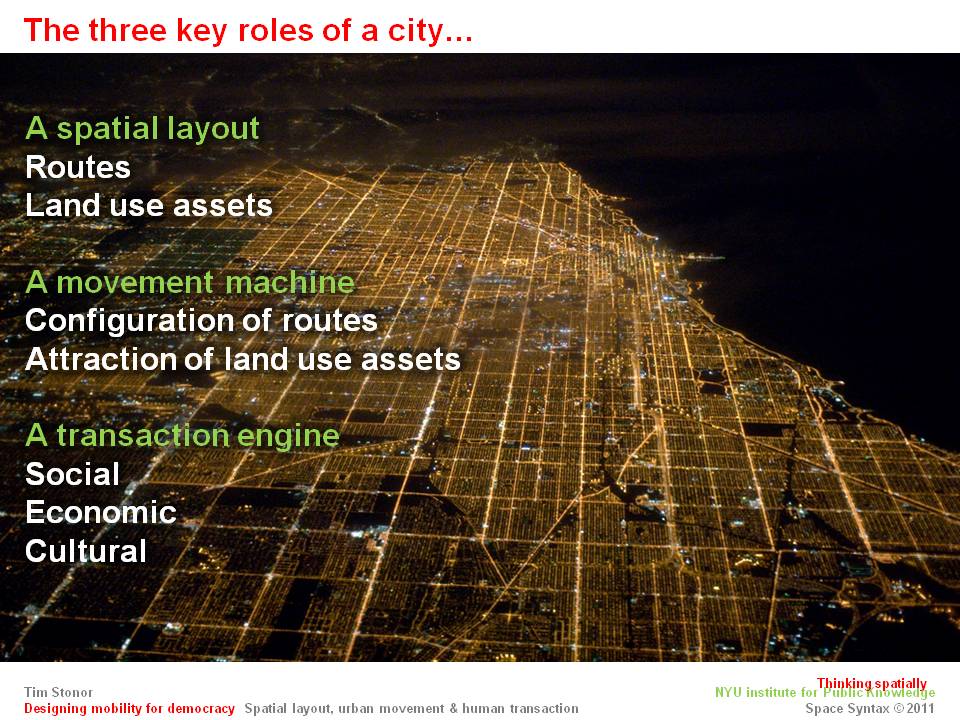
A city should act in three key ways:
1. as a spatial layout – of routes (streets and paths) and of land use assets
2. as a movement machine, organised by the configuration of the route network and the attraction of the land uses assets
3. as a transaction engine, generating and accommodating social, economic and cultural exchange.
A city is therefore a place of production and reproduction.
When cities don’t work a whole series of assumptions are typically loosed into the policy framework. Perhaps the greatest and most damaging of these is that that they lack transport infrastructure. Witness Sydney’s aerial people mover or the radical and crude plumbing of highway arteries into the capillary network of historic cities, especially here in the US.
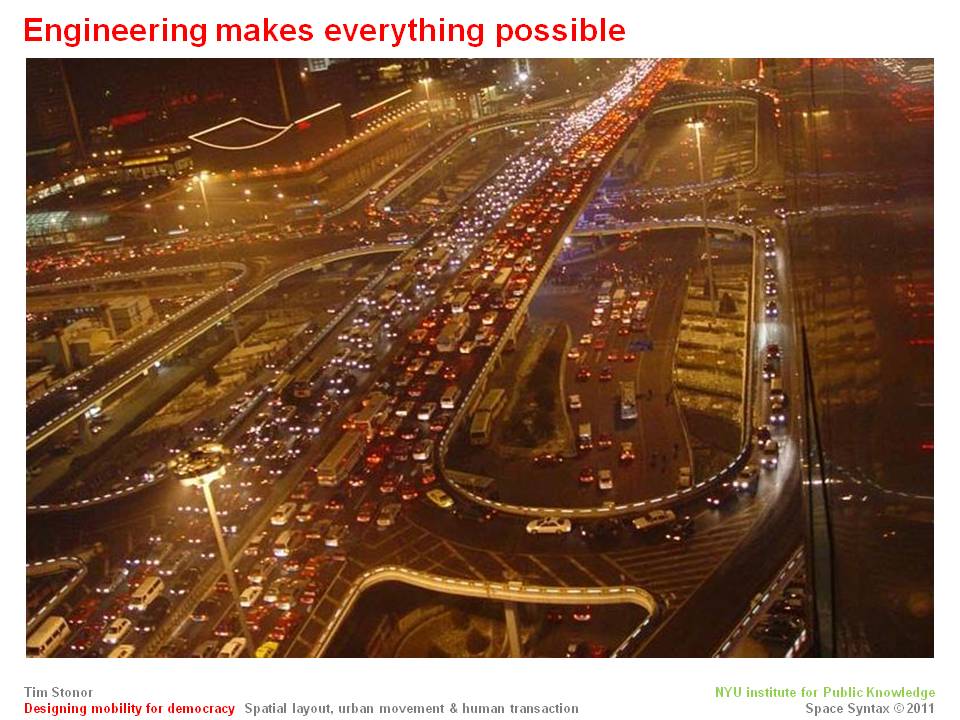
 Often the last thing that troubled places need is more transport infrastructure, especially when it is about moving people large distances. Engineering shows us that we can move human beings in pretty much any way we please, whether it’s to the moon or into the hearts of historic places, like here in Beijing.
 As Sartre remarked, “Everything has been figured out, except how to live.”
Heroically engineered mobility in the form of great road intersections such as that in Beijing is – with notable exceptions – the default response of the global transportation community and therefore of the political system. Witness the federal response to the current economic recession and the bent towards building and fixing highways.
In this talk I want to argue that, if cities are to fulfill those three roles I set out they need to provide a new kind of mobility. And this is not, as Enrique Peñalosa said, only a problem of government. it is also a problem of design. And a problem of design theory at that.
-
Ed Glaeser at the American Planning Association
Notes from Prof Ed Glaeser’s keynote at the 2011 American Planning Association Conference in Boston, 12th April 2011
A city’s “innovative density” is provided by its urban connections.
Historical urban growth and decline
Historically, cities grew by water.
As transport costs lowered (now 10% of a century ago) people and production did not need to be near water hubs – leading to suburbs and low density living.Warmer cities grow faster.
Transportation
The car is a product of a city (Detroit) but not the kindest of progeny.Average US car commute 24min
Average US pub transport commute 48minThe hallmark of declining cities is that they have an abundance of infrastructure. Governments need to invest in people not in infrastructure. This was the mistake of the Detroit people mover, passing over empty houses on empty streets.
Cities that come back eg NY through the influence of financial markets – a fact that is not discussed enough.
Wealthy people live in and work in cities because, in terms of making money, intimate knowledge is more important than having lots of space eg the Bloomberg bullpen, modelled on wall-less financial market settings.
By being around smart people we become smarter.
More skilled areas have grown more quickly.
Cities are places of promise and poverty. Urban poverty is not sign of failure but of success. Dharavi attracts people with a promise of a better life; better than the enforced sterility of the suburbs.
If, when a subway stop is built, poverty levels rise in the vicinity of that stop, is that a bad thing? No, it shows that subways attract people who can’t afford to drive – this fact should be celebrated.
Roads and driving
The answer is not to build new roads.
Turner showed that “If you build it they will drive”.
Congestion charging is the solution. There is no right to drive in the Constitution.Conclusions – Policy changes needed
1. change the US obsession with home ownership, especially large houses. Typically, even lower income homes in the US are 2x those in the UK and Germany – by making urban housing expensive, the federal government is socially engineering poor people into suburbs2. change the US federal obsession with building highways, especially in low density cities
3. reform the schools system that is forcing people to suburbs in search of good schools.
Thank you for coming and thank you for what you do. Planning matters because space matters.
-
Eduardo Rojas
Notes of a talk by Eduardo Rojas given to MIT Humphrey SPURS Fellows and Harvard Loeb Fellows at Stella Conference Room 7-338 MIT, 11th April 2011.
Housing in Latin America
1900
25% urban1985
4.7 family size2000
75% urban
4.1 family size2015
80% urban
3.5 family sizeInformal sector
1990s 60% new jobs
48% in informal sector
24% self employedHigher, more persistent and increasing inequalities in Latin America than in the rest of the world. (more…)
-
“On your feet, Wellington”
 An article in the New Zealand Dominion Post, titled “On your feet, Wellington” reports on Space Syntax’s proposals to reconnect the pedestrian infrastructure of the capital.
 -
Tim Stonor – Minister of Planning for Urbania?
Yesterday I took part in a role play in Dr Mike Hooper’s class on “Urbanization & International Development” at the Harvard University Graduate School of Design. The class was divided into three groups and given 20 minutes to prepare proposals for upgrading an informal settlement on land in the centre of an imaginary city, “Urbanopolis”, the capital of “Urbania”.
Each team then had 5-6 minutes to present slum upgrading proposals to the (apparently) notoriously short tempered Minister of Planning for Urbania – played by me! (more…)
-
Carbon emissions & spatial connections
 I spoke today to Dr Joyce Rosenthal’s “Environmental Planning & Sustainable Development” class at the Harvard University Graduate School of Design.
My presentation “Carbon emissions & spatial connections” can be viewed on Slideboom.
-
Connectivity is only the beginning – networking is the goal
 For digital users
2010 was the year to get connected; 2011 will be the year to become networked.
It is one thing to buy an iPhone, join Facebook and Twitter, get a blog, friend and follow. It is another to keep it all going.Already, people are being encouraged to unplug. But why unplug when it is possible to network? How? The solution is to link Twitter and Facebook to a blog; to connect the blog to LinkedIn, taking advantage of the interconnections so that things are only done once.
In other words, connectivity is only the beginning – networking is the goal. And not just for tech geeks but for all users of urban places…
 For urbanists
The 20th century was about cities getting connected; the 21st will be about cities becoming networked. (more…) -
Giving it all away? Space Syntax & the future of urban planning software
Notes for a lecture to be given at the Lincoln Institute of Land Policy, 23rd March 2011
Themes
With notable exceptions, the current use of technology in planning and, especially, urban design/architecture practice is medieval. More visual than analytic. More about the “Wow!” than the “Why?”, the “Which?” or the “Will it?” Example of animation in traffic models – “Our clients like to see them move!”
Urban imperative – rapid scaling up of urban centres – provokes need for new thinking.
We need to look more at how places work than how they look.
We need to bring academic research into practice and for academia to be better led by the needs of practice.
We need to think about online social networks as well as “real-world” physical/spatial networks. Indeed real world is as much online as physical/spatial.We need to share our data. The future will be made by great partnerships, not great individuals. It has arguably ever thus been.
Open source makes commercial as well as ethical sense as the route to collaboration.
Space Syntax as the case study. (more…)
-
Achieving prosperous local communities – physical connectedness is key
Community prosperity means social, economic and environmental prosperity. Each of these dimensions is strongly influenced by the physical design of the places where people live. Physical design influences human behaviour, which in turn influences community prosperity. The most important aspect of physical design is connectedness. Connectedness can be measured scientifically. Its effects on societal wealth have been identified by UK scientific research over the last forty years.
-
Millennium Development Goals
MDG 1
Eradicate extreme poverty and hungerMDG 2
Achieve universal primary educationMDG 3
Promote gender equality and empower womenMDG 4
Reduce child mortalityMDG 5
Improve maternal healthMDG 6
Combat HIV/AIDS and other diseasesMDG 7
Ensure environmental sustainability -
Dharavi – slum for sale
Notes from screening at Harvard GSD
The key issue is employment, not housing. Need to retain micro-industry as well as housing.
Resident’s comment on high rise housing proposal (but no clear proposal for providing places of work): “Will the oxygen up there fill our stomachs?”
Industry generates 750 million dollars per annum. Dharavi therefore as an economic object. Much of the economy is informal.
Redevelopment as a step backwards because people can’t continue their previous trade and have to shift to new trades – “lift men and doorkeepers”
“Let people build for themselves – give them water not money.”
SPARC: Don’t leave it to the international developers.
The proposed redevelopment is not just professionally poor but morally poor because it raises expectations among the poor. The plan should instead be done by the municipality.
One objective should be to see Dharavi as a test case of dense, mixed use, low carbon community.
The lack of evidence seems important. Proposals being made in a vacuum of knowledge.
Bryan Bell – need to tap into social capital there rather than turn up in a Mercedes.
-
Connecting the disconnected – how much is enough?
Yesterday evening, Ed Parham gave a talk at the Graduate School of Design on Space Syntax’s work redesigning unplanned settlements in Jeddah, Saudi Arabia. Despite the really awful weather, which turned Cambridge into a pedestrian sludge, there was a full house.
Ed showed how Jeddah’s unplanned settlements share a common spatial property of being locally walkable but globally disconnected from the bigger movement structure of the city. This supresses the economic potential of these places. To counter this, the Space Syntax team has developed Area Action Plans for dozens of unplanned settlements, identifying opportunities to bridge between the local and global movement networks with new streets lined with commercial activity. These streets allow the unplanned settlements to trade outwards in new ways.
The big question raised by this work is: to what degree should unplanned settlements be reintegrated into the spatial fabric of the city? To a degree, the spatial distinction of these places creates a cultural identity for the inhabitants, with certain social benefits. The risk of reintegration is that this identity will be diluted or even lost by the new flow of movement, social identity and capital through the unplanned areas.
Ed described how, in fact, a spatial hierarchy can be created that leaves much of the original spatial fabric intact, especially the fine-grained, more residential and more spatially segregated fabric that helps to structure the cultural identity of the unplanned settlements. The long audience discussion that followed Ed’s talk showed how relevant the challenge of urban connectivity is to urban practice.
-
From landscapes of extraction to creative industries of organic matter & waste
Monday, 14th February 2011 at 6pm
Stubbins Room, Harvard Graduate School of Design, 48 Quincy Street, Cambridge, MA 02138Participants
Pablo Rey, Basurama
Manolo Mansylla, Trashpatch
Robin Nagle, anthropologist of material culture (waste)
Scientist doing research in biomaterials (Wyss Institute for Biologically Inspired Engineering/ Materials Research Science and Engineering Center – School of Engineering and Applied Sciences)Moderator
Richard Forman
Abstract
Technology has no limits. Science has no limits. Human creativity and imagination have no limits. The limits are imposed by matter. Raw materials are being extracted from the remotest of geographies and we are beginning to exhaust the last reservoirs of available minerals in order to perpetuate a production system based on disposability and the consumption of wholes, not parts; of large, not small; of new, not old; of multiple, not the one that is needed. In order to extract such minerals, we often deplete forests, along with the cultures that inhabit them, or contaminate river basins. Science and technology can produce brilliant responses to our environmental problems, but unless they take into account the source of the materials they consume, the counter landscapes of extraction, those of waste and slums (people get displaced as we render their land useless through monoculture or extraction), will continue to grow; setting off our good intentions to move towards a more sustainable future. (more…) -
Upcoming talk: “Planning the unplanned: An evidence-based approach to design in informal settlements”
Harvard Graduate School of Design, 18th January 2011, 6:30pm
With the world population of slum dwellers set to increase to 2 billion over the next 30 years, the need to provide adequate living conditions for the urban poor is recognised as a major challenge. Political and economic pressure to implement improvements quickly, often means that the contribution slums make to the wider city is not recognised as part of the solution.
Using the case study of his work in Jeddah, Saudi Arabia, Ed Parham of Space Syntax will explain how advanced techniques of spatial analysis have been used to identify a core spatial problem at the heart of the slum condition. These techniques have been used further to develop solutions in the form of individual area profiles, city-wide prioritisation strategies, settlement-specific needs-based improvement strategies, and to help generate detailed area action plans. Based on in-depth knowledge of the role and importance of spatial networks in cities, these solutions can be implemented incrementally and flexibly with the long-term aim of reintegrating the unplanned settlements, and their residents, through the minimum disruption.





 Tim Stonor
