Speaking at the invitation of the organisers of the British Business Summit, Istanbul, Turkey. (more…)
Category: Conference talk
-
Spatial Layout as Critical Infrastructure
Stub…notes for an upcoming conference talk
Key issue to be addressed:
– Urban-Rural development
– Urban Regeneration
– Smart Cities.
When a network of streets is laid out, planners and designers build in an enormous amount of “embedded potential”:
- the pattern of movement
- land use potential
- safety
- land value
- social interaction
- public health
- carbon emissions.
The design of the street network has a fundamental and measurable influence on each of the above.
Later changes – to land use pattern or to the local design of streets (eg road widening or narrowing, adding cycle lanes or public transport) – can enhance or even diminish these potentials, but such later changes always occur around a benchmark that is set by spatial configuration decisions.
Buildings come and go – are built and demolished – but the spatial network, once laid out, is harder to adjust.
Exceptional new connections – such as bridges – can be built to connect disconnected networks but grids are resilient to change. Therefore, putting the wrong grid into an urban development can be a pathological move, setting the socio-economic potential of places for generations to come.
How do we know this?
The evidence-base: post-war housing estates; UK New Towns. Places that go wrong within a generation, if that – sometimes within a few years. Car-dominant transport planning. Land use zoning.
Risk of failed UK models.
In finding a balance between the tension of urban and rural development, Chinese towns and cities should learn from China first:
– mixed use planning: marginal separation by linear integration.
– mixed mode planning: roads, streets, lanes, canals: Jiading.
– mixed character planning.
What are the Spatial Layout requirements?
The historic Chinese grid: rectilinear hierarchy.
Pervasive centrality.
To be developed…
-
Space Syntax City Projects Walk
On Tuesday afternoon, 3rd September, I led a walking tour of built projects by Space Syntax.
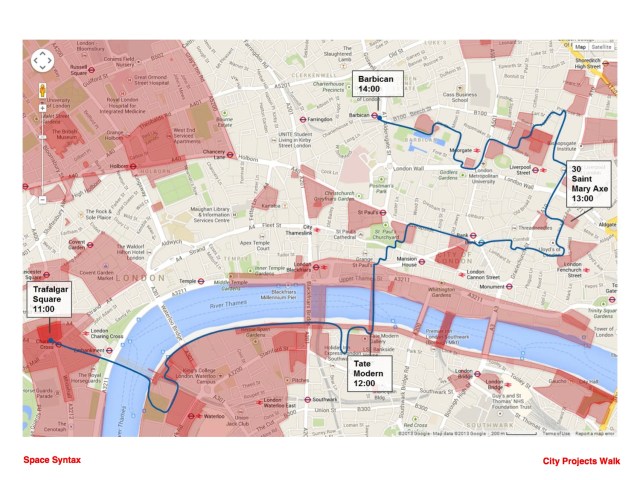
Trafalgar Square
Royal Festval Hall
Tate Modern
One New Change
New Bloomberg Headquarters (under construction)
Willis Building
30 St Mary Axe
Heron Plaza (under construction)
Liverpool Street Station retail concourse
Broadgate, Exchange Square
Barbican Arts Centre (more…)
-
Quality Streetscapes Conference notes
This first part of this presentation introduces a new approach to valuing urban design – one which allows design decisions to be embedded in real estate valuation calculations. The approach connects design to the rateable value of retail, commercial and residential property offerings. It allows investment decisions to be related directly to design proposals, showing how Proposal A will generate more long term value than Proposal B. The tool is already being used in practice.
Part Two describes Space Syntax Limited’s plans to disseminate its science-based, human-focused approach to urban planning and design. Key to this is the creation of an Academy to provide training to professional and non-professional stakeholders. (more…)
-
AoU Landscape Urbanism notes & questions
 These notes accompany a PowerPoint presentation Fragmented urbanism: the rise of Landscape Urbanism & the threat it poses to the continuously connected city
TS intro
This is a crucial moment for urbanism. In the UK, The Portas Review, highlighting the UK’s threatened high streets. Around the world, cities are growing faster than ever. But cities – as we knew them – are under threat.First, from the car. Car-dependent urbanism is the principal form of urbanism on the planet. our cities have become so fragmented by road systems in the last century that it is now almost impossible not to be far dependent – not without a major demolition and reconnection programme.
Second, from designers, accepting of the car and intellectualising around this complicity.
The aim of this talk
I have been forming my own views about Landscape Urbanism and am looking to raise a discussion within the Academy of Urbanism and beyond. Do people agree with me? If so, how do we respond? If not, why not?Summary of the Landscape Urbanism aesthetic
Parcels of grey wrapped by ribbons of greenLandscape Urbanism as anti-ecological
“If you have a culture that is fundamentally automobile-based, then an urban model that is anti-automobile is counterintuitive at best. There’s a strange precept these days that asserts that people will abandon their cars if we simply build cities that don’t accommodate them”.
Charles WaldheimNotes
Island bio-geography.Scale – JW.
Water.
Interim uses eg temporary food production. How can this be coded?
Layouts need to be walkable and workable.
Working with the grain of nature.
GRABS – green and blue spaces.
“It was good to find out about a new academic threat to good sense, and I very much agree with your doubts about the universal value of green space.
-
London Riots discussion at #lonconf
Darah Singh
Groups of rioters:
1. Motivators – of rioting
2. Aggressors – towards police
3. Late night shoppersSimeon
Riots gave people unusual opportunities for power and control. Abnormal empowerment.David Lammy MP
The risks of social & economic liberalism. Hyper individualism. The selfishness of greed. Poverty, choice, ethics, morality & vulnerability.A policy idea for London
TS: reconnect London at its grass routes by focusing on disconnected housing estates – spatial exclusion. Work with local communities to educate those who have been given authority to direct their influence towards the right places. Not only the high streets but the catchments of the high streets: the housing estates. -
Approaching large scale urban design schemes
 On Friday I gave a presentation at a Design Council CABE event, “Inside Design Review”. My talk, “Approaching large scale urban design schemes“, sets out a framework for thinking about the complexity of major urban development proposals.
 -
EPSRC Innovate 11: Working with universities
London, 11th October 2011
Tim Stonor
Opportunities & barriersIntro
Space Syntax Limited an SME working in the Creative Industries, specifically architecture and urban planning. A consulting company.Engaging in projects from high value real estate developments in the City of London to the regeneration of slum settlements. Outside urban space & inside building space. Dealing with issues of movement & interaction and how these influence value: social, economic & environmental.
Specifically, engaging with the EPSRC in its key knowledge domains of:
Global uncertainties
Climate change
Energy
(more…)

 Tim Stonor